Explainer | What foreign nationals need to know about Georgia’s new labour laws
From 1 March, new rules for employing foreign nationals will begin, affecting both self-employed individuals and those on employment contracts.

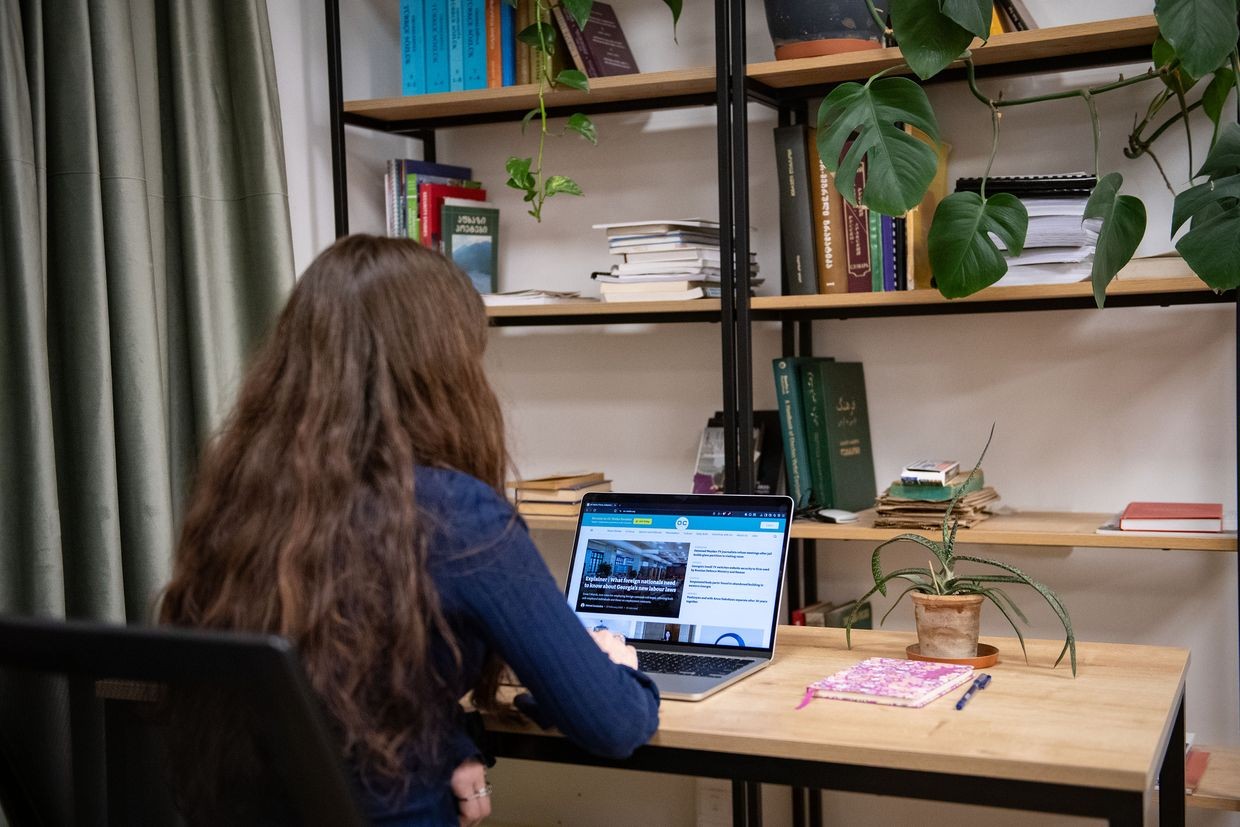
New labour migration amendments set to take effect in March 2026 will significantly complicate employment for foreign nationals in Georgia.
The key change is the introduction of work permits, something that did not previously exist in Georgian legislation.
The amendments were adopted by the parliament in June 2025, but details of just how the permit system is going to work emerged in a 20 February governmental decree.
The new rules introduce additional bureaucracy, costs, and waiting periods for both employers and employees. They also grant the state considerable authority to intervene in employers’ hiring decisions, allowing it to determine — according to its own assessment — whether foreign workers are needed in specific sectors.
Under the regulations set to take effect this spring, foreign nationals who do not hold permanent residency in Georgia will be required to obtain a work permit from the Labour Ministry. Failure to do so — and working without a permit — could result in substantial fines.
The previous rules
Under the previous legislation, foreign nationals could work in Georgia with the appropriate visa or a residence permit. The rules were more lenient for citizens of countries with extended visa-free access to the country. In such cases, even holding a residence permit was not strictly mandatory, with local employers simply registering foreign employees with the Ministry of Labour and Health.
Self-employed people faced even fewer bureaucratic requirements, especially since this concept was not recognised and explicitly regulated.
The new legislation will radically change this framework.
Permanent residence can be obtained after residing in Georgia for 10 years on the basis of a temporary residence permit (excluding periods of study, medical treatment, or diplomatic service). Exceptions can be made for the spouse or under aged children of a Georgian citizen, the parent of a minor Georgian citizen.
Who is affected?
The new legislation applies to foreign nationals working in Georgia who do not hold permanent residency. This includes:
- Individuals employed under an employment contract with a local employer;
- Self-employed people (such as individual entrepreneurs and freelancers);
- People engaged in entrepreneurial activity (such as company directors or partners);
- Individuals employed remotely by a local employer.
The law will not apply to:
- Refugees;
- Individuals with additional or temporary protection granted by Georgia;
- Asylum seekers;
- Employees of diplomatic missions or international organisations;
- International journalists accredited in Georgia;
- Holders of investment-based residence permits;
- Those covered by other exceptions provided for under international agreements which Georgia is part of.
The law defines a local employer as a Georgia-registered legal entity, an individual entrepreneur, a partnership, a representative office of a foreign organisation registered in Georgia, or a person lawfully residing in Georgia who is legally entitled to employ a foreign national without permanent residency in the country.
A self-employed foreigner, a concept added in the latest amendments, is defined as a foreign national who carries out labour activity in Georgia not under an employment contract with the aim of generating financial gain. This can include engaging in trade, services, or other types of business activity as an operator or partner, working as an independent contractor, or otherwise being involved in entrepreneurial or labour-related activities.
The law’s definitions make clear that the obligation to obtain a work permit also applies to foreign nationals who have founded their own companies in Georgia. They will need to secure a permit not only for any foreign employee they wish to hire, but also for themselves in order to legally conduct their own business activities.
Are digital nomads affected?
The law is not explicit in whether it includes foreign nationals who work remotely from Georgia for a foreign company or as a freelancer for clients outside Georgia.
While the law includes anyone ‘who carries out labour activity in Georgia’, Nika Simonishvili, a lawyer and former chair of the Georgian Young Lawyers’ Association (GYLA), told OC Media he believes the law is more aimed at those who are directly occupying positions in the Georgian labour market.
‘For example, if you’re performing certain work for Thailand [from Georgia], why should the [Georgian state] care whether you’re participating in Thailand’s labour market or not?’ he noted, adding:
‘The whole point is that if you are participating in the labour market in Georgia, you need to coordinate it [with the state].’
How will people be able to obtain a work permit?
Work permits will be issued by the Labour Ministry’s Employment Promotion Agency. However, the procedure differs depending on whether the foreign national has an employer or is self-employed.
If the individual is self-employed, they must personally submit the required information and documentation to the agency via the Labour Migration Electronic System at labourmigration.moh.gov.ge, including:
- Personal data;
- Details of their education and professional experience;
- Information about the nature and scope of their current or planned activities in Georgia.
If they intend to start an entrepreneurial activity, they must also provide a detailed business plan; if they’re already operating one, they must submit relevant information about it.
The agency has a specific time frame — between 10 business days and 30 calendar days — to either approve or reject the application. The service is fee-based: standard processing within 30 calendar days costs ₾200 ($75), while expedited processing within 10 business days costs ₾400 ($150). A payment receipt must be submitted with the application.
And that’s not all: self-employed applicants must also undergo a video interview with the agency and confirm their electronic application at its conclusion. A recording of the interview, provided by the agency, must be attached to the application.
In cases where the applicant is employed under an employment contract in Georgia, the procedure is different. Here, the employer — not the prospective employee — contacts the agency, provides relevant documentation, and pays the fees.
However, the process involves noticeably more bureaucracy — and this begins even before the employer applies for the work permit itself.
First, at least 10 business days before submitting an application for a foreign national’s work permit, the employer must post the vacancy on the Labour Market Management Information System (worknet.moh.gov.ge) for the position they wish to fill with a foreign worker.
The agency then has 10 business days to propose local candidates. If it fails to do so, the employer can proceed with the work permit application for the foreign employee by submitting the necessary information — including details about the employer, the candidate, and the job — via labourmigration.moh.gov.ge.
The processing times and fees are the same as for self-employed applicants, with the difference being that here the employer is responsible for paying the fee.
But what if the agency successfully nominates a local candidate for the position the employer intends to fill with a foreign worker?
Two outcomes are possible.
- In the first, the employer changes course, selects a local candidate, hires them, and withdraws the offer to the foreign applicant.
- If the employer rejects the agency’s proposed local candidate, they must, within three business days of completing the selection process, notify the agency and provide a reason for the refusal.
The agency then has three business days to assess the employer’s reasoning. Following the review, one of two decisions may be made:
- The agency may authorise the employer to proceed with obtaining a work permit for the foreign national;
- It may find the refusal of the local candidate unjustified and discontinue the work permit process altogether.
‘The state has been granted very broad discretion to intervene in the relationship between employer and employee, effectively preventing an employer from hiring a foreign national’, Simonishvili said.
He noted that an employer may have a specific foreign candidate in mind — one with precisely the skills and professional experience required for the role — yet still be unable to hire them if the state agency deems the decision not to employ a Georgian candidate unjustified.
For those already working in Georgia:
- Self-employed individuals who are active in Georgia as of 1 March 2026 will fall under the new regulations starting 1 May 2026; this means they must ensure compliance with the new rules by that date;
- Immigrants with employment contracts whose registration is active in the Labour Ministry’s database as of 1 March 2026, must organise their documentation — obtaining both a work permit and the appropriate residence permit (if not already held) — by 1 January 2027.
I received a work permit. Now what?
Simply having a work permit is not enough for a foreign national to work in Georgia.
In addition to the work permit, you must also hold a visa or one of two types of residence permits: a work residence permit or a residence permit for employment in information technology (IT).
What exactly is required depends on the foreigner’s location and legal status at the time the permit is issued:
If the labour immigrant is not yet in Georgia, they must apply to the authorised body to receive a D1 category immigration visa no later than 30 calendar days from obtaining a work permit;
If the labour immigrant is already in the country, they must apply to the authorised body to receive a residence permit of a relevant category (if they don’t have one), no later than 10 calendar days after obtaining a work permit.
That being said, the visa and residence permit obligations do not exist if work activities are carried out entirely remotely and this activity does not require their entry into Georgian territory.
What’s the duration of a work permit and how can it be extended?
Work permits will take effect on the date the relevant visa or labour residence permit is obtained. If the foreign national already holds such documentation, the permit takes effect immediately on the date of issuance.
The initial validity period ranges from six months to one year. For the first five years, it can be extended for no more than one year at a time. Once the permit has been continuously valid for five years, subsequent extensions can range from one to five years.
The rules are different for employees in the information technology (IT) sector. For them, like the others, a first-time permit becomes effective immediately if they already hold the required documentation. However, their first-time permit can be valid for up to three years. Each subsequent extension may also be granted for a maximum of three years.
To extend an existing permit, the employer or self-employed individual must apply to the agency at least 30 calendar days before the current permit expires. This service is also fee-based and costs ₾200 ($75).
In addition, the employer is required, in the event of early termination or amending of a contract with an immigrant holding the working permit, to reflect the relevant information in the Labour Ministry’s electronic database within five calendar days from the date of termination or amendment of the contract.
Does having a work permit let you work anywhere?
No, receiving a single work permit does not mean that a foreigner affected by the new regulations can automatically work in different places.
In the case of self-employed individuals, permits are issued based on specific sectors. Accordingly, if a self-employed person wants to change the sector for which they previously received a permit or add another sector, they must apply to the agency again and request a permit for the new sector.
For those employed under an employment contract, if they wish to add or change a job, their new employer must apply for a permit from the agency in the same way the previous employer did.
When does the permit terminate?
A work permit may be terminated in the following cases:
- Upon expiration or early termination of the employment contract;
- If a self-employed foreigner leaves Georgia for more than six months;
- Upon expiration or termination of the labour visa, except in cases where a residence permit has already been obtained at that time;
- Upon expiration or termination of a residence permit in Georgia;
- If an application is not submitted within the established period to obtain an immigration visa and/or residence permit;
- If the competent authority issues a negative decision on the issuance of an immigration visa or work-related residence permit;
- In the event of the foreigner’s deportation from Georgia.
What happens if the law is violated?
Violations of the new regulations, in their various forms, result in fines.
Fines of ₾2,000 ($750) have been introduced for working without a permit, applying to employees, employers, and self-employed alike.
In the case of repeat offences, the fine rises to ₾4,000 ($1,500), and for each subsequent violation, it increases to ₾12,000 ($4,500).
If an employer fails to submit information to the state regarding the early termination of a contract with a labour immigrant, amendments to the contract, or its extension, they will be fined ₾1,000 ($370) for the first offence, ₾2,000 ($750) for the second, and ₾6,000 ($2,245) for each subsequent one.
Financial sanctions also apply if an immigrant under an employment contract changes their employer, or a self-employed foreigner changes their type of work, without renewing their work permit. The fine is ₾2,000 ($750) for the first violation, ₾4,000 ($1,500) for the second, and ₾12,000 ($4,500) for each subsequent violation.
Are all fields open to foreign workers?
One important component of the government’s 20 February decree was the establishment of quotas, which the state can set annually for specific professions.
The government has already used this mechanism to set the quota at zero for delivery drivers, passenger transport workers (i.e. taxi drivers), and tour guides.
The decision will effectively eliminate employment opportunities for foreign nationals without permanent residency in sectors where their numbers have risen noticeably in recent years.
This has been particularly evident in food delivery services, where, alongside local workers, a significant number of international workers are active — including many from South Asian countries. The number of foreign nationals has also increased to some extent among taxi drivers.
For the fourth activity subject to quotas — mountain and ski guiding for tourists — the annual quota has been set at 200.
Putting the government’s stricter stance on immigration into the broader context
The amendments come into force against the backdrop of the government’s increasingly strict rhetoric on migration. In a video released on 13 February, Prime Minister Irakli Kobakhidze promised the public that ‘Georgia will be fully freed from illegal migrants’.
Alluding to past government actions on migration, Kobakhidze also mentioned changes to labour legislation, which, in his words, ‘will allow us to properly safeguard both the country’s economy and the interests of our citizens’.
At the same time, while discussing the issue in parliament on 18 February, Kobakhidze spoke about a ‘serious labour shortage in Georgia’, noting that ‘without the presence of foreigners, many infrastructure projects in the country could not be carried out’.
‘The shortage mainly affects the construction sector, though not exclusively. There is also a significant labour gap in the hospitality industry, which means there is a need for labour migration in our country’, he added.
Kobakhidze estimated the number of illegal migrants in Georgia at 20,000 — about 7.8% of the country’s total foreign population of 257,000 and 0.5% of the total population, which the National Statistics Office’s preliminary June 2025 census put at 3,914,000.
 Mikheil Gvadzabia