The Georgian government has moved to restrict the employment of foreign nationals without permanent residence in delivery services, passenger transport, and tour guiding. The measures were set out in a decree that forms part of the recently tightened legislation regulating the employment of foreigners in the country.
Under the legislative amendments, most of which enter into force on 1 March 2026, foreign nationals without permanent residence seeking employment in Georgia will be required to secure a work permit.
The permit must be issued by the Ministry of Health and Labour on the basis of an application submitted by a local employer or by the self-employed foreign national.
However, in a decree dated 20 February, the government enforced an annual quota mechanism for several sectors, setting the quota at zero for delivery services, passenger transport, and guiding tours. In the fourth activity subject to quotas — mountain and ski guides for tourists — the annual quota has been set at 200.
The decision would effectively eliminate employment opportunities for many foreign nationals in sectors where their numbers have risen noticeably in recent years. This has been particularly evident in food delivery services, where, alongside local workers, a significant number of international workers are active — including many from South Asian countries. The number of foreign nationals has also increased to some extent among taxi drivers.
Under the new legislation, fines of ₾2,000 ($750) have been introduced for working without a permit, applying to employees, employers, and the self-employed alike. In the case of repeat offences, the fine rises to ₾4,000 ($1,500), and for each subsequent violation, it increases to ₾12,000 ($4,500).
Furthermore, in order to work legally in Georgia, foreign nationals covered by the law cannot rely solely on an employment permit issued by the Labour Ministry. After obtaining this permit, they are also required to hold the visa or residence permit category.
The government has set transitional provisions for foreign nationals already working in Georgia:
- Self-employed foreigners who, as of 1 March 2026, are working in the country, will be subject to the enforcement procedures starting 1 May 2026;
- Labour immigrants who already have established relationships with local employers and whose registration status in the Labour Ministry’s unified database is active as of 1 March 2026, must obtain a work permit and a corresponding residence permit by 1 January 2027.
The law will not apply to refugees, as well as individuals with additional or temporary protection granted by Georgia. It also excludes those registered in the country as asylum seekers, as well as employees of diplomatic missions or international organisations, international journalists accredited in Georgia, holders of investment-based residence permits, or any other exceptions provided for under international agreements.
The amendments adopted by parliament in June 2025 come into force against the backdrop of the government’s increasingly strict rhetoric on migration. In a video released on 13 February, Prime Minister Irakli Kobakhidze promised the public that ‘Georgia will be fully freed from illegal migrants’.
Alluding to past government actions on migration, Kobakhidze also mentioned changes to labour legislation, which, in his words, ‘will allow us to properly safeguard both the country’s economy and the interests of our citizens’.
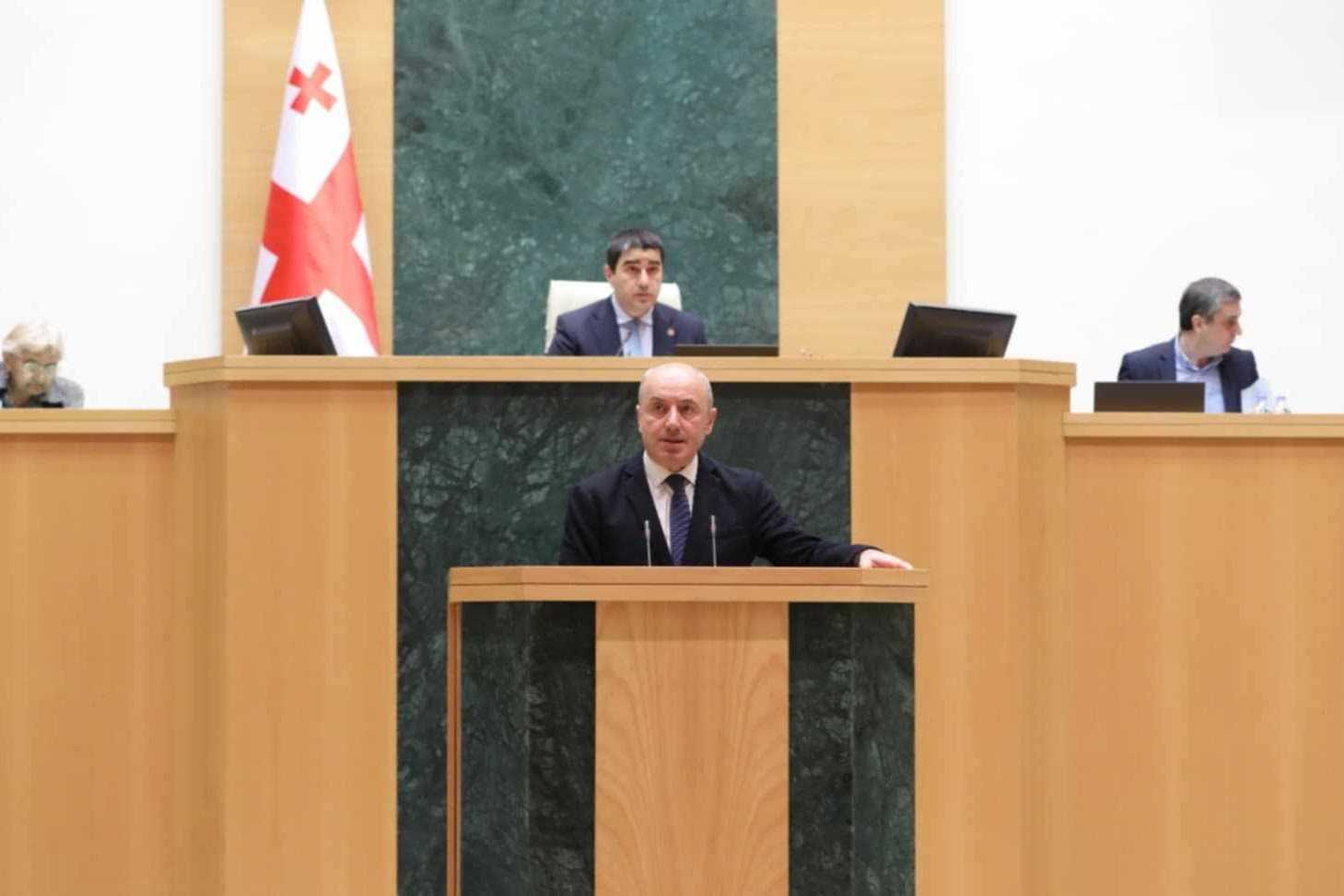
At the same time, while discussing the issue in parliament on 18 February, Kobakhidze spoke about a ‘serious labour shortage in Georgia’, noting that ‘without the presence of foreigners, many infrastructure projects in the country could not be carried out’.
‘The shortage mainly affects the construction sector, though not exclusively. There is also a significant labour gap in the hospitality industry, which means there is a need for labour migration in our country’, he added.
 Mikheil Gvadzabia
This article was translated into Armenian and republished by our partner CivilNet.
This article was translated into Azerbaijani and republished by our partner Meydan TV.