A leaked confidential report produced for a new soft-power unit within the Russian Presidential Administration has outlined the Kremlin’s priorities for working with the Russian diaspora, referred to as ‘compatriots’, including in Armenia, Azerbaijan, and Georgia.
The report comes as the Kremlin continues to openly discuss the need to strengthen its soft power strategy, particularly in Armenia.
The 15-page report was produced by the Moscow State University and is dated December 2025. It shows that Russia is seeking a policy on how to enhance its work with its diaspora — making it more loyal towards Moscow, including from the Russian communities in the South Caucasus.
The document was first published by Michael Weiss, editor at the Russian independent media outlet in-exile The Insider, who described it as an updated version of a 1968 KGB manual on managing and mobilising diaspora communities.
The report’s author, Evgeny Kozhokin, is a professor at MGIMO’s Institute for International Studies and has a background in Russia’s Foreign Intelligence Service (SVR). Since 2002, he has also served on the Russian Foreign Ministry’s Government Commission on Compatriots Living Abroad, where he specialised in analysing the sociological characteristics of Russian diaspora communities.
Kozhokin divides the diaspora into three broad groups.
The first consists of those actively seeking to preserve a Russian identity abroad and who are described as already defending Russian state interests.
The second group distances itself from contemporary Russian policy. This segment expanded significantly after the full-scale invasion of Ukraine in 2022 — referred to in the report as the ‘special military operation’ — and is characterised as broadly sympathetic to so-called ‘foreign agents’, portrayed as adversaries of the Russian state.
The third group, described as the largest, is considered largely apolitical, maintaining cultural or social ties to Russia without overt political engagement.
 Nate Ostiller
South Caucasus in focus
While the report offers a global overview, it mentions Armenia, Azerbaijan, and Georgia specifically too.
Azerbaijan, along with some Central Asian states, is described as a particularly challenging environment for strengthening Russian identity.
Kozhokin notes that ‘even before the start of the Special Military Operation, compatriots had to take into account the authoritarian nature’ of the Azerbaijani state.
He adds that Russian-speaking citizens in Azerbaijan and Central Asia are subject to closer scrutiny by security services and law enforcement than members of the titular ethnic group.
Armenia, by contrast, is characterised as a more accessible operating environment due to its retention of ‘elements of a democratic system’. At the same time, the report notes that long-established Russian communities are small, while more recent arrivals tend to live ‘largely separate lives’.
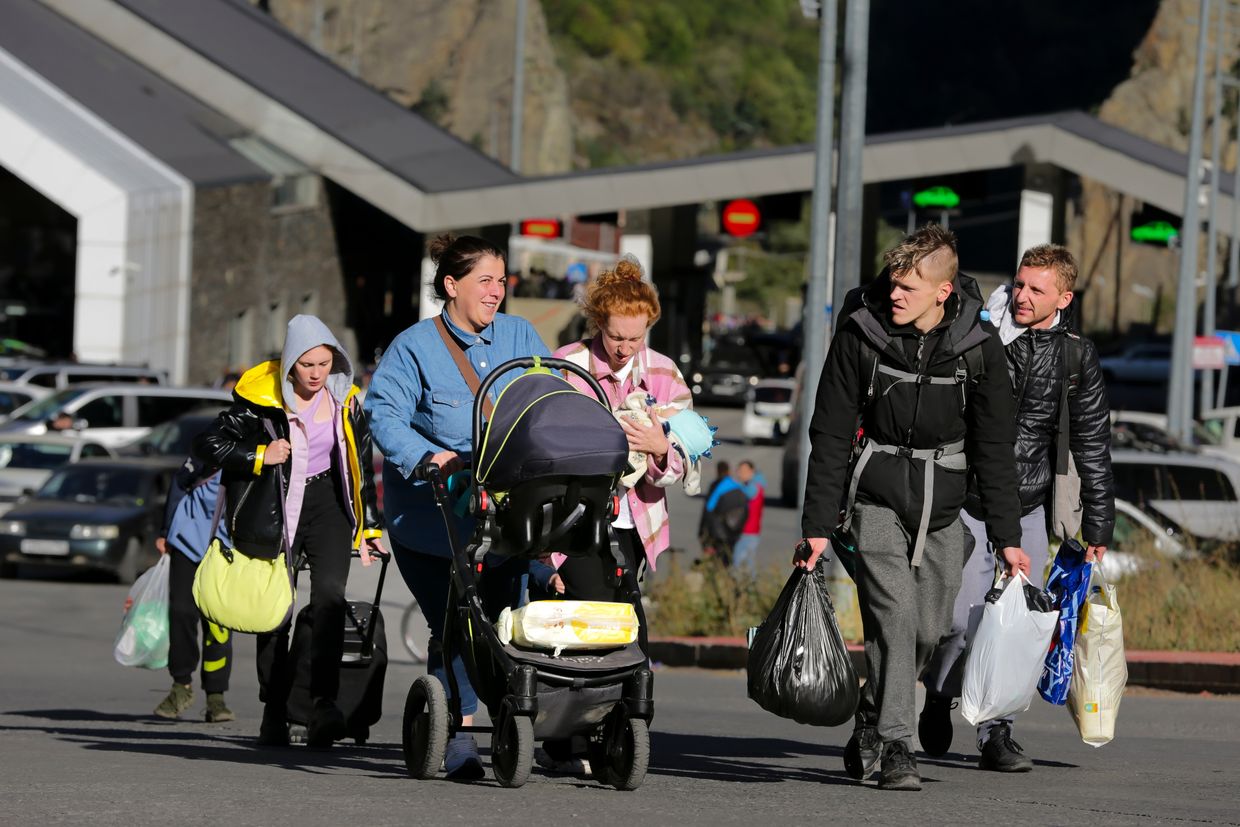
Georgia is highlighted as the primary destination for Russians leaving the country after 2022, with 15.5% of emigrants reportedly settling there.
The role of the Russian Church
The report points to the Russian Orthodox Church as a potential channel for engaging the diaspora, while cautioning against use of overt politicised language. Kozhokin argues that an explicitly apolitical approach would, for now, be more effective — implicitly suggesting that an overly political climate, for now, could alienate parts of the diaspora communities.
In particular, Sunday schools are identified as one of the most effective tools for engaging diaspora communities. ‘At present, any attempt to introduce propaganda into these schools should be avoided’, the report states. ‘It is important that they remain apolitical’.
The head of the Russian Orthodox Church’s structures in Georgia is Vladimir Aleksandrov, who was sent to Tbilisi by the Moscow Patriarchate in 2018, after previously serving in Sweden and working within the Church’s external relations framework. It is connected to work structures close to the Kremlin.
Recommendations to improve the work in the diaspora
The report concludes with a series of recommendations aimed at revitalising Russia’s diaspora outreach. Russian Centre of Science and Culture — known as Russian Houses — should prioritise family-oriented programming rather than focusing primarily on older audiences, it states.
Younger compatriots, Kozhokin argues, should be introduced to ‘a Soviet Union they know nothing about — a Soviet Union of vibrant creative thought’.
Modern Russian cinema is dismissed as having ‘self-discredited itself’, with the author urging instead the promotion of films centred on themes such as ‘the special military operation’ in Ukraine. He also stresses the importance of cultural quality control: ‘It is advisable not to encourage tours of mediocre Russian theatres in post-Soviet states’.
The final recommendation calls for renewed engagement with wealthy members of the diaspora, including millionaires and billionaires, and for reconnecting them with Russian universities once the ‘special military operation’ has concluded.