Opinion | Georgia’s regime has given critics a choice: prison or exile
A new draconian legislative package that vaguely defines a ‘foreign grant’ is placing anyone tangentially related to politics at risk of imprisonment.

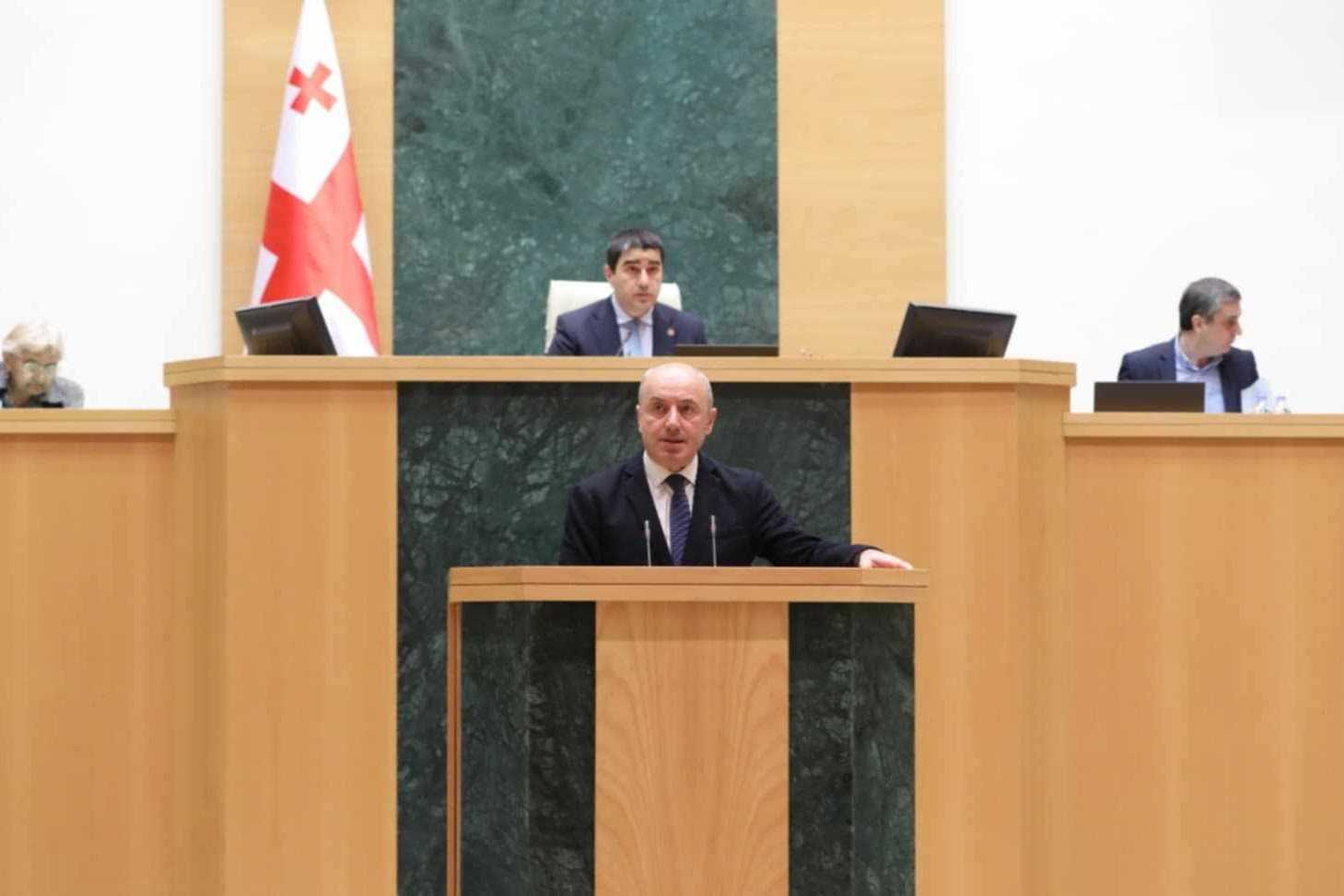
As the second year of a full-scale campaign to eradicate any vestige of autonomous civil society begins, Georgia’s ruling regime is doubling down on repression. Just this week, Georgian Dream’s parliamentary leader Irakli Kirtskhalia announced another draconian legislative package designed to tighten control over foreign funding and perceived channels of ‘foreign interference’. The regime’s ‘mad printer’ of authoritarian legal measures is again running at full speed.
From the standpoint of constitutional legality — with which the regime shows no concern — the proposed amendments push even further into constitutional no-go zones. Once again, the first victim is the rule of law. Consider the sheer overbreadth of the new definition of a ‘foreign grant’, now subject to prior government approval, with non-compliance punishable by up to six years in prison:
‘A “grant” shall also be understood to include funds or assets transferred, in monetary or in-kind form, by another state, or by a citizen or legal person of another state, to a citizen of Georgia or a person holding a residence permit in Georgia, to a legal person of another state whose activities essentially involve engagement with issues related to Georgia, as well as to a legal person of Georgia, where such funds or assets are used or may be used — under the belief or with the intention of exerting some influence over the authorities of Georgia, state institutions, or any part of society — for activities carried out or to be carried out that are aimed at shaping, implementing, or changing Georgia’s domestic or foreign policy; and likewise where they are used or may be used for activities that derive from the political or public interests, approaches, or relations of a foreign state’s authorities or a foreign political party’.
As usual, the regime claims this language is taken verbatim from the US Foreign Agents Registration Act (FARA). What it conveniently omits is that under FARA, terms such as ‘belief’ and ‘intention’ require stringent evidentiary thresholds to establish. The Georgian Dream regime’s attitude toward such safeguards becomes clear from another definition it has introduced:
‘A “grant” shall also be understood to include funds or assets transferred in monetary or in-kind form where, in return, the recipient of those funds provides the issuer/provider of the funds with technical assistance in the form of sharing technologies, specialised knowledge, skills, or expertise, providing services, and/or other forms of assistance; as well as technical assistance provided free of charge in the form of sharing technologies, specialised knowledge, skills, or expertise, providing services, and/or other forms of assistance’.
Kirtskhalia has clarified the implications: ‘Accordingly, if a foreign power hires experts in Georgia in exchange for payment, that money will be considered a grant’.
In practice, this means that anyone working for a foreign employer can be barred from participation in public or political life, regardless of the nature of their work or the profile of the employer. Such sweeping overbreadth prima facie violates several constitutionally protected freedoms, including freedom of expression, freedom of information, academic freedom, and the freedom to choose one’s occupation.
 Mikheil Gvadzabia
Under constitutional Rule of Law standards, such provisions must meet strict requirements of precision and foreseeability. Georgian constitutional jurisprudence itself illustrates this. In 2012, Georgian Dream recognised Vakhtang Maisaia, an academic and former diplomat convicted of espionage as a political prisoner. That same year, the Constitutional Court struck down one of the legal provisions underpinning his conviction, holding that producing research based on open sources for a foreign organisation — which the applicant could not have known was acting on behalf of a foreign intelligence service — could not justify criminal liability. The provision was invalidated precisely because its overbreadth enabled unjustified restrictions on freedom of information.
Notably, in that case, the Court accepted that the organisation might indeed have been a front for a foreign intelligence service. The decisive factor was that the individual could not reasonably have known this.
Today, more than a decade later, Georgian Dream effectively prohibits Georgians from working for any foreign legal entity that ‘substantively works on Georgian matters’ unless the government grants prior approval. Non-compliance again carries penalties of up to six years’ imprisonment. This provision is transparently targeted at civil society organisations that have registered abroad (mostly in Europe) to avoid the regime’s foreign agents’ legislation, while continuing to operate in Georgia. These organisations are further barred from operating local branches in Georgia or transferring assets to them. These provisions do not, however, imply that the regime’s enforcement capabilities now extend to transnational repression — Georgian Dream knows that the people operating these foreign entities are Georgian citizens and physically within its jurisdiction. That is precisely why they are targeted with criminal sanctions rather than other measures. By contrast, any attempt to assert transnational jurisdiction over foreign legal entities would make little legal or practical sense.
In effect, the regime seeks to force these organisations out of the country and to prevent them from employing local staff. The real choice presented to civil society leaders and employees is not between seeking approval and defying it. Given the structure of the scheme, approval is not a genuine option. The true choice is between prison and exile.
After a blanket ban on any research or expert work for a foreign employer by anyone who expresses opinions on public matters, the new legislative package appears to seek to foreclose any remaining opportunities for foreign employment for such individuals.
If a foreign company hires a Georgian programmer to write code and that person is active on Facebook criticising the regime, the regime may jail him for getting a grant under the cover of a ‘sham or deceptive’ transaction.
Legislation on political organisations further tightens restrictions on political parties and politically active individuals or business entities. Party leaders could be convicted for receiving foreign money as defined under these overbroad regulations. Individuals and business entities who express their opinions on public matters are subject to even stricter reporting and monitoring requirements. Public statements on policy matters can trigger a registration requirement that entails extensive reporting and monitoring duties. They are also required to establish special political action funds ‘for transparency’. An individual can be legally equated with a political party at the say-so of the State Audit Service under this overbroad ‘standard’.
Non-compliance with these regulations entails criminal conviction and prison terms. Those formerly employed by a foreign employer who somehow fall outside the scope of these measures may still be subject to sanctions of a criminal-law nature — namely, restrictions on their membership in political parties for eight years (with the time period running from the calendar year in which they last received income from an organisation acting as a conduit for foreign interests).
The regime insists that it is not at war with civil society but only combating ‘undue foreign interference’. Yet its broader repressive repertoire tells a different story.
While closing off remaining avenues for foreign funding, the regime also ensures that no domestic funding is available. Commercial entities now face fines of up to ₾20,000 ($7,400) for political activities (and double that for a repeated offence). This provision responds to the regime’s frustration with earlier repression efforts: while large enterprises embedded in the cartelised, patronal economy around Bidzina Ivanishvili remain compliant, smaller businesses have proven harder to deter from participating — financially and personally — in anti-regime mobilisation.
What drives the ‘mad printer’?
Some repressive measures are clearly reactive: the regime continuously adjusts its toolkit to civil society’s adaptation strategies. Others, however, bear no rational connection to any plausible threat to regime stability. The criminalisation of lobbying foreign governments, for example, could at most target politicians and civil society leaders who speak before foreign parliaments or meet foreign officials. Making political purpose an aggravating factor in the offence of money laundering reflects an even more detached legal imagination: no plausible threat of this kind exists.
Yet the ‘mad printer’ does not depend on coherent justification. It operates on a different fuel. The instinct of self-preservation — so central to the regime leader’s worldview — does not necessarily process threats rationally.
Elene Koridze
Still, this should not lead us to conclude that authoritarian legislating is purely irrational. There is a cold, if often distorted, cost–benefit calculus behind each repressive act. When asking why a particular measure is introduced, we should ask simple questions: What are the costs? What are the benefits? What are the trade-offs? Repression is policy. It cannot escape this logic.
Adopting the regime’s perspective is difficult. Its decisions are made under imperfect information and shaped by fear, paranoia, and cognitive rigidity. Otherwise, how could one explain the belief that, in today’s fragmented global order, vast sums of democracy-promotion funding might suddenly pour into Georgia and topple a provincial authoritarian regime?
Yet in chasing the ghosts of colour revolutions, the regime — and its Kremlin patrons — routinely overreach. The Rose Revolution and its regional counterparts were deeply traumatic events for their worldview. Even as global democratic momentum has faded, they remain trapped in outdated mental frames.
Obsessions with external ‘democracy imposition’ generate a compulsion to repress. Since 2024, mass repression in Georgia has significantly reduced the regime’s perceived costs of coercion. Repression has become cheap. Political, social, and international costs have proven bearable. The trade-offs appear manageable. The regime responds accordingly, escalating repression against both plausible and imagined threats.
Once initiated, mass repression is notoriously difficult to reverse. It produces immediate benefits in terms of compliance and control, reinforcing the dictator’s appetite. If left unleashed, repression subsides only when it succeeds in enforcing red lines — when the certainty of punishment for non-compliance becomes internalised. Such compliance further lowers enforcement costs, which in turn sustains both the repressive appetite and the institutional machinery of repression. Georgia’s regime does not need to enforce these measures against everyone who potentially falls within their scope. A few criminal cases and imprisonments could be enough to produce a chilling effect and drive the internalisation of new red lines. For that reason, ‘they can’t jail us all’ is not a rational strategy in the face of repression campaigns like this: the regime doesn’t have to jail everyone to achieve its desired outcomes.
From the regime’s perspective, relaxing mass repression without having drawn red lines is dangerously destabilising. The perceived risks of loosening control outweigh the costs of continued repression, especially when those costs remain low. The result is what we now observe: a ‘mad printer’ of repressive legislation operating at industrial speed, chasing embattled democratic civil society into every imaginable sanctuary.