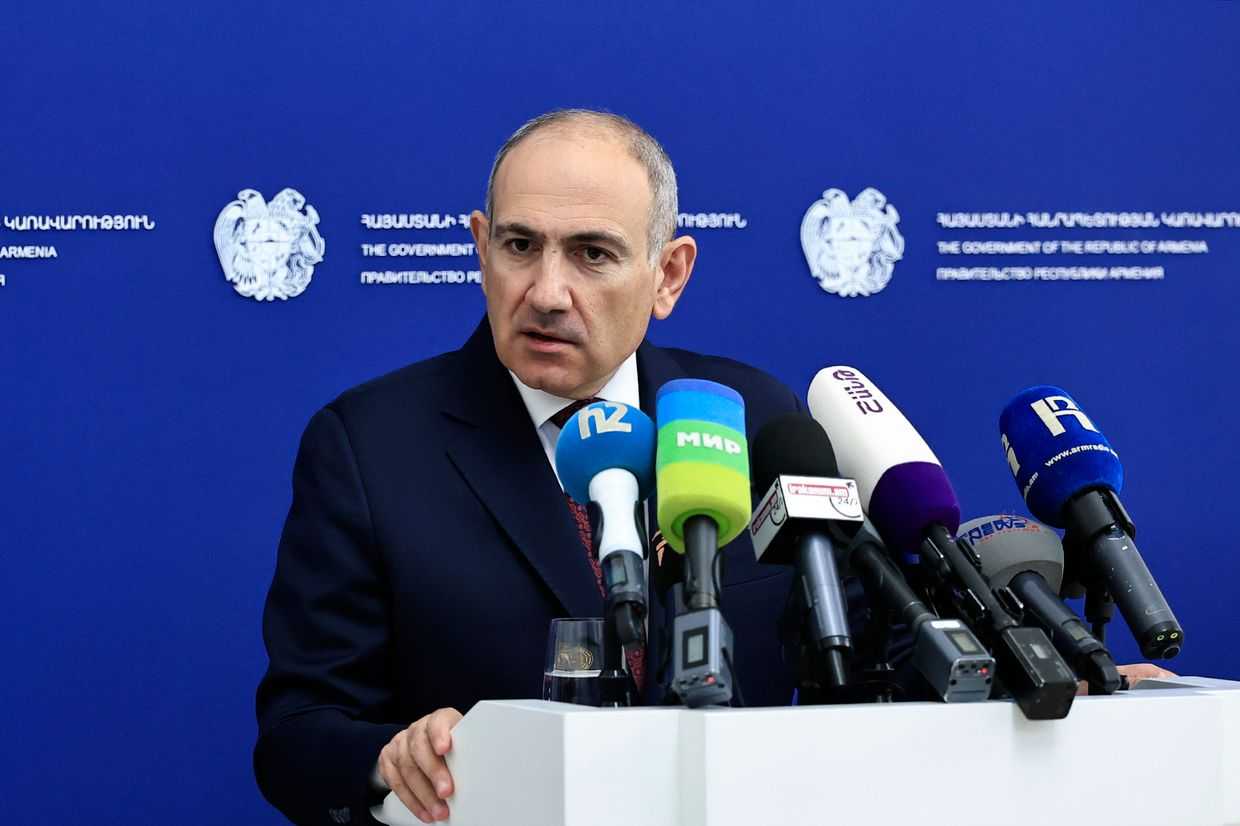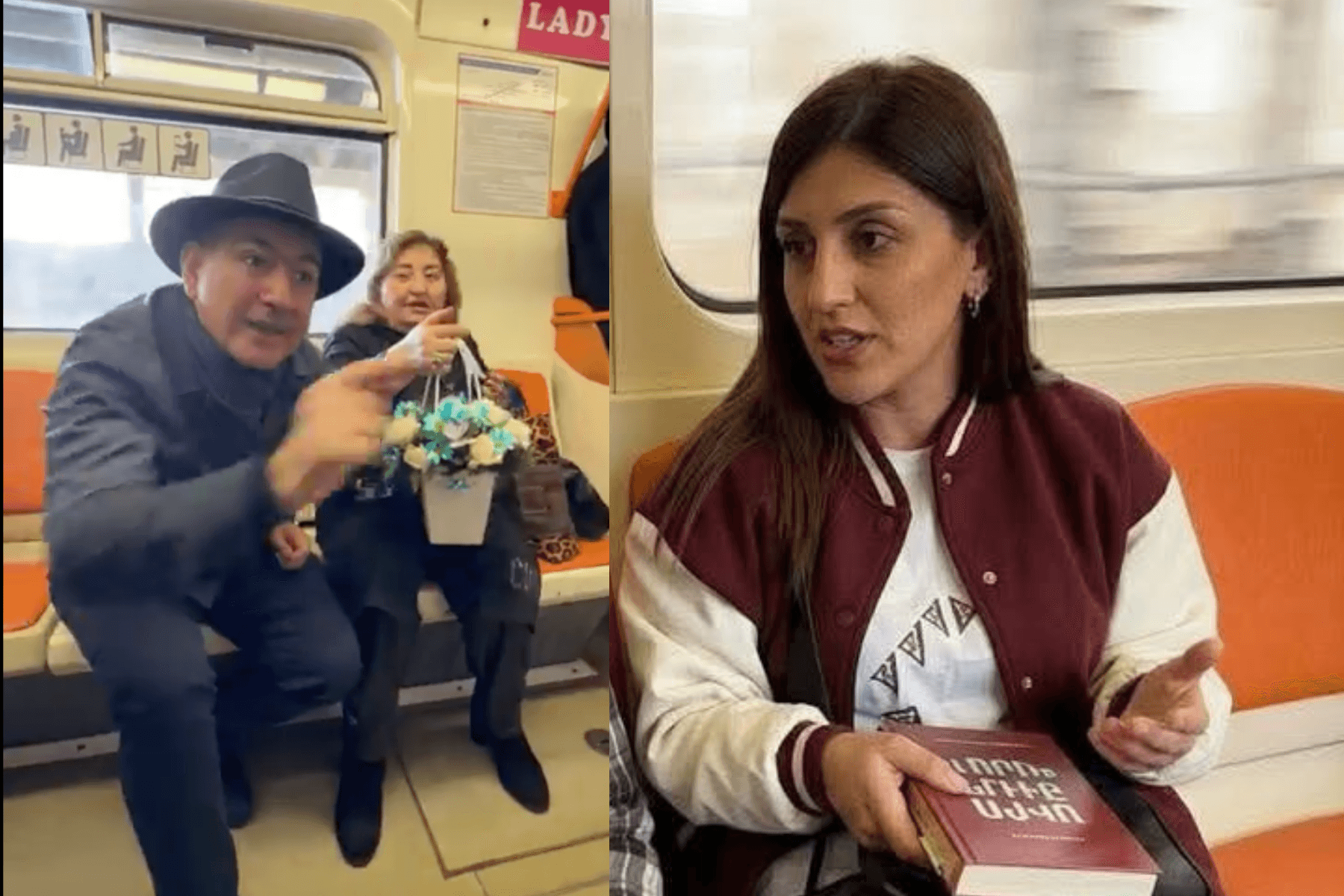
Prime Minister Nikol Pashinyan has faced backlash after calling Nagorno-Karabakh Armenians ‘runaways’ during an argument with a refugee from the region on Sunday. After initially denying that he had used the insult, he later apologised the same evening.
The argument, which was caught on video and spread widely across social media, took place on the metro while Pashinyan was conducting his Civil Contract ‘inter-party campaign’ in Yerevan. While on the campaign trail, Pashinyan has traveled across Armenia to meet constituents. As part of his travels, Pashinyan has been gifting pins with the shape of Armenia’s internationally recognised borders. The ‘Real Armenia’ narrative — meaning that Armenians must accept modern Armenia within its current borders — has been a key part of Pashinyan’s political messaging.
The heated discussion lasted around five minutes and began after Pashinyan asked if he could give a pin to a boy with his mother, which they refused.
The woman, later identified as Armine Mosiyan, was a refugee from Nagorno-Karabakh. In her rejection of the gift, Mosiyan told Pashinyan that they have a ‘different map’.
Although Pashinyan initially appeared to accept the disagreement, after a few seconds he returned to the woman, pointing the pin again and telling her to take into account that her son ‘will live within this map’.
He also added they would not allow their ideology, appearing to refer to conceptualisations of Armenia beyond its internationally recognised borders. ‘You won’t allow us to live in our Artsakh? You have already not allowed [us to live there], but you can’t deprive us from our hope to live in our Artsakh, the return and the rest’, Mosiyan said.
The woman asked Pashinyan to stop arguing with her, explaining that they were on their way to a chess tournament, and otherwise would have left the car upon seeing Pashinyan enter. However, Pashinyan said that because he had listened to her arguments, she was obliged to listen to him.
‘We have done everything so that you would live in Artsakh, in [Nagorno-Karabakh]. In 2023, it was you who were accusing me that I had closed the borders so that people would not come from Karabakh to Armenia, and you were demanding that I open the borders and you were saying that I had deliberately closed them so that the people would not leave Karabakh. Now you come here and say, “Oh, but we wanted to return” ’, Pashinyan said.
In September 2023, after Azerbaijan’s final offensive against Nagorno-Karabakh and the subsequent surrender of the authorities in the region, Pashinyan controversially stated that the civilian population of Nagorno-Karabakh was ‘not under direct threat’, despite calls for the Armenian government to help facilitate evacuations to Armenia.
During the argument on Sunday, Pashinyan angrily told Mosiyan that Yerevan had spent ‘billions [...] so that you would stay there, so why didn’t you stay there?’
After Mosiyan told him not to wag his finger at her and to lower his voice, Pashinyan responded: ‘Then, next time, do not try to say, you runaways, don’t try to say that I gave away Karabakh’.
Pashinyan’s remarks fueled public outcry online, in what many perceived as a continuation of his government’s rhetoric targeting Nagorno-Karabakh Armenians. Criticism became harsher after social media users learned that Mosiyan’s father, Meruzhan Mosiyan, had served as a field commander and been killed in the First Nagorno-Karabakh War.
 Arshaluys Barseghyan
As criticism spread on Facebook later that day, Pashinyan denied using the word ‘runaways’ during a press briefing.
‘No, I could not have said such a thing. If it was perceived that way, it was perceived incorrectly. If I said something the wrong way, I apologise’, Pashinyan said.
However, amid growing criticism online, he later apologised to Mosiyan and her son for ‘for [his] emotions’ that evening while summing up the day with members of his Civil Contract party.
He acknowledged that he had ‘said something not in the [right] way, I didn’t say it with the right gesticulation, I didn’t say it with the right tone, I didn’t say it with the right facial expression, somewhere I also did not treat the content correctly’.
In the same video, Pashinyan confessed that he was still unable to address issues regarding ‘the events of 2023 without emotions,’ assessing it as a ‘big flaw’.
Arshaluys Barseghyan
He further expressed hope and readiness to meet with Mosiyan again and ‘speak calmly’, foreseeing that his offer would be rejected, and ‘then [Mosiyan]might say two harsh words afterward — I accept that humbly’.
In a separate Facebook post, he again invited Mosiyan to meet with him at the government building or another place of her choosing to personally offer his apology.
On Sunday, the Human Rights Defender’s Office issued a statement underscoring the ‘need to ensure sensitivity towards forcibly displaced persons and refugees’. The statement did not include any condemnation of Pashinyan’s actions.
For ease of reading, we choose not to use qualifiers such as ‘de facto’, ‘unrecognised’, or ‘partially recognised’ when discussing institutions or political positions within Abkhazia, Nagorno-Karabakh, and South Ossetia. This does not imply a position on their status.
This article was translated into Russian and republished by our partner SOVA.