3.5/5★
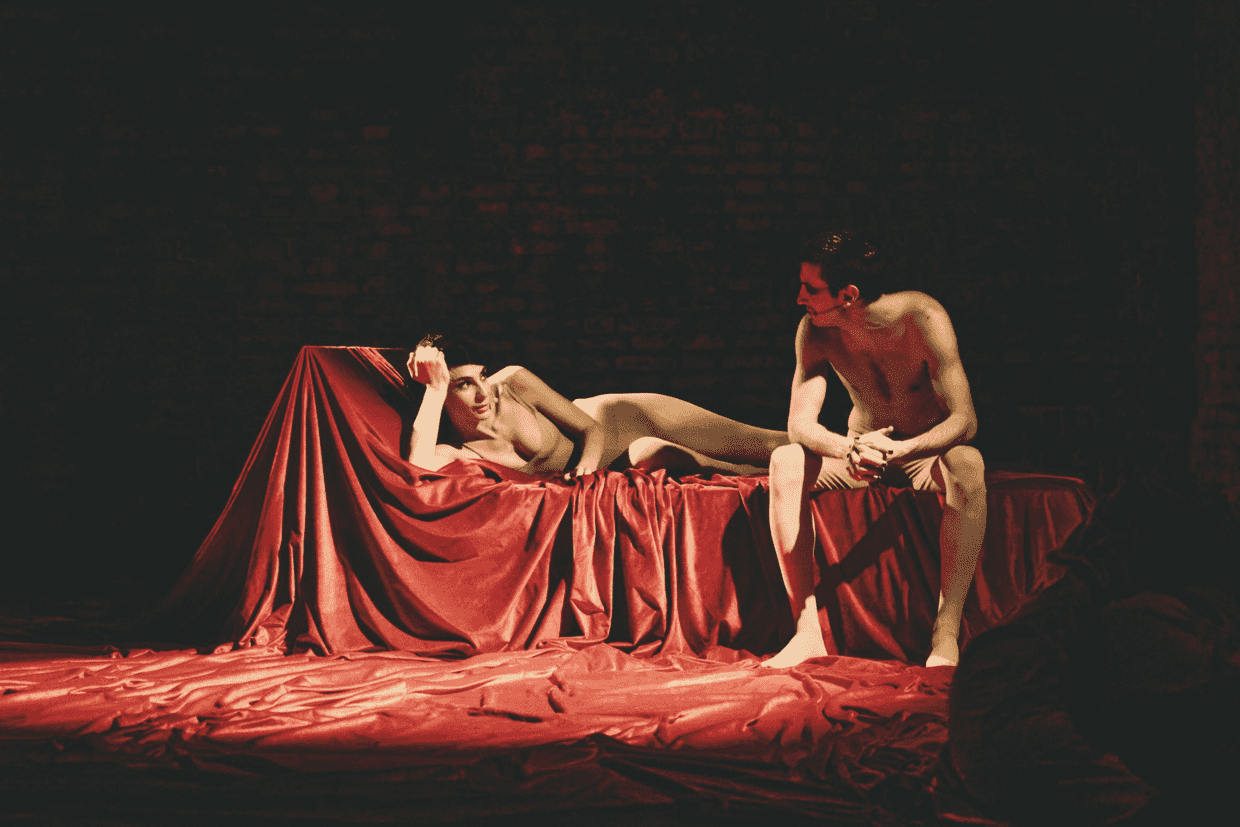
Nothing Political examines life inside Georgia’s protest movement through documentary footage and live performance.
I have been thinking a lot lately about what will remain in art history from the poems, films, documentaries, multimedia projects, and theatre works being created by Georgian artists today who are also playing a large role in the ongoing protests. This question shaped how I approached Nothing Political — with a sense of fatigue familiar to many viewers of protest-driven art in Georgia.
In Georgia today, protest has become not only a political act but a cultural condition. Much of this work is created by people who stand on the front lines of demonstrations themselves, who experience repression, hope, fatigue, and rage not as abstract ideas but as daily practice. Encountering yet another artistic response to protest therefore produces a double feeling: involvement on the one hand, and thinking about the future on the other. One begins to ask not whether the work is ‘good’, because it truly was, but what will remain of it once the moment passes: whether these works will survive as individual artistic statements or dissolve into a general memory of ‘that period’.
The performance Nothing Political is not built on an earlier play, nor does it attempt to reinterpret an established text. It is created entirely for the present moment, focusing on the past two years of political crises and protests in Georgia, while also reaching toward the symbolic threshold of a new year with all the fragile expectations such a transition implies.
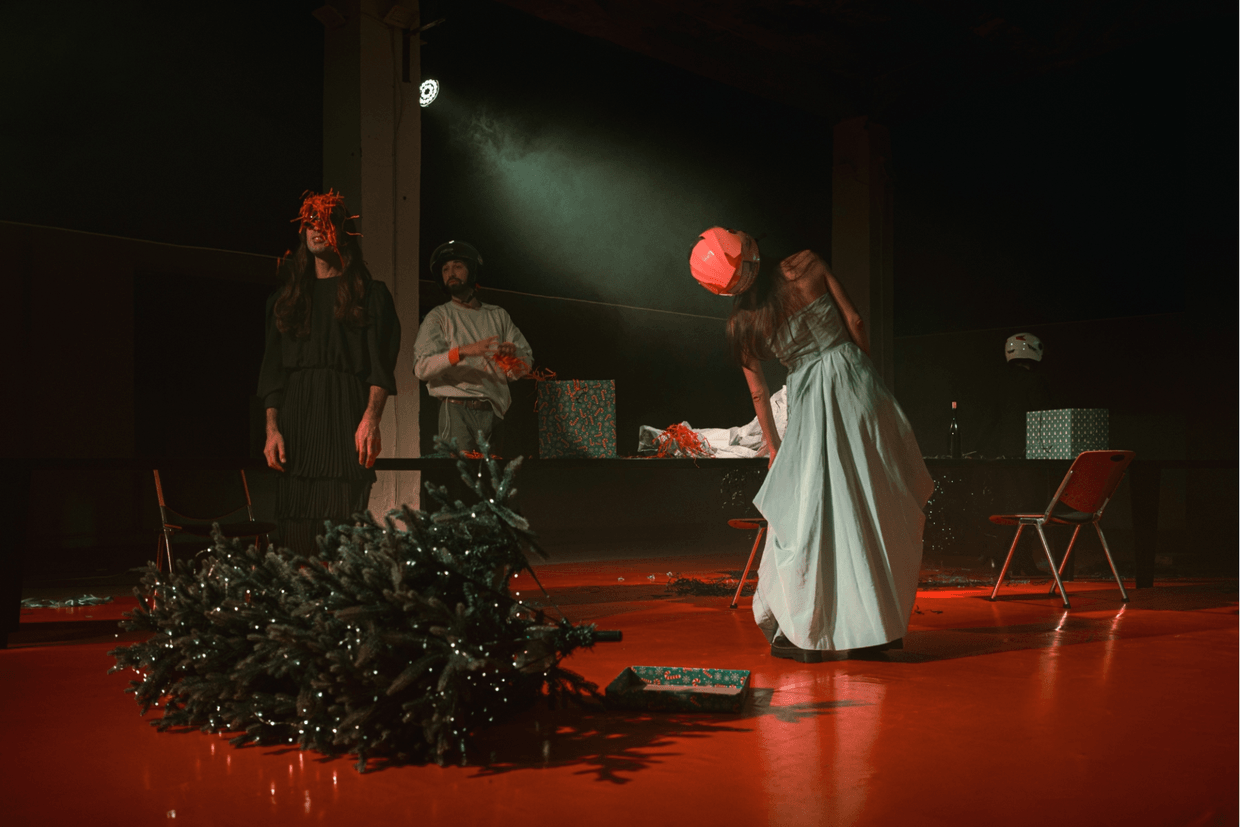
The four actors are storytellers who are also in dialogue with one another. As they move along and around a long table, they try to tell us small stories that are part of much larger ones, yet which themselves are on the verge of being forgotten.
I left the space with a sense of positive charge, almost energy. But I was also left with a lingering question: perhaps not all art needs to endure. Perhaps some performances are meant to be seen only a few times, to exist intensely, and then disappear.
The title Nothing Political immediately frames this paradox. As actor Nikusha Bakradze has explained while speaking to media, living and creating in the current reality is difficult, but losing one’s sense of humour within the chaos is even more dangerous. The title operates as irony, defence, and provocation all at once. In a context where everything is political, calling a performance Nothing Political becomes a way of exposing how deeply politics has invaded every aspect of life, including attempts to escape it.

Subscribe to the Culture Dispatch
A bi-weekly newsletter featuring film, book, and music recommendations from the Caucasus, handpicked by our team.
The text of the performance was written collectively by the entire creative group: actors Sopho Zeragia, Sandro Samkharadze, Nikusha Bakradze, and Magda Lebanidze, along with playwright and musician Dato Khorbaladze and scenographer Tamri Okhikiani. The performance does not present a distant voice, but it speaks from inside the experience it depicts. The material is drawn directly from the performers’ own involvement in protest, their own words, doubts, and predictions. As a result, the performance feels less like a finished argument and more like a living process.
Formally, Nothing Political is partially documentary. Behind the stage, an on-screen projection shows real political statements and comments made by the actors, creating a layered structure: the performers confront their own recorded words, sometimes critically, sometimes ironically. Bakradze has noted that documentary work usually requires distance from events, time for reflection. Here, that distance does not exist. What emerges instead is a form of self-reflexive documentary theatre.
This documentary material is one of the strongest elements of the performance. At times, the actors’ statements appear almost pathetically sincere; the audience sometimes even laughs, revealing that the protest must be self-critical in order to survive. In this sense, humour functions not as relief, but as a strategy of resistance.
The performance feels like a hybrid between an archive and a manifesto. Instead of offering solutions, it presents an ongoing sequence of hope, disappointment, failure, and small victories, emphasising their inevitability and repetition.
One of the central achievements of the performance is how carefully it negotiates the boundary between activism and theatre. This is a performance about activism, and it undoubtedly contains activism within it. Yet activism does not overwhelm theatricality. The creators manage to keep the work firmly within the realm of theatre, rather than allowing it to collapse into a direct political statement.
At the heart of the performance lies two recurring, unresolved questions: should one continue anything that they are doing, or should one stop? Is it worse to continue fighting when the struggle seems meaningless, or to stop too early? Despite this uncertainty, performance’s emotional momentum remains oriented toward endurance, suggesting that stopping is not an option, not because victory is guaranteed, but because survival depends on motion.
Nothing Political was staged at Open Space, an independent cultural venue in Tbilisi known for hosting experimental theatre, discussions, and politically engaged artistic work. The performance was presented with English subtitles. The next performances are scheduled for 12, 13, and 14 January 2026.