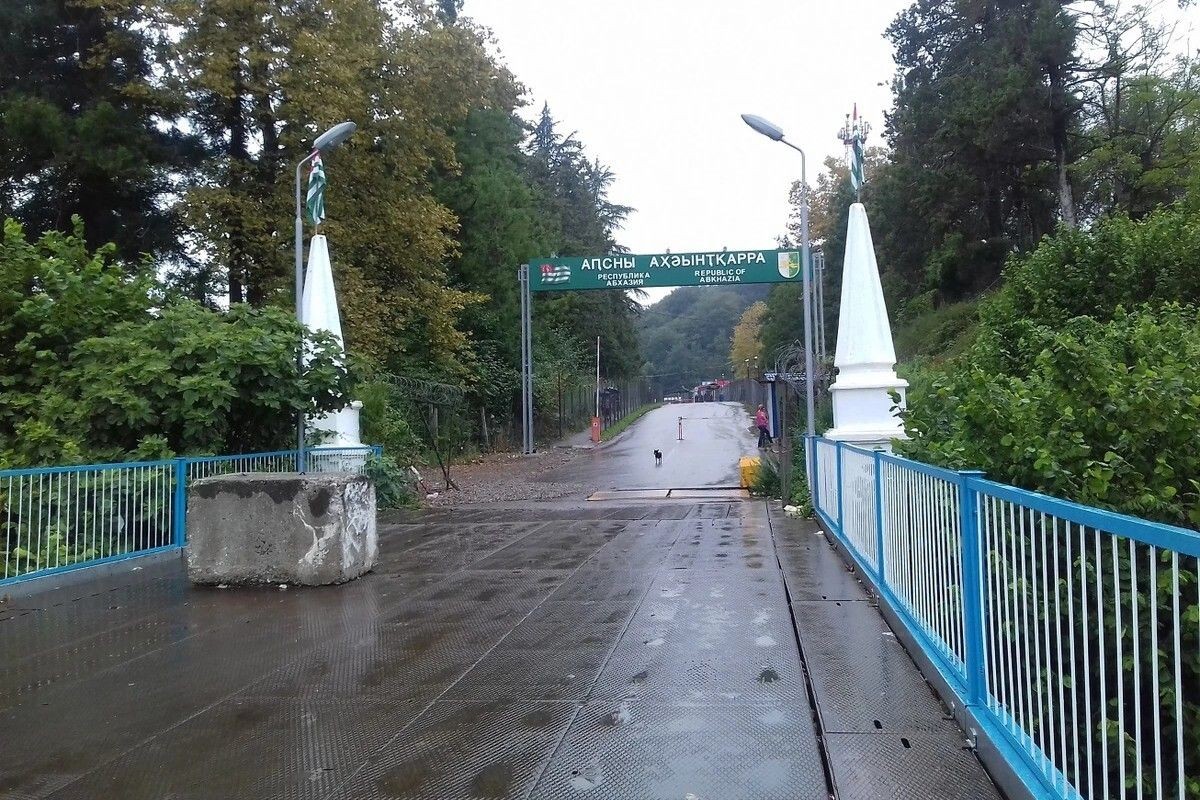
A new transit hub in Abkhazia to facilitate the transit of goods between Russia and other countries through Georgia will soon be opened, officials in Sukhumi (Sukhum) have announced. Abkhazian officials have insisted the project would not benefit Georgia, despite claims to the contrary.
Astamur Akhsalba, the general director of a transit and logistics company, told Sputnik Abkhazia earlier in December that the construction of the facility in Abkhazia’s eastern Gali District was complete, and that currently, preparatory work is underway. During the construction process, the hub was kept under wraps due to geopolitical tensions, he said.
Akhsalba explained that the hub was a joint Abkhazian–Russian project and would prohibit trade with Georgia or the involvement of Georgian drivers. Goods, largely from Armenia, Azerbaijan, Iran, would still transit through Georgian territory, he said.
The hub would serve as an additional route into Russia, complementing the existing Upper Lars checkpoint at the Georgian-Russian border. The Upper Lars route passes through mountainous terrain, resulting in frequent delays due to weather conditions.

‘The discussion is specifically about transit infrastructure and expanding logistical capabilities — meaning ensuring that flows pass under our control and according to our rules, rather than bypassing us’, Akhsalba said.
According to him, plans for the hub had existed for some time, but gained newfound importance for Russia after the start of its full-scale invasion of Ukraine in 2022.
Akhsalba said the project would benefit Abkhazia as well, as it would create new jobs, ensure tax revenue, and develop infrastructure.
‘Customs clearance/operations, storage, security services, consulting and other service fees, as well as terminal services — all of this [would] remain in the Gali District and benefit [Abkhazia’s] budget through tax payments, if the contracts, tariffs, and reporting are properly structured’, Akhsalba said.
Neither the Abkhazian Customs Committee nor the Economy Ministry have made any comments regarding the transit hub.
However, some opposition figures have expressed doubt about the project and the rosy predictions of economic benefits for Abkhazia.
Tengiz Dzhopua, a former employee of the Abkhazian Customs Committee and a member of the opposition, poured cold water on the idea that it would generate significant tax revenue.
‘I can confidently tell you that the only payment made during transit is the customs duty. It constitutes 0.1% of the customs value of the goods being moved across [Abkhazia’s] customs territory’, Dzhopua told the OKNO Telegram channel on 11 December.
Dzhopua also raised questions about the potential damage that the movement of goods along Abkhazia’s roads could cause.
‘We have problems on the roads even without long columns of vehicles, especially during the summer. Sooner or later, roads will deteriorate from heavy goods transport. How does the state intend to compensate for this damage? Are there any depreciation allowances?’, Dzhopua asked.
There is also a geopolitical factor, he added.
‘We are parties to a treaty with Russia on the transit of goods. It doesn’t oblige us to transit through Georgian territory. This agreement includes a clause stating that the transit of goods can only be carried out without prejudice to the security of the Republic of Abkhazia and its economic interests. Our relations with Georgia remain undefined, and our border with Georgia has not become an internationally recognised state and customs border’, Dzhopua added.

Contrary to statements from Akhsalba, Dzhopua said the main beneficiary would be Georgia.
‘All parallel imports come specifically to Georgia. In all transportation, banking, and commercial documents, the country of destination will be Georgia! No one will write that the country of destination is Russia there. Therefore, upon the arrival of these goods in Georgia, customs duties, taxes, and economic policy measures such as licenses and quotas will be applied there. And Georgia will receive maximum profit from all foreign trade operations’, Dzhopua said, adding that Georgia has been doing just that in recent years, generating significant revenue in the process.
At the same time, Dzhopua said he was not opposed to the idea of transit through Abkhazia in principle, but would want assurances that there would be actual material benefits.
‘Let Georgia repeal the law on occupied territories and end the policy of isolating Abkhazia on the international stage, at least in the fields of culture, sports, and education. If they want the transit to go through our territory, then we should also be participants in this transit. Then we should also have the opportunity to send and receive goods, for example, from Armenia and Azerbaijan. Otherwise, it turns out that we are an unclear territory’, Dzhopua said.
A decade-old agreement
The establishment of the route appears to have been based on an agreement signed between Georgia and Russia back in November 2011. Negotiations on the agreement were facilitated by the US, and included a concession from the Georgian side to withdraw its objections to Russia joining the World Trade Organisation (WTO).
According to the agreement, ‘extraterritorial trade corridors’ would be created through Abkhazia and South Ossetia in accordance with WTO rules. It was additionally proposed to entrust the monitoring of cargo movement to the Swiss company SGS. As part of this process, there were plans to equip every vehicle entering the corridor with chips — without the participation of the Abkhaz side.
For its part, the Georgian government has largely opted not to discuss reports of the transit hub, chalking it up to ‘speculation’.
‘We do not recognise any so-called state border […], and therefore there can’t be any discussion about this on our part’, Prime Minister Irakli Kobakhidze said earlier in December.
Kobakhidze went on to further distance the Georgian Dream government from any connections to the hub, saying that the previous agreements were made during the rule of the United National Movement party (UNM), which is now in opposition.
For ease of reading, we choose not to use qualifiers such as ‘de facto’, ‘unrecognised’, or ‘partially recognised’ when discussing institutions or political positions within Abkhazia, Nagorno-Karabakh, and South Ossetia. This does not imply a position on their status.
 Lana Agrba
This article was translated into Russian and republished by our partner SOVA.