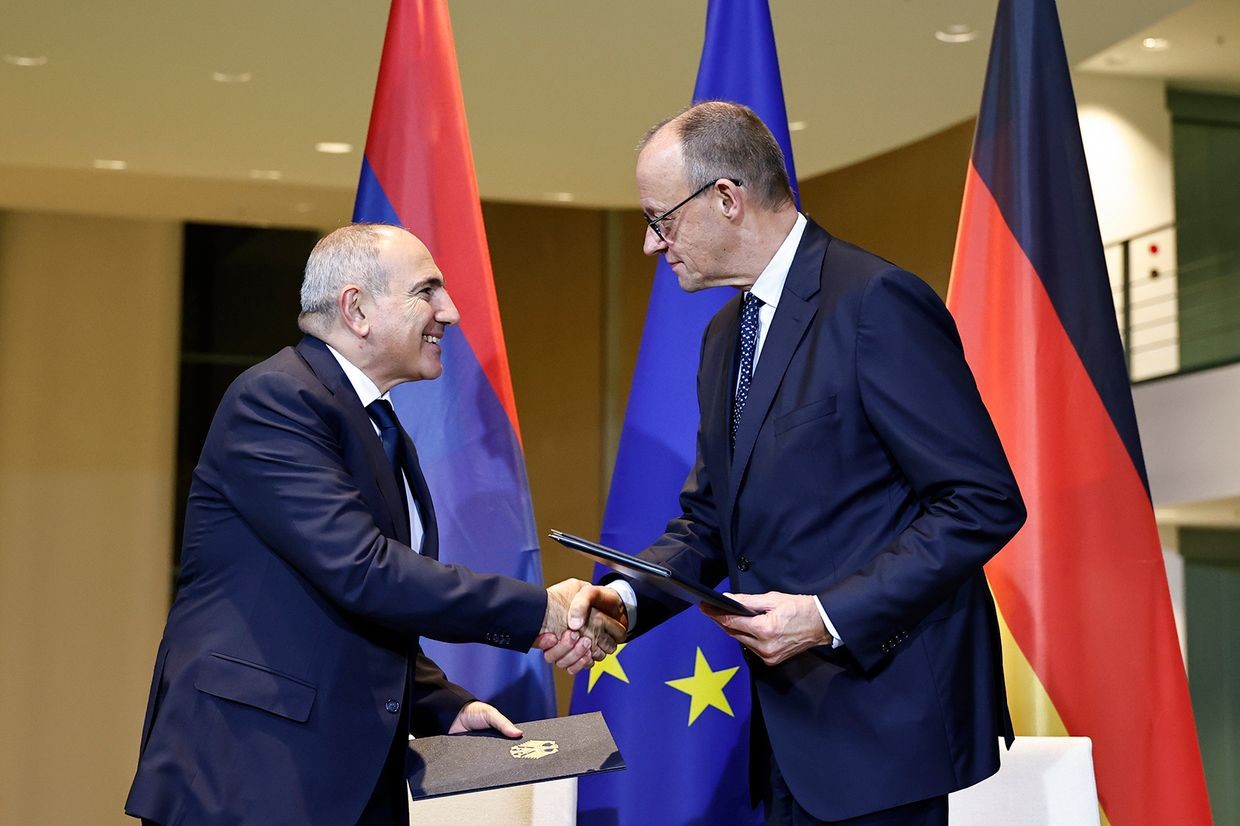
Armenia and Germany signed a joint declaration on the strategic agenda of bilateral partnership on Tuesday as part of Armenian Prime Minister Nikol Pashinyan’s official visit to Germany.
The joint declaration outlined the areas in which the two sides intend to cooperate, including in politics, economics and trade, development and capacity building, and security and defence.
The text also clarified that the implementation of actions under the declaration ‘will depend on the availability of resources and the relevant laws and regulations of the parties’.
Economic cooperation
Aside from the signing ceremony, Pashinyan and German Chancellor Friedrich Merz offered their comments on their meeting during a joint press briefing.
Pashinyan called his visit ‘truly historic’, considering that the bilateral relations between the two countries were now ‘entering the stage of strategic partnership’.
He further elaborated that an ‘important component’ of his visit was ‘the establishment and strengthening of economic ties’ with Germany.
‘In this regard, I have great hope that the favourable environment created in and around Armenia will arouse new interest among German businessmen in investing in our country, as well as in activating cooperation with Armenian businessmen’, Pashinyan said.
In turn, Merz said that the sides had ‘intensified’ relations in the economic sphere.
German companies ‘are increasing their interest in Armenia’, Merz said, given the region and Armenia itself ‘are important as a junction point between Asia and Europe’.
‘And we must use our potential. For this, framework conditions and peace, rule of law, [and] free competition are necessary’, Merz said.
In the meantime, Merz noted, it was not ‘so easy’ for German small and medium-sized businesses to make large investments ‘in distant countries’.
‘But they are very reliable and trustworthy partners when they see the right framework conditions in a specific country. That is why the reforms that are taking place in Armenia are very important’, Merz said.
The Trump Route
Merz also put an importance on ‘close cooperation’ during ‘these turbulent times’.
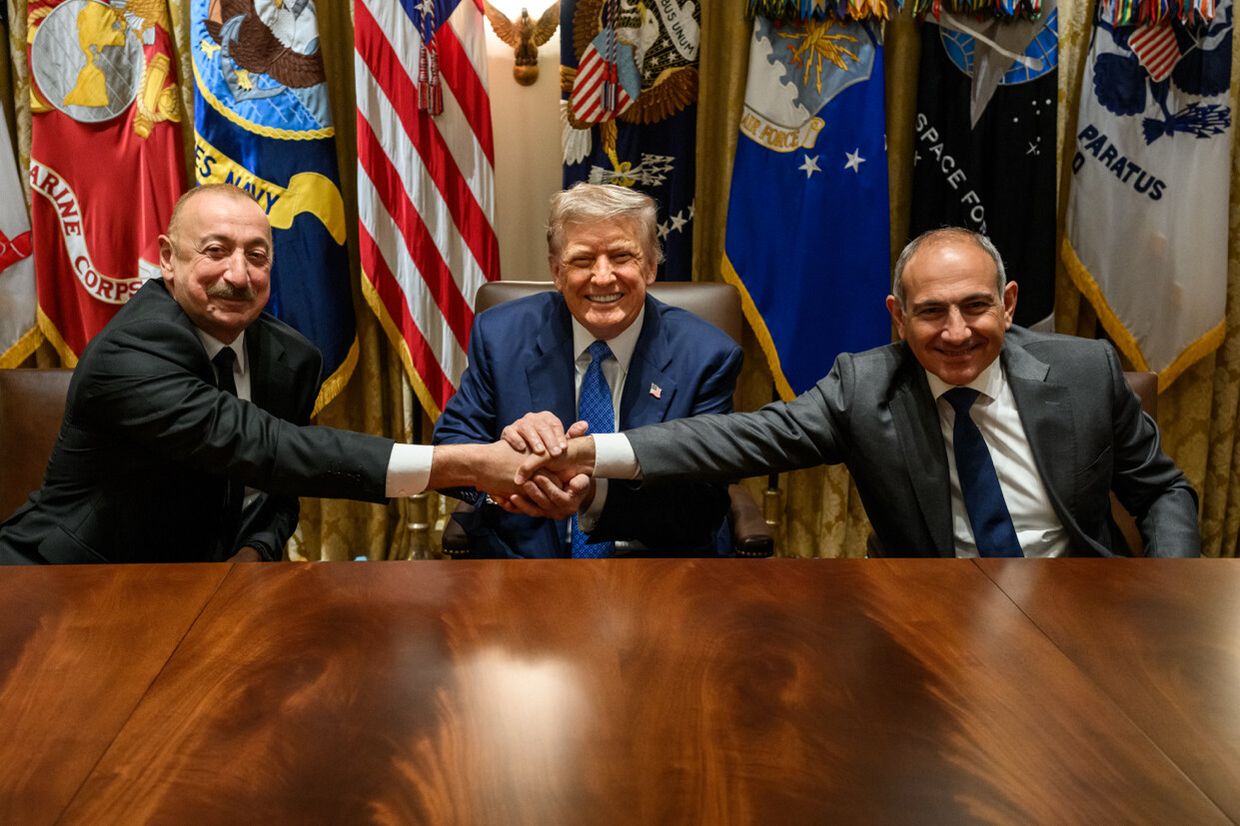
In his remarks, he congratulated Pashinyan and Azerbaijani President Ilham Aliyev for managing to ‘to reach a peace agreement’, calling it a ‘great achievement’.
Armenia and Azerbaijan concluded their negotiations on the text of the peace treaty in March 2025 after years of negotiations. The document was then initialled, but not signed, in August during a trilateral meeting in Washington.
 Nate Ostiller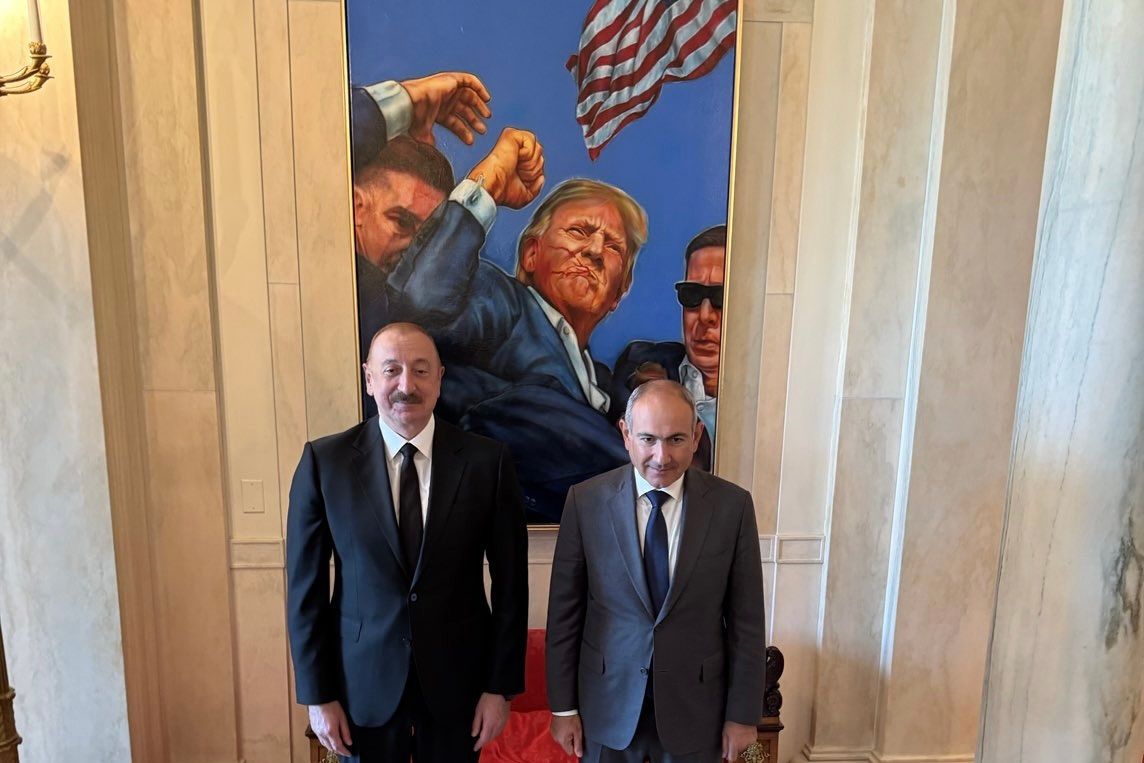
The Washington summit, hosted by US President Donald Trump, also resulted in an agreement to create a route connecting Azerbaijan to its exclave of Nakhchivan, through Armenian territory.
‘This is very important for prosperity, peace and development. This is a very positive signal for the South Caucasus, which reaches beyond this region’, Merz said, encouraging the sides to ‘take the next steps to resolve the remaining issues’.
Separately, Pashinyan noted that he had presented to the German side ‘the broad opportunities opening up’ in this regard, as well as for the ‘expansion of cooperation in the infrastructure sectors in the South Caucasus’, as part of the unblocking of regional transit routes.
In reference to his government developed project Crossroads of Peace, as well as the Trump Route, Pashinyan expressed his confidence that these projects ‘will become an important node for the Middle Corridor, which is also of great importance for Germany’.
Later the same day, during his visit to the German Council on Foreign Relations, Pashinyan disclosed the name of the Armenian–American company — the TRIPP Company — which would be registered in Armenia.
The TRIPP Company will be ‘granted a right to develop the necessary infrastructure of railway, road, oil and gas pipelines, and fiber optics’, Pashinyan said.
He also added that ‘intensive negotiations’ were underway on the general terms of implementation of TRIPP, and that the implementation and construction phase would start ‘as early as next year’.
Pashinyan also had a tête-à-tête meeting with Merz, during which, among other things, the German side ‘welcomed the strengthening of Armenia’s ties with the EU and the wider family of democratic states’.
During his visit to Germany, Pashinyan also met with German President Frank-Walter Steinmeier, who ‘emphasised his country’s readiness to develop relations with Armenia’, according to the Armenian readout of the meeting.