As Russia further restricts the internet, what does the future hold for the North Caucasus?
The North Caucasus has been facing various internet blockades for several years. Can things really get any worse?


Victoria, a teacher in North Ossetia’s capital Vladikavkaz, has spent most of the last 20 years using WhatsApp to speak to her daughter in Germany. Even after WhatsApp was designated an extremist organisation in Russia, they continued using it, resorting to a paid VPN.
In February 2026, however, Victoria could no longer reach her daughter, even without using video, the connection having deteriorated as internet restrictions ramped up.
‘I suggested that my daughter also install MAX’, Victoria tells OC Media, referring to the Kremlin–backed ‘national messenger’.
‘We were all forced to install it at work’ she continues, ‘but she is against it and discourages me from using it. But what difference does it make to me — as long as it works.’
They eventually found a compromise: the family now communicates via the Russian social media network VK, a less politicised alternative. Although Victoria says her family has nothing to hide, she believes taking precautions does no harm.
‘Our constitution guarantees the secrecy of personal correspondence, and I would like our conversations to remain strictly within the family’, Victoria says. ‘When it suits them, they make you sign a hundred forms just to work with personal data. And here — they sort everything out themselves’.
She does not want to say how she will stay in touch with her family if the restrictions tighten further, but insists she does not wish to move to Germany to be with her daughter. Having previously openly supported Russian President Vladimir Putin, when asked how she feels about him now, she replies only that she is a Russian patriot.
A brief history of internet censorship
At the end of February 2026, RBC and The Bell reported, citing sources, that Russia had made the decision to ban the Telegram messaging app completely from 1 April, describing the decision as ‘final’. The same information was also reported by the Telegram channel Baza, which has close ties to the Russian security services.
Telegram is just the latest app to fall afoul of the Russian government, however, marking a decade-long history of increasing restrictions.
In 2010, the Russian internet was a time of absolute freedom: people argued with each other on forums, torrents were used to download everything imaginable, and the word ‘Roskomnadzor’ (The Federal Service for Supervision of Communications, Information Technology, and Mass Media) was known perhaps only to officials and their relatives.
But then something changed. Like with many decisions, it all appeared to start with good intentions: ‘There is too much harmful content online, let’s protect children’. In response, the Unified Register of Prohibited Websites appeared in 2012.
At the time, it seemed almost harmless. The list included sites with drugs, child pornography, and suicide. The internet community grumbled, but understood the logic. However, this was also the origin of the ‘infrastructure of prohibition’.
In 2014, the rules of the game changed sharply. Blocking ceased to be only ‘about children’. The ‘Lugovoy Law’ appeared, allowing websites to be blocked without a court order if they were deemed to contain ‘extremism’ or calls for unlawful protests.
The Prosecutor General’s Office received a magic wand: wave it, and an opposition media outlet disappears from search results. It was then that the Russian internet began to divide into ‘acceptable’ and ‘banned’.
In 2018, the battle for Telegram began, lasting three years. The Federal Security Service (FSB) demanded that the messenger hand over encryption keys, but Telegram’s founder, Pavel Durov, said ‘no’. As a result, Roskomnadzor decided to simply switch the messenger off in Russia.
The agency blocked millions of IP addresses belonging to Google and Amazon in an attempt to ‘catch’ Telegram. As a result, supermarket tills, ticket booking systems, and even government websites went down, while Telegram continued to function. It was a victory of technology over bureaucracy. In 2020, the blocking was officially deemed pointless and lifted. But the authorities drew a lesson: IP blocking is a dead end.

The state realised that to control the network, it needed to control the ‘pipes’ through which traffic flows. That is how the ‘sovereign internet’ law appeared. Providers were required to install Technical measures to counter threats (TSPU) — ‘black boxes’ that allow the state to see what you download and forcibly slow down or disable specific services.
Twitter was the first social media network to be ‘tested’ in 2021. It was not switched off, but simply made so slow that images took minutes to load. The technology worked.
After February 2022, when Russia began its full-scale war against Ukraine, the pace of blocking became an avalanche. Instagram and Facebook — designated as extremist in Russia — along with dozens of independent media outlets, were banned within days.
Russia moved from targeted restrictions to full-scale filtering. But the most interesting phase came later — when YouTube was targeted. In the summer of 2024, it was not officially blocked but simply ‘slowed down’ to the point of unusability.
According to cyber law expert Sarkis Darbinyan, most messengers and other Western services will continue to face such restrictions in the future, with Telegram simply being the latest to face yet another round of government control.
The North Caucasus as a testing ground for new technology
At the same time this was happening across Russia, the first instance of full shutdowns came during Ingush protests against border changes with Chechnya in 2018, when thousands of people took to the streets. It was then that Ingushetia first experienced a complete communications blackout. The case remains with the UN Human Rights Committee, and no decision has yet been made regarding violations.
Following this, Daghestan and Chechnya first encountered full mobile internet shutdowns after hundreds of protesters stormed Makhachkala airport in October 2023 in an attempt to attack passengers arriving from Tel Aviv.
 Tata Shoshiashvili
The largest internet provider in Daghestan, Ellko, explained the outage as an exercise by Roskomnadzor to ‘develop scenarios for disconnecting access to the foreign segment of the internet’.
Amidst these reports, Russia’s Minister of Digital Development Maksut Shadaev stated that there were ‘no communication problems’ in these republics.
The Daghestani newspaper Novoe Delo later wrote that federal authorities might use Daghestan, Chechnya, and Ingushetia as a trial run for disconnecting from the global internet, creating a North Caucasus analogue of China’s ‘Golden Shield’ system. Roskomnadzor confirmed the existence of such plans in mid-November 2024.
‘The Caucasus was probably one of the testing grounds for new censorship technologies. And now we see that Moscow has also been under mobile shutdown for several weeks, and the same technological methods are being used, but now on a much larger scale’, Darbinyan tells OC Media.
Madina, a resident of Daghestan, similarly notes that the restrictions no longer surprise anyone.
‘I used to spend almost all my free time on Instagram. Now it feels like something fantastical’, she tells OC Media.
‘How is that even possible? Instagram has become something unreal, like the COVID-19 epidemic, which now feels like some kind of dream. Sometimes people send me links to reels on Instagram, but I don’t even try to open them — my VPN works on and off, and by the time you switch it on, you no longer feel like it’, she says.
Madina says that she is now more focused on work, social media, she says, used to distract her a lot. She was also forced to install MAX — she works in a state institution — but no one writes anything there, and she only uses it for work correspondence.
Now, she says, the biggest problems arise on days when drone alerts are announced — when the North Caucasus is attacked by Ukrainian drones. Even if Daghestan itself is not under threat, the connection is still jammed, and as a result, it is impossible even to pay by card in a shop.
Elizaveta Chukharova
A member of Daghestan’s Public Chamber, Shamil Khadulaev, notes in conversation with OC Media that the restrictions ‘very much irritate people’.
‘People in Daghestan are used to openly receiving information, sharing information, and holding discussions. People here are very politicised, they like to stay informed about everything, and of course restrictions irritate them. People pay for mobile communications, for the internet, and it turns out they are paying for something that is not being provided. People are exhausted’, Khadulaev says.
According to him, Russia is now facing a new Iron Curtain, drawing a parallel with the Soviet Union, when access to information was restricted by strict censorship.
‘Russia is a world champion at stepping on the same rake. If the government believes that information is not true, then engage in dialogue, provide the correct information’, Khadulaev says.
‘But you cannot assume in advance that I am a fool and tell me: you will only watch this. We have already been through banning and blocking. It leads nowhere good. The state itself will not know the public response and will keep making mistakes, which will lead to what we came to in 1991. Here we go again: we wanted the best, but it turned out as always’, he concludes.
The state messaging app MAX
Following Russia’s full-scale invasion of Ukraine, the state and major Russian IT companies began actively promoting the idea of ‘digital sovereignty’: creating domestic platforms controlled within the country. It was in this context that the national messenger MAX appeared.
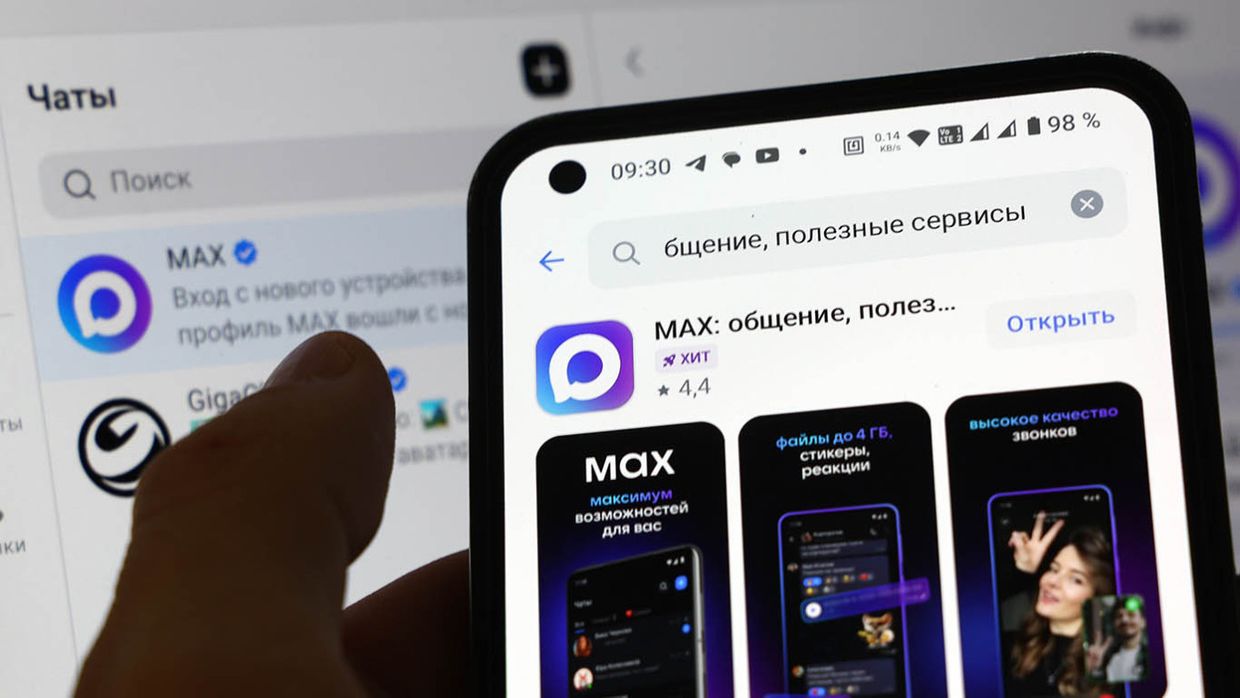
MAX was initially presented as an alternative to familiar messengers such as Telegram or WhatsApp. However, unlike them, MAX from the outset was perceived not simply as another communication app, but as part of a broader infrastructure. Its purpose, as officials stated, is not only messaging but also potential integration with other services — from corporate systems to government platforms.
The app became a continuation of a logic already visible in other areas: the creation of national payment systems, local social networks, video hosting services, and cloud platforms.
Russian legislation already includes mechanisms obliging services to store user data and, if necessary, provide it to state bodies upon request. This means that any messenger operating within Russian jurisdiction becomes embedded in this system. MAX was created within it from the beginning.
When people refused to use it voluntarily, they began to be transferred there by force. Work chats in state institutions, school parent chats, and neighbourhood chats created by management companies moved to MAX. To use certain services, including all state services, authorisation via MAX is required.
Elizaveta Chukharova
A number of Telegram channels of Russian state media or media linked to security services do not publish all information there, instead directing users to MAX. This is especially common when publishing sensitive information — for example, the aftermath of attacks on Ukraine, with captions such as ‘More photos and videos — on our MAX’.
Yet even with this pressure, MAX has not seen huge popularity. Even Chechen Head Ramzan Kadyrov was only able to gather around 10,000 subscribers to his channel on MAX over six months, 200 times fewer than the 2 million he has on Telegram.
His associates — Chechen Prime Minister Magomed Daudov and MP Adam Delimkhanov — also have significantly smaller audiences on the state messenger. Daudov has only 800 subscribers on MAX compared to 1.8 million on Telegram, while Delimkhanov has 4,380 compared to 1.8 million.
‘If they had made the platform interesting, people would have come on their own’, Khadulaev says. ‘But when a person is forced, they automatically resist. You cannot twist someone’s arm, put a knife to their throat and say: move to MAX. That is not democratic and even unconstitutional.’
He believes that precisely because people are being pushed into MAX, they do not want to register there.
‘If they had not forced it at gunpoint but said: here is our national messenger MAX, use it — the advantages are this, this and this — then maybe people would have gone. There is no connection, but MAX works — interesting, useful. But not like this: suppress Telegram and then say “here is MAX”. A person immediately feels something is wrong. When you are forced, you do not trust. And later it will be impossible to fix — no incentives will work’, he emphasises.
‘If you isolate a person, ban Telegram, people will obtain information from other sources. I remember Soviet times. When Voice of America existed — how many people in Daghestan could listen to it? Very few. But the information they transmitted spread from kitchen to kitchen across the whole of Daghestan, and people trusted it far more than official sources’.
According to him, the state is losing the information war and, instead of correcting mistakes within the law and constitution, chooses the simplest path — blocking.
Loujaine Laamal
‘The whole world is on YouTube and Instagram — what will we have? Everything will be blocked, we will not be there, while the whole world is there. And what then? They will hit our country from one side and win. Russian citizens will not even have the option to respond. Who does this harm? Again, it harms the country itself’, Khadulaev believes.
In any case, he notes that all the officials he knows still use Telegram, though no longer under their real names.
In the same vein, Darbinyan has found that those least willing to move to MAX are security officials, the military, and civil servants.
‘It seems to me they understand better than ordinary Russians that any correspondence within MAX is accessible to the Federal Security Service. Of course, no one wants to conduct corrupt dealings or personal correspondence there. Therefore, trust in the MAX messenger is zero’, he says.
He also emphasises that using MAX entails certain risks related to other applications installed on the same device.
‘In this case, MAX behaves like spyware, tracking user behaviour and collecting analytical data that allows it to block competitors such as WhatsApp and Telegram even more effectively’, Darbinyan notes.
While many have compared MAX to China’s WeChat, Darbinyan highlights that the latter developed organically as a commercial service 20 years ago, when Instagram was not yet so popular.
‘China initially created applications that were popular among its population because they were in Chinese and had Chinese content. Only later did the Communist Party decide that this private initiative could serve national interests’, he explains.
‘Unlike Russia, there was no law in China designating WeChat as a national messenger with a specific mandate. In this respect, Russia differs significantly. Russians, unlike Chinese users, lived with foreign social networks for 20 years and are not ready to change their habits so quickly by moving to MAX’, he further argues.
Is this the end of internet freedom in Russia?
Despite the continued restrictions, Darbinyan believes there are still gaps to be found within the existing framework.
‘These include VPNs that operate on more resilient protocols such as BLESS and Amnesia WireGuard — protocols capable of splitting VPN traffic packets and mixing them with ordinary traffic. As we can see, Roskomnadzor cannot cope with this’, he notes.
He further states that messengers themselves are also using various technologies to allow users to stay online. For example, he cites the MTProto-Proxy developed by Telegram, ‘which helped it defeat Roskomnadzor in 2018’. MTProto-Proxy allows users to mask Telegram’s IP address and make user traffic unintelligible, thereby making it harder for the authorities to detect outgoing connections.
While the government’s TSPU can now detect these proxies, such protocols force it to operate at capacity, Darbinyan says, which means sometimes traffic can still break through.
At the same time, he stresses that users should not rely on a single tool and should ideally have several VPNs, several proxy tools, and other applications capable of functioning even under aggressive blocking.
‘These include applications based on mesh networks, as well as those that use email protocols, such as DeltaChat, which operate on classic email protocols, and it seems that the authorities are not yet ready to shut down all email services in the country’, he says.
According to him, Telegram’s future depends primarily on its owner, Pavel Durov.

‘Durov can still do something that will completely change the balance of power. There are two directions he could take’, Darbinyan says.
‘First, Telegram has around 100 million users in Russia, and Durov could implement mesh network technology. Mesh networks operate without the internet, limited by a range of around 50 metres. Devices connect directly to each other, forming a large network without a central server. With such a large user base in urban areas, this network could function quite stably’, he says.
‘Second, he could integrate the BLESS protocol into Telegram itself. This is a modern protocol that allows traffic obfuscation — splitting packets and blending them with ordinary traffic so that they are not detected by TSPU systems. We see that this works for VPNs, which means it could work for Telegram. If Durov implements either option, Roskomnadzor may again lose the battle for Telegram’, Darbinyan concludes.
He adds that major messenger operators are also not ready to give up and are now changing their traffic signatures to bypass government systems more effectively.
‘There is hope in this. There is also hope that by the end of this year, we will see a significant increase in VPN users. While last year we estimated it at around 30% of the country’s internet population, by the end of 2026 we may reach Iran’s level, where 50% of the population uses VPNs’, he says.
‘This leaves hope that people will use VPNs not as a way to break the law, but as a form of civic protest — when you cannot go out into the streets but can protest against MAX and access independent information that authorities try to hide. It seems that the current situation is only increasing VPN adoption and making censorship less effective, despite the use of advanced technologies to restrict internet traffic’, Darbinyan concludes.
In any case, he does not believe that a full blocking of Telegram will actually occur on 1 April.
‘Of course, this is no longer testing — all of this was tested in the Caucasus long ago’, he says. Reports of the impending ban, he argues, were likely ‘aimed at discouraging people from using prohibited messengers and pushing them to migrate to the national messenger MAX more quickly’.
He also highlights that using a VPN in Russia is neither a criminal nor administrative offence, despite potentially ‘misleading’ legislation, such as an amendment to the code of administrative offences which penalises the deliberate searching for extremist content ‘including with the use of a VPN’.
‘Frankly, it was not very clear why this addition was there, as it does not create a separate offence or an aggravating factor. But apparently it was included to create panic and the impression that VPN use could be punished. No — the use of VPNs for personal and business purposes is entirely legal’, Darbinyan emphasises.
Elizaveta Chukharova
He suggests that the use of VPNs for personal purposes will always remain legal, arguing that Russia is rapidly approaching the model of Turkmenistan and Iran, where VPNs are sometimes created by security services themselves — so-called honeypots — and this appears to be a very successful and effective business.
‘On the one hand, you provide people with paid access to the global network, and on the other, you accumulate a large amount of user data […] Therefore, in modern Russia this seems a very profitable business. It is possible that such VPN services already exist, so one must be extremely careful when choosing them’, Darbinyan warns.
He also advises being very cautious about applications. In Russia, so-called alternative clients are becoming very popular — for example, an alternative Telegram application Telega, which allows users to make video and audio calls similar to Telegram. However, all connections pass through Russian servers and may therefore also be subject to analysis by the FSB.
He also does not believe that the whitelists and shutdowns will continue forever.
‘These are likely temporary solutions even for the authorities, because it seems that Russia is not yet ready for the Iranian scenario, which made whitelists the basis of a new logic of internet regulation this year’.