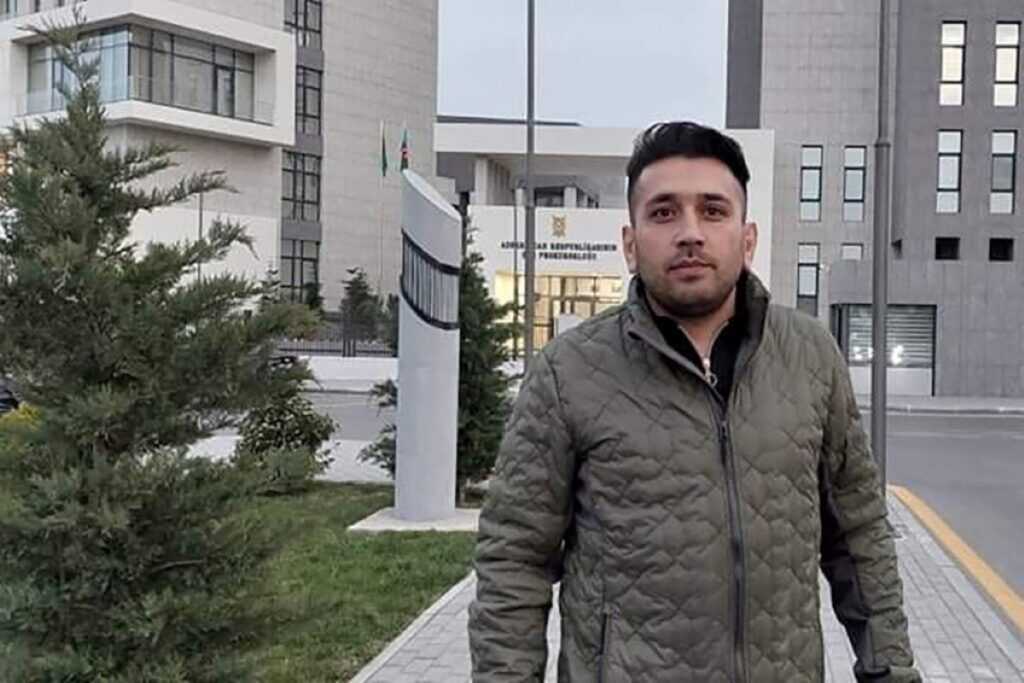
Political scientist and OC Media contributor Bahruz Samadov, who is serving a sentence of 15 years in prison on charges of treason at the Umbaki facility in the suburbs of Baku, reminds me of Stefan Zweig’s main character, Jacob Mendel, from his short story Buchmendel.
During WWI, Mendel, a Russian Jew born along the Russian–Polish border, resides in Vienna without any documentation, his life wholly consisting of books. When he is falsely accused of collaborating with enemies of the Austro-Hungarian Empire, he is sent to a concentration camp.
So detached from reality, he cannot understand when interrogated why he needs identification documents to prove who he is.
Whenever I read Bahruz’s comments and posts, the first thing I would ask is, ‘Is Bahruz in Azerbaijan?’.
Like Mendel, Bahruz had forgotten the realities of the 21st century, that his posts and comments were being monitored by the State Security Service — and this is why he was eventually summoned for questioning.
Like Mendel, Bahruz communicated with ‘enemies’, Armenian colleagues and journalists, sending them articles. Bahruz wrote openly about the Armenia–Azerbaijan conflict, sharing his opinion and harshly criticising the Azerbaijani government. Bahruz detached from reality and stepped across the border which President Ilham Aliyev believes should be his sole domain.
Starting from the Second Nagorno-Karabakh War in 2020, Aliyev has continuously claimed he was ready to sign a peace agreement. Yet even the initialling of such a document only took place five years after the end of that war.
And with all that time gone and peace now finally on the cards, what changed after the Washington agreement inside Azerbaijan? Effectively nothing.
As before, government critics are arrested for allegedly communicating with the Armenian State Security Service and imprisoned despite no evidence of such communications being provided in court.
And now there is a new narrative — that opposition figures are attempting to organise a coup d’etat against the government by collaborating with some forces in Russia.
A government can change public opinion with one click — this is all the easier when the main weapon in their hand is the media.
Today, Azerbaijan reminds me of a truck speeding through a gate unable to brake. At this point anything can spark this mechanism, triggering a new media wave — and this is just what happened with Azerbaijani Eurovision star Samira Efendi.
During the Silk Road Star competition in late November in Kazakhstan, Efendi gave an Armenian singer the highest score of 12 points. She also gave a small speech about peace before hugging the Armenian performer.
Yet despite Aliyev’s public proclamations of peace and friendly relations between nations, Efendi’s actions instead became a new tool for Azerbaijani pro-government media to cast criticism. Throughout it all, helping manipulate such topics, were the deceased soldiers’ mothers and wives, the families who are almost entirely forgotten within Azerbaijan until a conflict anniversary.
However, unlike others, Efendi has appeared to survive this pressure with aplomb — when asked to apologise to the mothers of those killed during the Armenia–Azerbaijan conflict, she responded that she was only following Aliyev’s initiative of peace. And who could speak out against that?
Yet, this is the exact same peace that was voiced by Bahruz at a time when everyone else was afraid to do so. A peace that took from Bahruz his very freedom.
Even in prison Bahruz worries the government. Because of that he was transferred from the prison to prison, each stricter than the one before it. As they limited his ability to communicate with his grandmother or to read books, he twice attempted suicide. He was saved at the last minute by his cellmate.
Transferring him to solitary confinement and prohibiting from reading effectively cuts him off from any contact with the outside world.
Our Mendel, in his last meeting with his grandmother, said that ‘without books, I would go crazy’.
Related Articles
OC Insider
Democracy is also about tolerance — something Pashinyan appears to lack

Public discourse in Armenia requires tolerance if democracy is to strengthen

OC Insider
The Iran war is raising hopes — and fears — among Azerbaijanis

The tensions between the republic of Azerbaijan and Iranian Azerbaijan are re-emerging in public discourse.
OC Insider
The Iran war has the potential to dramatically change the Caucasus

The Caucasus has once again found itself looking on with increasing concern as yet another war has erupted bordering our region. When I started writing this newsletter yesterday, it lead with this line — ‘So far, with the US–Israel war against Iran into its sixth day, there has been no direct spillover effects onto either the South or North Caucasus, besides a relatively modest (as of now) influx of refugees into Armenia and Azerbaijan’. Just one day later, this is no longer the case, as we wat