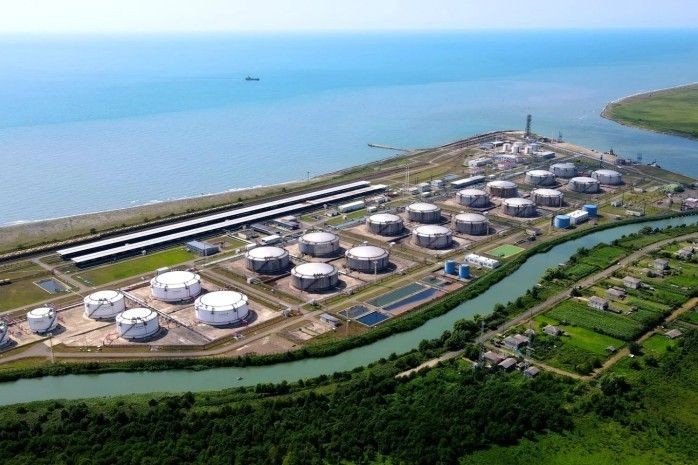
In a draft of the EU’s proposed 20th sanctions package against Russia, the Kulevi Oil Terminal on Georgia’s Black Sea coast owned by Azerbaijan’s state-run oil company SOCAR, has been included. RFE/RL reported that the measure still requires approval by EU member states before it can enter into force.
Over the past year, the EU has added a number of entities linked to Azerbaijan’s role in facilitating sanctions circumvention. The inclusion of Kulevi would mark a further step in that direction — this time including Georgian ties.
In late 2025, Reuters reported that Russia’s Russneft had delivered its first oil cargo to the Kulevi terminal. The shipment coincided with reports that Black Sea Petroleum — a relatively small Tbilisi-based company — had launched plans to expand the terminal’s capacity.
Black Sea Petroleum was founded in October 2022. In 2025, a Transparency International report stated that the company is owned by Maka Astiani, a former Georgian model, and Davit Potskhevria, the nephew of Astiani’s husband. Its supervisory board includes several former Georgian government ministers.
An investigation by the Russian outlet Proekt found that Astiani’s son is a business partner of Vladimir Alekseyev, a senior official in Russia’s GRU military intelligence service.
Funding for the terminal’s expansion has, according to Business Media, come from multiple sources, including a $5 million investment from the Georgian State Investment Fund and approximately $45 million in financing from three commercial banks: Cartu Bank, Basisbank, and Khaliqbank. Cartu Bank is part of a group of companies linked to Bidzina Ivanishvili, the billionaire founder of the ruling Georgian Dream party.
In November 2025, the Georgian opposition-leaning media outlet Formula TV said that it had seen confidential material from US authorities warning of the risk that the Kulevi terminal could be used to facilitate sanctions evasion, including through the re-labelling of oil in order to hide its origin.
EU sanctions hit Azerbaijan
OC Media has previously reported that the SOCAR’s STAR refinery in Turkey was added to sanctions lists following an inquiry to the European External Action Service (EEAS). Five Azerbaijani oil tankers were also included in the so-called ‘shadow fleet’.
Sources with insights in the EEAS told OC Media that Azerbaijan had unsuccessfully lobbied the EU to ease sanctions affecting its ability to act as an intermediary of Russian oil trade. The Azerbaijani side was particularly frustrated that similar sanctions did not hit Armenia.
On the eve of the EU’s Foreign Affair Council in December 2025, the Azerbaijani state media outlet AnewZ released a trailer for a documentary alleging that Armenia was assisting Russia in sanctions evasion.
An investigation by OC Media later found that Western experts — including former Lithuanian Foreign Minister Gabrielius Landsbergis — had participated in the production without being fully informed about its origin. Landsbergis told OC Media that ‘it was not [his] intention to participate in an Azerbaijani propaganda piece’.
The draft 20th sanctions package also includes OJSC Unibank, an Armenian subsidiary of a Russian bank. If adopted, it would be the first Armenian entity to be included in the EU sanctions. Previously, the US and UK have included VTB Bank.
 Rasmus Canbäck