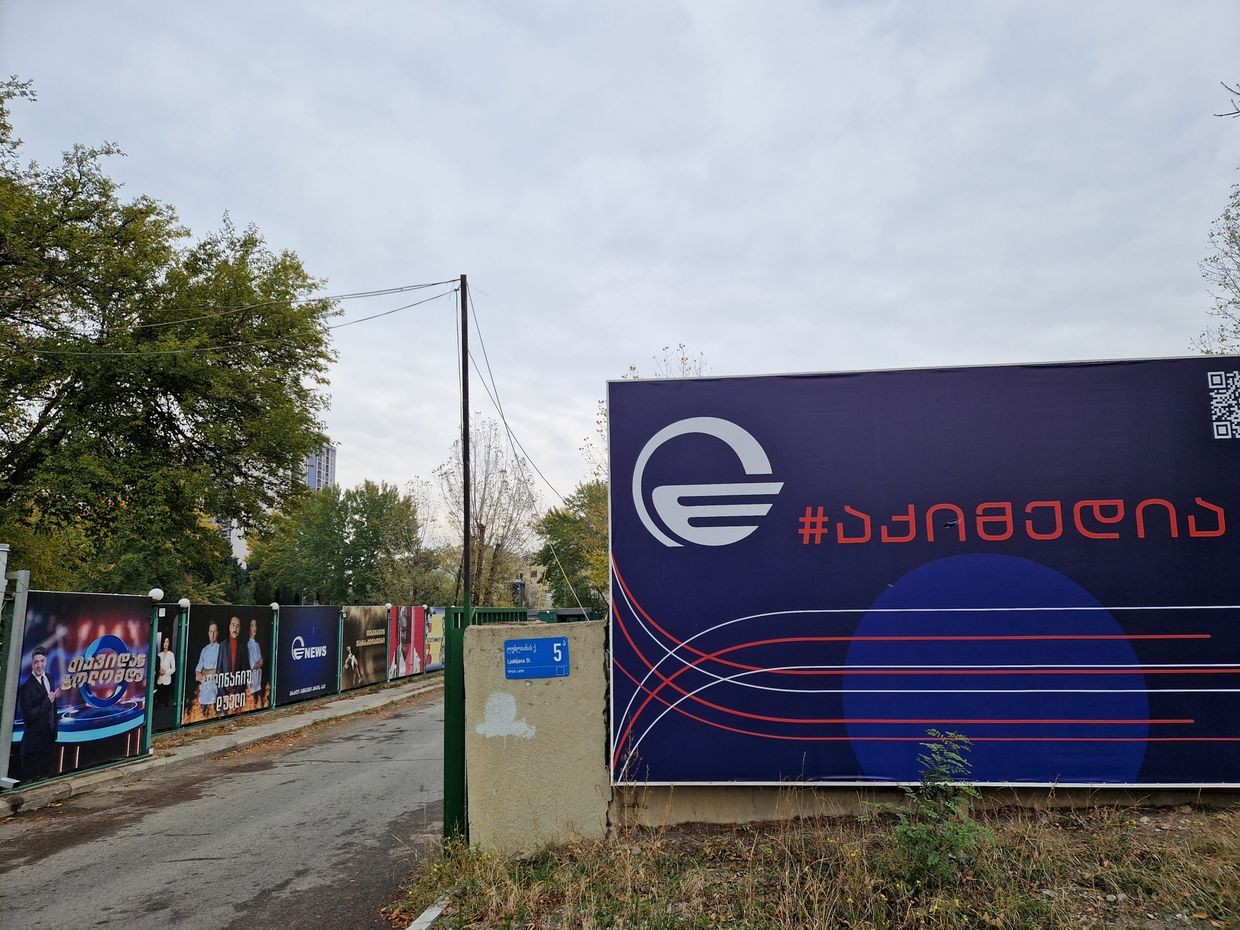
The major Georgian pro-government media outlet TV Imedi, which was recently targeted by UK sanctions, has revealed plans to establish its own bank. Announcing the decision, the channel mentioned concerns over the ‘potential risks’ Georgian financial institutions could face while cooperating with it.
In its Friday morning statement, Imedi dismissed what it called an ‘attack with cynical arguments and artificial hype’, claiming that it ‘will have no problems of any kind, including financial ones’.
‘We, the new founders of the Imedi holding, with the financial support of the channel’s loyal friends and sponsors, will establish our own bank, called Imedi Bank, in the shortest possible time’, said the channel, whose previous owner sold it for a symbolic price weeks before the sanctions, leading to the ownership changes.
The authors of the statement set the timeline for establishing the new bank at ‘just a few months’.
The UK issued sanctions against Imedi and another pro-government outlet POSTV on Tuesday, listing both as ‘entities involved in Russian disinformation’ and accusing them of spreading ‘deliberately misleading information’ concerning Russia’s full-scale invasion of Ukraine to its audiences.
The UK decision sparked active discussions in Georgia about its potential impact on pro-government TV channels, including whether Georgian banks and companies would continue cooperating with entities targeted by sanctions. Several observers highlighted the risks that third parties could face when working with organisations subjected to such measures.
In its Friday statement, Imedi added that following the sanctions, certain companies and organisations had expressed their readiness to continue providing financial support, and that several banks, ‘despite potential complications’, had shown willingness to provide ‘banking services to the channel’.
Imedi did not specify which entities, including banks, it meant, but noted that the channel does not want to ‘put them in the line of fire’.
‘We are fully aware of the potential risks to their business activities, whether from anti-PR campaigns, financial difficulties, or other challenges’, Imedi added, while concluding the statement by announcing the plans regarding its own bank without specifying details.
Under Georgian law, creating a commercial bank requires a license from the National Bank of Georgia, and no one may use the term ‘bank’ in their name without it — except in specific cases, including where it’s clear from context that the entity isn’t carrying out licensed banking activities.
Requirements include a supervisory capital of ₾50 million ($19 million) — which serves as a financial buffer to ensure the bank’s stability — along with an effective business plan. According to the National Bank of Georgia, there are currently 17 licensed commercial banks operating in the country.
Georgian law also recognises microbanks, which have a lower supervisory capital requirement of ₾10 million ($3.7 million).
No public statements from commercial banks
The UK imposed the same three set of sanctions on both entities — ‘asset freeze, trust services sanctions, director disqualification sanction’ — meaning that all assets or properties held by the companies in the UK will be frozen, it will become illegal for UK citizens to help create or manage trusts for the companies, and the individuals running the companies will be barred from running any other UK-based company.
Commercial banks in Georgia have not made public statements regarding the enforcement of the sanctions imposed on pro-government TV channels. However, two of the country’s largest banks, TBC and Bank of Georgia, are listed on the London Stock Exchange.
On Wednesday, the President of the National Bank of Georgia and former Minister of Economy, Natia Turnava, commented on the issue for the first time in a statement given to Imedi, which the channel published on its website overnight.
In Turnava’s words, ‘commercial banks operating in the country are legal entities established under Georgian legislation, whose activities are subject to the Constitution of Georgia and national laws’.
Criticism of the sanctions was voiced by both TV channels, with Imedi stating that ‘British sanctions have no value’, and ‘the only valuable assessment for Imedi TV is the trust of the Georgian people’. In its evening news broadcast, the channel further described the reasoning of the sanctions as ‘slander’ and ‘disinformation’.
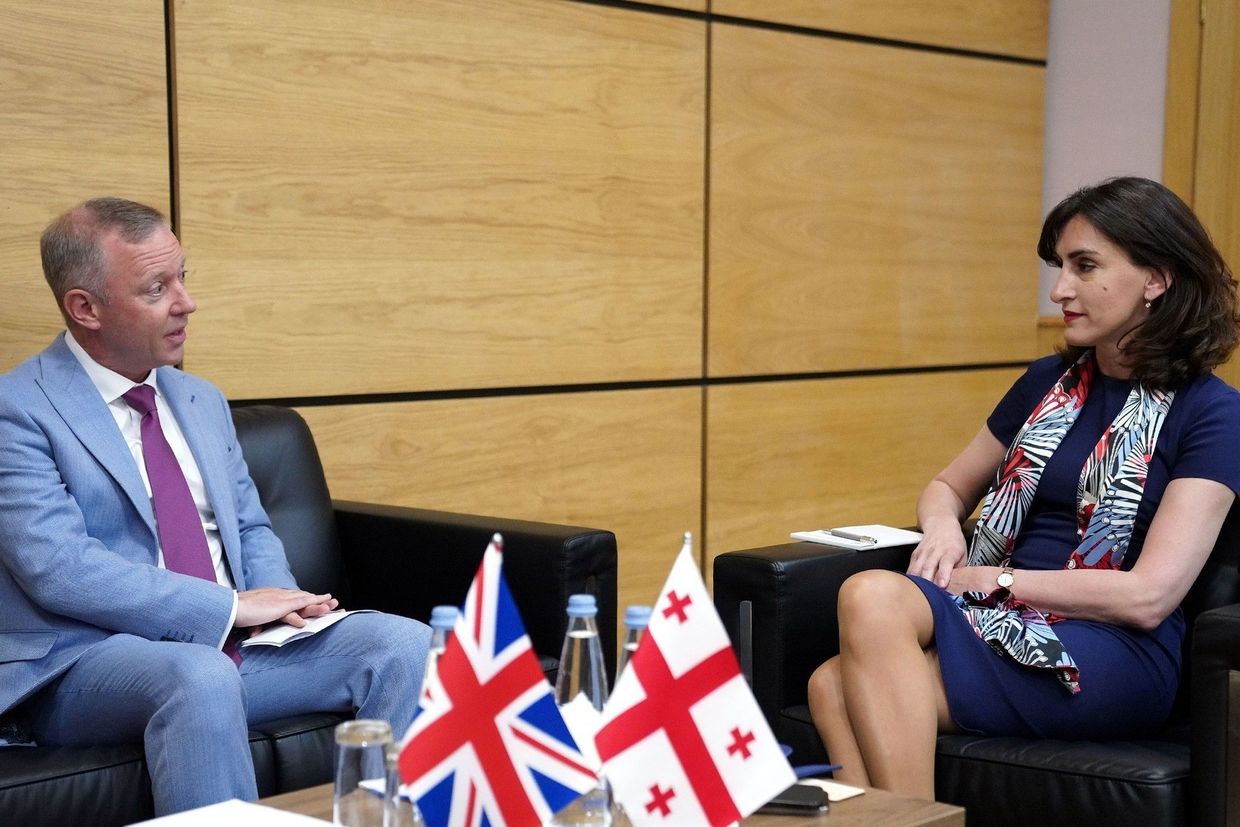
Shortly afterward, representatives of the Georgian government also condemned the UK over the sanctions. On Thursday, the Foreign Ministry summoned the British Ambassador in Georgia, Gareth Ward, and demanded explanations regarding the sanctions.
 Mikheil Gvadzabia