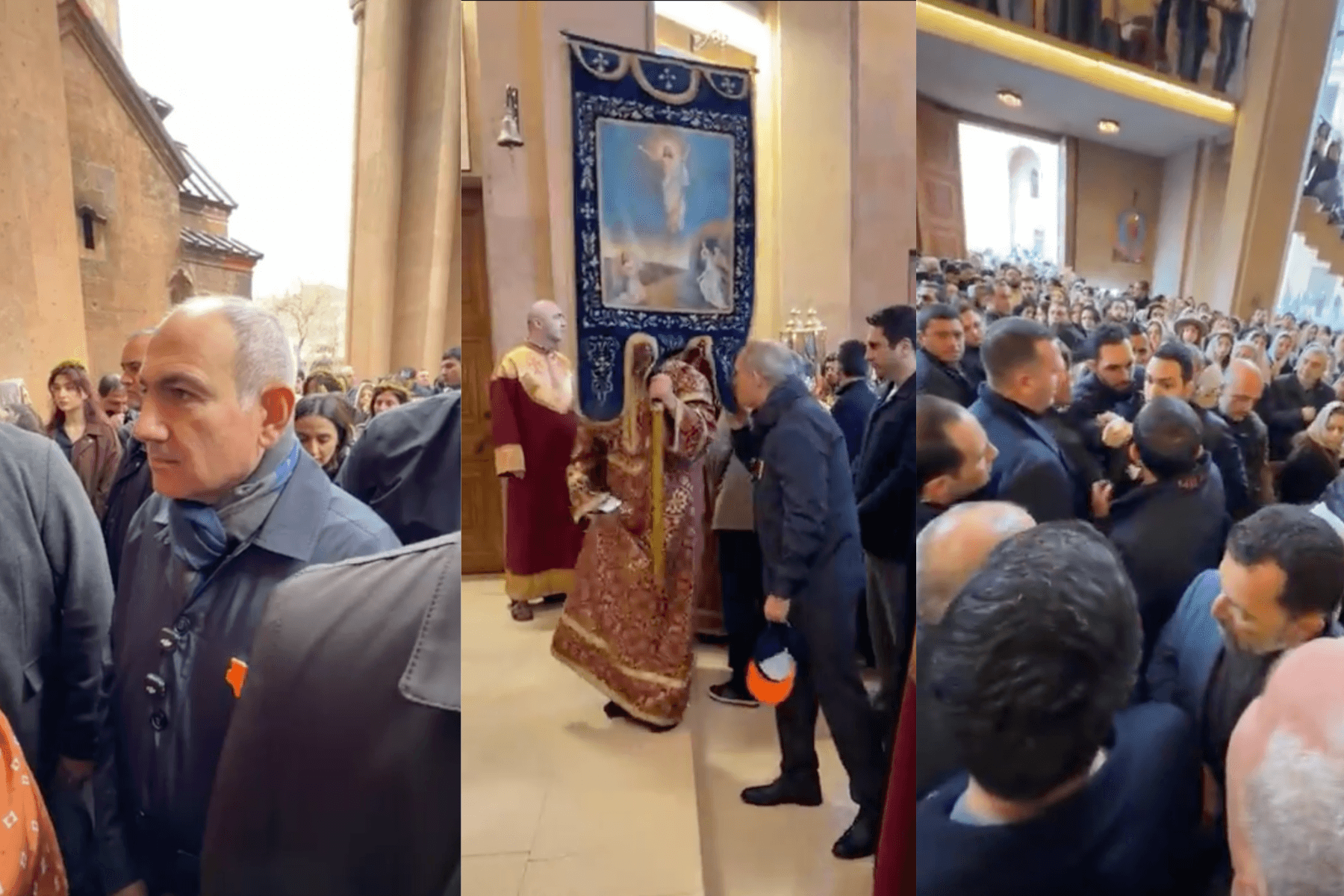
Three people have been arrested after a man attempted to hit Armenian Prime Minister Nikol Pashinyan as he was leaving a sermon at Yerevan’s St. Anna Church.
The three could face charges of hooliganism and interfering in the political activities of an official, the Investigative Committee told the media.
If charged and found guilty, the suspects could face up to five years in prison.
Pashinyan was at the church as part of his Civil Contract party’s pre-election campaign on Palm Sunday.
As he was leaving the church, Pashinyan’s guards cleared a path for him to reach the front row. Later, as the liturgy was still ongoing, he began leaving through the crowd, again with bodyguards pushing through the crowds.
Unhappy with being pushed aside, a young man was heard saying: ‘I want to stand in the middle’, before turning to Pashinyan and wagging his finger at him, saying, ‘don’t look at me like that’.
The same person then reportedly attempted to strike Pashinyan with his hand.
As tension grew, Pashinyan signalled his team to remain silent.
The media reported that two of those arrested were twin brothers, David and Mikael Minasyans, both 18-year-old high school students.
The third person to be arrested was opposition activist Gevorg Gevorgyan, who was seen staring at Pashinyan as he was leaving the church seconds before the incident.
Later, government-affiliated media circulated photos of him with former President Serzh Sargsyan, as well as Archbishop Bagrat Galstanyan, who in 2024 spearheaded a major opposition movement against border demarcation with Azerbaijan
 Arshaluys Barseghyan
Who was the provocateur?
The video of the incident went viral, drawing mixed reactions. Most people condemned the use of violence, while also interpreting Pashinyan’s visit differently.
‘They talk about God, kindness, the church, and traditions, but like a rabid dog they hit and hit from behind inside the church’, Parliamentary Speaker Alen Simonyan, who accompanied Pashinyan during the incident, wrote on Facebook.
On Monday, Pashinyan’s Chief of Staff, Arayik Harutyunyan, in turn accused Karekin II of turning the Church into ‘a sect of political rejects, who on holidays or during liturgies gather in churches and try not to allow people they dislike to enter the church, or try to provoke the situation.’
He insisted that the cult should be ‘rejected’ along with its leader, Catholicos Karekin II.
The tension between the Church and Pashinyan’s government has been steadily escalating since May 2025. As accusations against the Church, and specifically against Karekin II, continued to grow, Pashinyan gradually made clear that he was seeking to oust the Catholicos.
Arshaluys Barseghyan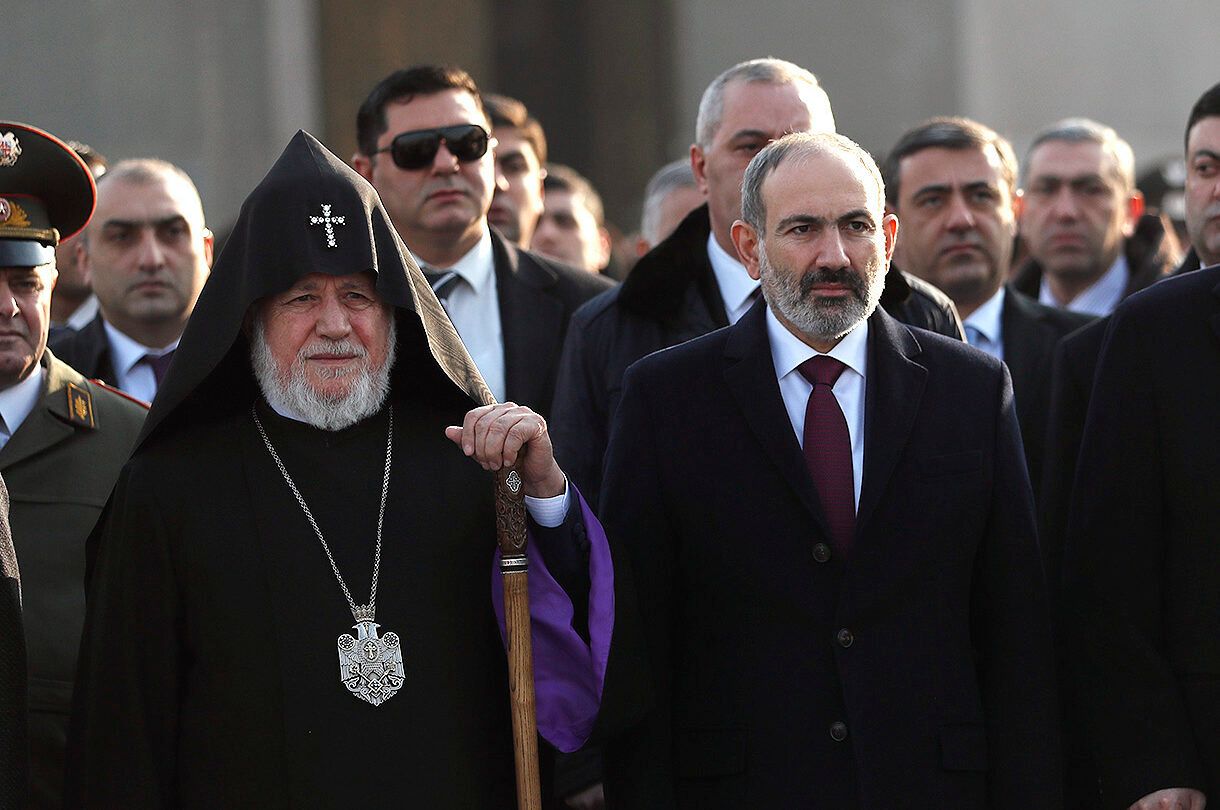
Political analyst Hakob Badalyan, however, had a different take on the incident.
In his analysis on Facebook, he described Pashinyan’s entry into the church as ‘provocative’ in a social media post, noting that he attended despite the church being crowded for Palm Sunday and was accompanied by a large group of people. He added that the bodyguards’ actions caused discomfort to other attendees.
‘It’s natural that the reactions of those present there could already be very different. Did Nikol Pashinyan have any calculation to “get” an incident? I don’t know. I have long noted that Pashinyan does not take any step without calculation. Another question is what the motive behind that calculation is’, Badalyan wrote.
Similarly, government critic Hakob Karapetyan, who was attacked by a masked individual in Yerevan in September 2025, called Pashinyan ‘an ordinary provocateur’, noting that he entered the church while it was crowded, knowing his presence would not be ‘perceived positively’.
‘Either Pashinyan has lost his sense of reality and believes that at the Catholicos’ seat in the cathedral in Yerevan he should be welcomed with ovations, or, with deliberate cynicism, fully aware that his presence would upset the faithful, he provoked today’s incident’, Karapetyan concluded.
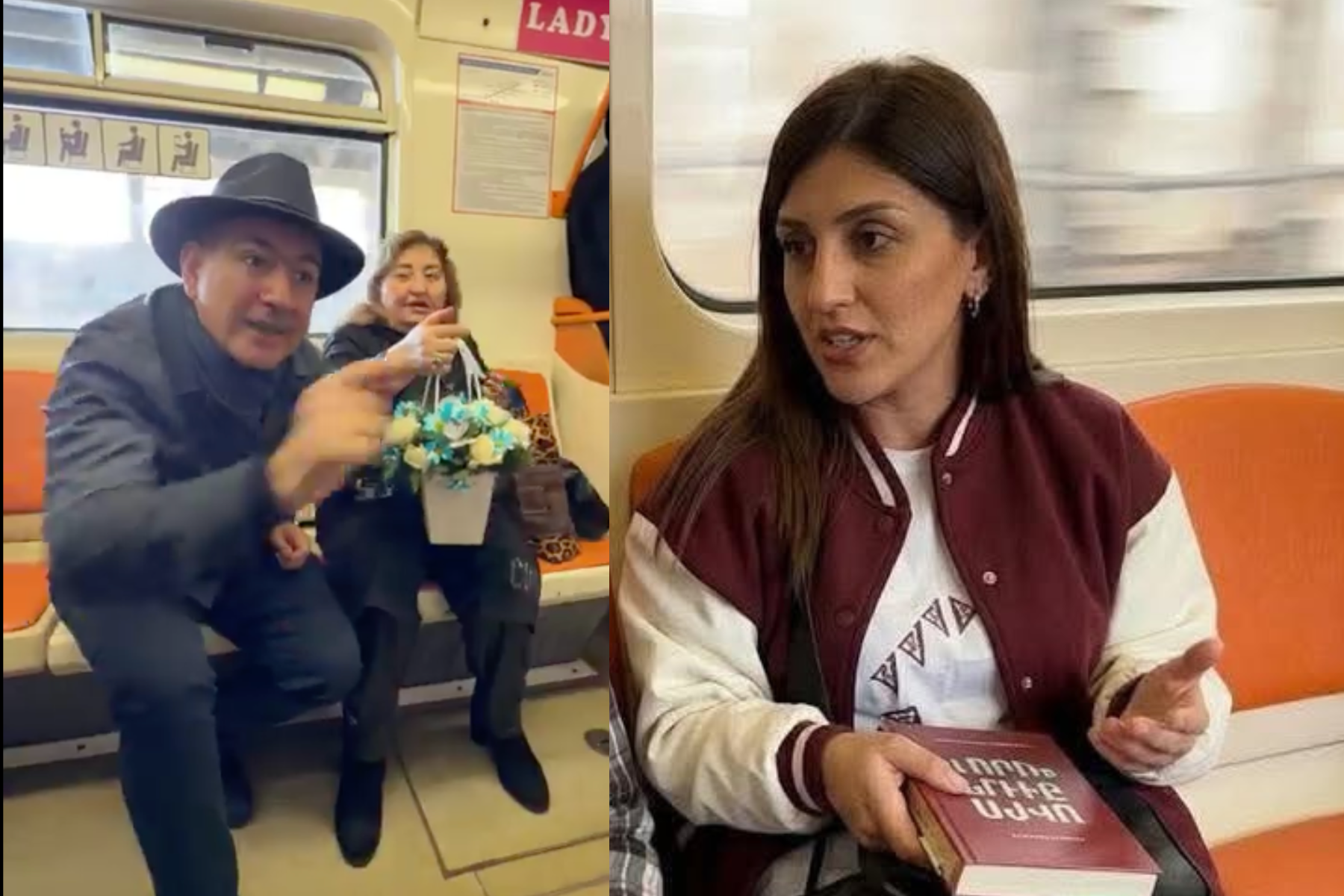
Earlier in March, while on the campaign trail in Yerevan, Pashinyan was met with backlash after calling Nagorno-Karabakh Armenians ‘runaways’ in a heated argument with a refugee on the metro. After initially denying that he had used the insult, he later apologised the same evening.
Arshaluys Barseghyan