Baku hosts Azerbaijan–Georgia Media Forum, bringing pro-government figures from both countries

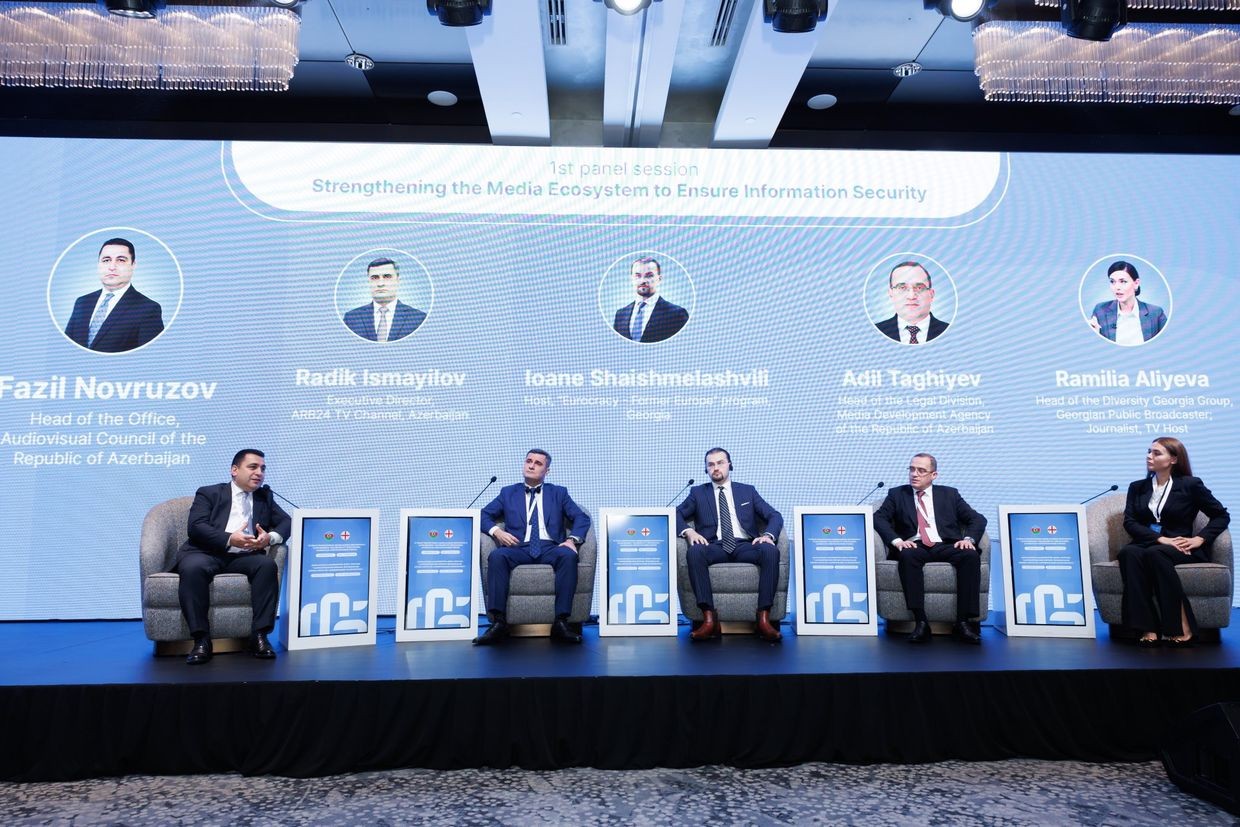
The Azerbaijan–Georgia Media Forum was held in Baku on 5 December, bringing together a mixture of pro-government media figures and academics from both countries. Throughout the forum, Georgian and Azerbaijani individuals pledged further cooperation between the two countries, criticised the spread of so-called fake news about the region, and called for increased media literacy.
The forum was organised by Azerbaijan’s Media Development Agency, with more than 40 people from both countries participating. Although there were some academics, there were no representatives of independent media outlets from either Georgia or Azerbaijan.
Georgian participants largely hewed to the pro-government line, with several individuals referencing the recent BBC investigation that alleged Georgian police had sprayed a WWI-era chemical substance, camite, on protesters in December 2024.
Gia Abashidze, from the prominent pro-government media outlet POSTV, said the investigation was representative of the spread of ‘hybrid attacks and fake news’ against Georgia.
‘To defend against such hybrid attacks, cooperation and exchange of experience between media institutions, politicians, and experts of both countries are essential’, Abashidze said.
Ioane Shaishmelashvili, host of the Eucrocracy–Former Europe show on POSTV, also mentioned the BBC’s investigation, calling it ‘absurd’ and a ‘subject of ridicule’.
Shaishmelashvili also accused the BBC of spreading misinformation about Azerbaijan.
Separately, he described APA, one of the leading pro-government media outlets in Azerbaijan, as trustworthy, adding that media plays an important role in fostering bonds between Georgia and Azerbaijan.
‘It is very important that there are either laws or some regulations so that everyone knows: if we are no longer talking about the personal interpretation of a journalist or host, but about negative information aimed at escalating the situation within the country or between Georgia and Azerbaijan, there should be certain rules here’, Shaishmelashvili said.
The forum came as both countries have increased their respective crackdowns on independent media outlets, with Azerbaijan in particular being singled out as being one of the most egregious offenders in the assault on media freedom.
In November, Reporters Without Borders (RSF) named Azerbaijani President Ilham Aliyev one of 34 ‘press freedom predators’ for his role in repressing press freedom within Azerbaijan.
‘Under Ilham Aliyev’s presidency, Azerbaijan has become a media wasteland. All critical voices are silenced, independent media outlets have been shut down or placed under state control, and the 2022 media law has institutionalised censorship’, the RSF wrote.
Since late 2023, dozens of independent Azerbaijani journalists have been arrested, often on charges of smuggling.
At the same time, Azerbaijan has revoked the accreditation of numerous international media outlets, including Voice of America, Bloomberg, and the BBC, the latter of which also had its offices shut down.
The RSF report also labelled Georgian Dream’s billionaire founder Bidzina Ivanishvili as a ‘press freedom predator’, stressing that he ‘continues to be the centre around which power gravitates in Georgia despite his official withdrawal from political life’.
‘His business empire guarantees him decisive influence, with several commercial TV channels, including Imedi TV and Rustavi 2, broadcasting views in favour of Georgian Dream, the party he founded’, the RSF wrote.
They cited declining pluralism in Georgia under his influence and the government’s vilification and persecution of journalists, in addition to violent attacks carried out against media representatives ‘with impunity’.
They additionally cited Georgia’s two-year sentencing of media manager Mzia Amaghlobeli and its sabotaging of Georgia’s EU accession by failing to respect press freedom.
Georgia ranked 114th on the 2025 RSF Press Freedom Index, while Azerbaijan ranked 167th out of 180.
 Arshaluys Barseghyan
This article was translated into Russian and republished by our partner SOVA.