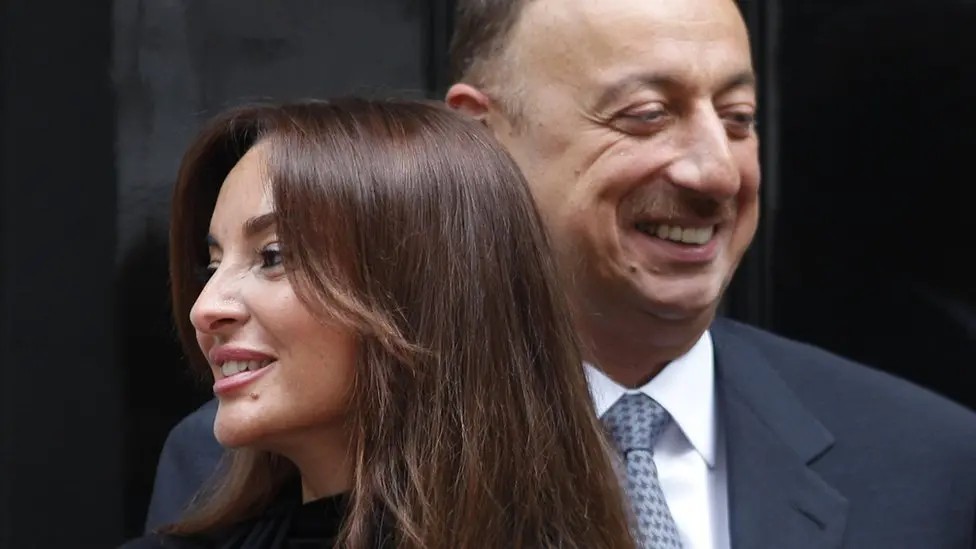
On 15 February, Azerbaijani Vice President and First Lady Mehriban Aliyeva made headlines when she decided to respond to a government critic at the Munich Security Conference.
When approached by Emin Huseynov, who asked about the democracy situation in the country, Aliyeva responded:
‘You are the person who wore a woman’s dress to hide in a foreign embassy’.
She deflected a question about the state of human rights and freedom of expression in her country with a personal insult, mocking Huseynov by alluding to and distorting how he tried to survive the government’s crackdown on civil society in July 2014.
Azerbaijani pro-government media and President Ilham Aliyev try their best to whitewash the state of democracy in the country, claiming that rights are guaranteed to all Azerbaijanis. Aliyev also repeatedly claims that Azerbaijan, as a conservative country, respects the elderly, women, and children.
However, when it comes to dealing with his critics, these values are thrown out the window, and his regime weaponises people’s personal lives against them, as well as ridicules and humiliates women.
Imagine returning home from work, turning on the TV to relax, and suddenly seeing an intimate video, slightly blurry, featuring the editor of the opposition newspaper Azadliq, Azar Ahmadov. Or imagine opening a newspaper and seeing intimate photos of Azadliq editor-in-chief Ganimat Zaidov.
These are both real examples of how the Aliyev regime uses intimate footage, most usually sex tapes, as a weapon to silence critics, journalists, and civil society members.
The footage does not have to feature the person targeted — instead, the regime often targets close relatives.
For example, famous Azerbaijani historian and government critic Jamil Hasanli was forced to issue a statement after his daughter’s intimate video was leaked in 2021.
‘My daughter is 38 years old and she can decide what to do with her life, she is independent’.
In 2013, prominent investigative journalist Khadija Ismail was blackmailed with an intimate video. The footage was then sent to her brother’s house, seemingly to encourage an episode of domestic violence that would allow pro-government media to write that Ismail was killed due to her ‘immoral’ lifestyle. Indeed, after viewing the footage, Ismail’s brother attacked her, and it was only due to intervention from their mother and a friend that Ismail survived.
Almost a decade later, in 2021, feminist activists Gulnara Mehdiyeva, Narmin Shahmarzada, and Vafa Naghi, among others, had their devices hacked, after which information was shared about their private life.
Yet even more recently, blogger and government critic Mehman Huseynov, Emin Huseynov’s brother, who is also currently living in exile, published a story alleging that Aliyev’s daughter-in-law was an escort. Soon, the story was circulating on social media — the government did not know how to react.
This last example demonstrates that Aliyev has taught Azerbaijani society that it is now acceptable to resort to measures like these to maintain power, no matter the outcome or the price.
Azerbaijan’s society, which has been under Aliyev’s rule for over three decades, is now starting to resemble it. And now it is unfortunately the time to reap the results of these tactics.