An International Monetary Fund (IMF) mission has concluded that Georgia’s economic performance will remain strong throughout 2026 at 5%, supported by prudent macroeconomic management and policies. It stressed, however, that war in Iran could hamper this growth through its impact on tourism and energy.
The IMF mission led by Alejandro Hajdenberg visited Georgia from 25 March to 7 April for Article IV consultations — mandatory, regular consultations carried out by the organisation in member countries.
The institution praised the country’s economic performance, but warned that rising geopolitical risks — particularly the Iran war — could affect the outlook. It concluded that Georgia’s economy is expected to continue growing at a solid if the conflict is short-lived, but more moderately than it has in recent years.
The IMF also noted that headline inflation has risen above target because of higher food and energy prices, but core inflation remains contained. The current account deficit has narrowed, international reserves have reached a historic high, fiscal discipline has been maintained, and public debt remains low.
According to the IMF, Georgia is better prepared than before to absorb external shocks because of strong macroeconomic fundamentals and policy buffers. It stressed that preserving macro-financial stability and accelerating structural reforms will be essential to sustain growth and create jobs.
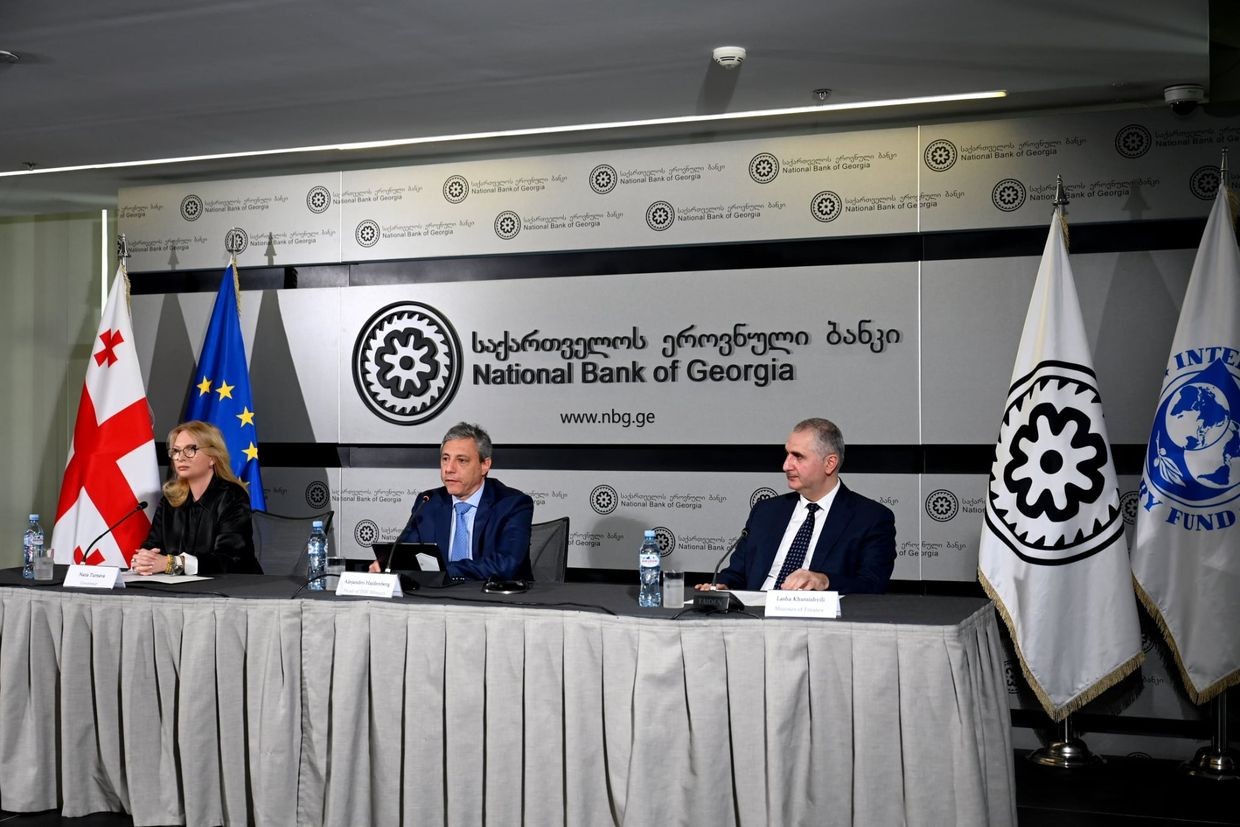
At a concluding briefing in Tbilisi, along with National Bank Governor Natia Turnava and Finance Minister Lasha Khutsishvili, IMF mission chief Hajdenberg said that preliminary estimates show real GDP growth reached 8.4% in January–February, up from 7.5% in 2025. Growth was driven by the tech industry, transport, and education services, while private consumption remained the main demand-side driver, supported by wage growth and consumer lending. So far, the war’s economic impact has primarily affected tourism.
Assuming no prolonged regional escalations occur as a result of the conflict, the IMF projects Georgia’s economy will grow by 5.3% this year and stabilise around 5% over the medium term.
Inflationary pressures increased after the conflict began, with consumer inflation rising from 4% at the end of 2025 to 4.3% in March, reflecting higher imported food and oil prices, partly linked to the war. However, core inflation remains below the National Bank’s 3% target. Inflation is expected to stay elevated during the first half of 2026 because of higher fuel and electricity prices before easing toward target by mid-2027.
The external position has improved, although it remains vulnerable to energy price volatility and tourism revenues. The current account deficit narrowed to 2.6% of the GDP in 2025, supported by strong services exports, lower energy import costs, and resilient remittances. Gross international reserves reached a historic high and exceeded the IMF’s reserve adequacy threshold for the first time since 2022, supported by foreign currency purchases, deposit de-dollarisation, and gains in reserve asset values. The current account deficit is projected to widen to 5% of GDP this year because of higher oil prices and lower tourism income.
Fiscal indicators also remain strong, as the 2025 fiscal deficit came in below target because of stronger revenues and slower capital spending, while public debt remains below 35% of GDP. The 2026 budget targets a deficit of 2.5% of GDP, with capital spending expected to recover. The successful refinancing of a $500 million Eurobond in January reflected investor confidence in Georgia’s macroeconomic credibility.
Finance Minister Khutsishvili stressed that Georgia was ‘one of the fastest-growing economies in the world, and this is naturally attractive to every investor’.
He added that the successful Eurobond placement clearly demonstrates investor trust in the country.
National Bank Governor Turnava said the regulator remains in wait-and-see mode but is prepared to tighten monetary policy if inflation risks intensify. She noted that inflation averaged only 1.1% during 2023–2024, well below target, and although inflation exceeded target in 2025 due to low base effects and temporary factors, the expectation had been for it to decline gradually after autumn 2025. She said events had so far developed in line with those forecasts.
Turnava emphasised that new risks linked to the Middle East conflict, possible disruptions in the Strait of Hormuz and oil market uncertainty require close monitoring. According to her, March inflation at 4.3% still reflects only limited impact from the shock, while core inflation remains at 2.4%, below target, showing that inflation expectations are still well-managed.
She said the National Bank has already conducted internal stress scenarios based on different oil price assumptions and remains ready to tighten policy if necessary. Georgia’s policy rate currently stands at 8%, one percentage point above neutral, and although the bank had hoped to normalise rates gradually, uncertainty now requires caution. Turnava said that the National Bank had built a reputation for reacting faster than many peers during recent shocks and will continue doing so if needed.
The IMF also underlined that governance reform at the National Bank remains important. Most recommendations from the 2022 safeguards assessment have already been implemented, but further progress is needed in strengthening board oversight, clarifying executive responsibilities, and improving decision-making procedures.
Looking ahead, the IMF said risks remain tied largely to external developments, including possible escalation in the Middle East, weaker tourism from Israel and Gulf countries, higher inflation and tighter financial conditions. At the same time, Georgia could benefit from redirected trade, tourism, and financial flows, as well as stronger transit through the Middle Corridor.
The fund also stressed that banking sector stability remains solid, but authorities should continue monitoring fast-growing lending, foreign currency exposure, real estate financing, and digital asset activity.
To sustain long-term growth, the IMF said Georgia must continue addressing high structural unemployment — especially among youth — through vocational education, labour market reforms, and stronger support for high-productivity sectors. Investment in energy, transport, and logistics infrastructure, together with anti-corruption reforms and a predictable business environment, will remain critical for preserving investor confidence and strengthening Georgia’s role as a regional trade and transit hub.
The press conference also addressed sensitive issues including sanctions, energy-related court cases, the planned state-led bank, and corruption. On the proposed Development Bank of Georgia, the IMF noted that details remain undecided, but stressed that if created, it must follow strong governance standards to improve financing for SMEs and farmers while ensuring transparency and avoiding fiscal risks.
 Helena Bedwell