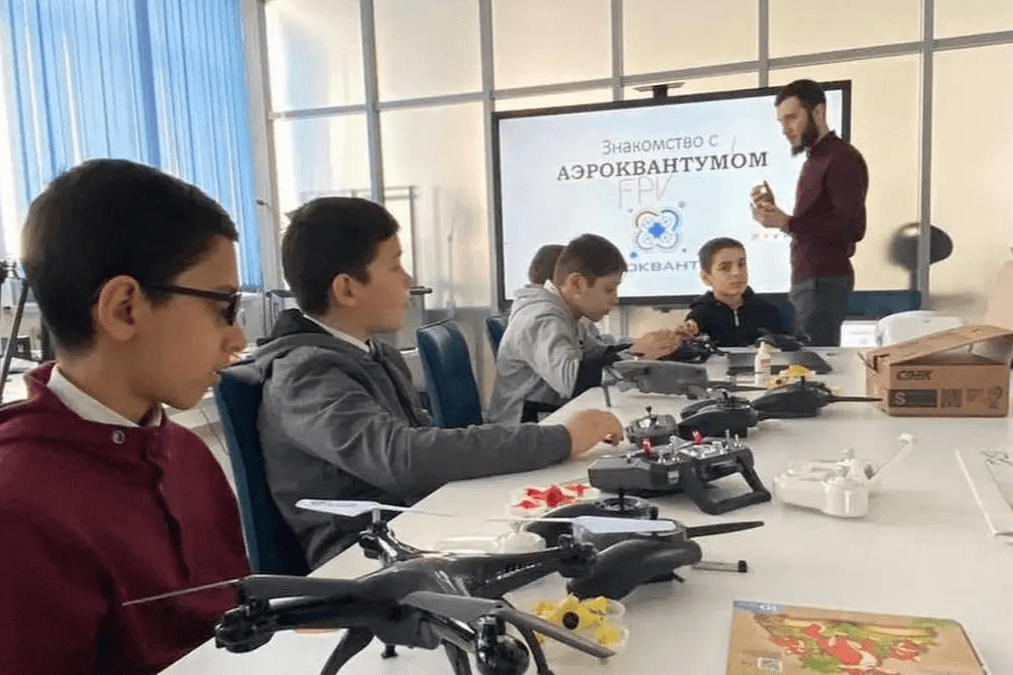
In Ingushetia, classes teaching schoolchildren how to work with drones have begun for the first time in schools. While the authorities have not explicitly said that schoolchildren were being taught to operate military drones, the initiative comes as Russia has begun implementing courses teaching ‘security and defence of the Motherland’.
Citing Ingushetia’s Youth Affairs Committee, Russian news agency Interfax reported on Monday that the courses were intended for pupils in years 7–11 and will run until 9 May.
Classes are being held at the Kvantorium children’s technopark in Magas, as well as at a multidisciplinary lyceum and a secondary school in the village of Ali-Yurt in the Nazran district.
A representative of the Committee for Youth Affairs of Ingushetia said the training programme includes both theoretical and practical modules. As part of the course, pupils are taught about the basics and types of unmanned aerial vehicles, as well as their design and applications. The practical component focuses on developing drone piloting skills. Separate sessions on working with FPV drones are planned for the most successful participants.
The programme also includes meetings with veterans of the ‘special military operation’ — the term used by the Russian authorities to refer to their full-scale invasion of Ukraine. The final stage of the training will be a competition, after which outstanding participants will receive awards.
The Committee for Youth Affairs said the main aim of the project is to develop pupils’ technical skills, foster interest in modern technology and digital professions, and support youth initiatives in engineering and aerospace education. According to committee representatives, the training is also intended to create conditions for meaningful and constructive leisure activities for teenagers.
The educational programme is being carried out with the support of the Ministry for External Relations, National Policy, Press, and Information of Ingushetia, as well as the Presidential Grants Foundation.
The Committee for Youth Affairs believes that the launch of such courses will expand opportunities for young people in the region and improve practical skills in the field of modern technologies. Representatives of the agency also claim that such initiatives may contribute to early career guidance for schoolchildren.
At the same time, state-run news agency RIA Novosti reported on Wednesday that a new school subject, the Fundamentals of Security and Defence of the Motherland, is being introduced in schools.
As part of the programme, children will also be taught how to assemble and operate drones. Training kits for working with UAVs have been included in an expanded list of teaching equipment for school classrooms approved by the Russian government.
The updated list includes educational and methodological kits on drones, sets for drone development and assembly, hardware and software complexes for piloting training, drone construction kits, as well as software for drone racing. A basic educational UAV kit is also provided for learning the fundamentals of block-based programming and control via a remote controller or smartphone.
In addition to drone-related equipment, the supplementary list contains more than 50 items, including electronic and pneumatic shooting ranges, elements of obstacle courses, night-vision devices, radios, mountaineering equipment, and water rescue gear.
The mandatory list of teaching equipment also includes mock-ups of Kalashnikov assault rifles and Makarov pistols, dummy grenades, first aid supplies, gas masks, and general-purpose protective kits. In total, the two lists contain nearly 90 items of ‘educational’ equipment.
Officials from the republic have previously reported that Ingushetia is set to open its first research and production centre for unmanned aviation systems,which will operate out of Serdalo Technopark.
The production of unmanned aerial vehicles of various types has increased in Russia since the full-scale invasion of Ukraine. UAVs are widely used by both sides of the conflict. By spring 2025, the Russian army was receiving around 4,000 drones per day on the front line.
 Elizaveta Chukharova