

Somewhere in Yerevan, people arrive quietly to a nondescript building, often looking over their shoulders before stepping inside. Some are there for trauma counselling after being kicked out of their homes. Others have survived online discrimination. A few are still minors, trying to run away from violence both outside and inside their families. Many simply want a peaceful place where they can meet friends, where they are not told they ‘should not exist’.
For nearly 18 years, the human rights NGO Pink, more widely known as Pink Armenia, has been that place for many people. Founded in 2007, the organisation has grown into one of Armenia’s central providers of support, advocacy, and evidence for lesbian, gay, bisexual, transgender and queer (LGBTQ+) people.
Pink Armenia’s governance
Karine Aghajanyan, the organisation’s chairperson, says her relationship with Pink Armenia began long before she took on a leadership role.
‘I started as a volunteer and a beneficiary myself back in 2011. At that time, it was very hard to find safe spaces where community members could hang out, feel comfortable, and meet friends’, she says.
By 2019, she had joined the staff full-time. Today, she leads the organisation whose services include everything from legal, psychological and social workers’ counselings to research, strategic litigations and policy advocacy.
Pink Armenia’s evolution mirrors Armenia’s shifting public conversations around sexuality.
‘Back then, people would say, ‘there are no LGBT people in Armenia’, it is something that doesn’t exist in Armenia and is something foreign brought from the West’, Aghajanyan says. ‘Now, the narrative is: There are LGBT people, but there shouldn’t be.’ Pink Armenia’s work, she argues, focuses on moving that narrative toward something more sustainable: acceptance, knowledge, and safety.
Over the years, Pink has produced a consistent body of evidence documenting human rights violations. In its 2012 shadow report to the UN Human Rights Committee, titled “Human Rights Violations of LGBT People in Armenia,” the organisation outlined patterns of state inaction, discrimination, and violence. Pink has been publishing annual reports on LGBT human rights violations since, and more recently, its annual human rights situation reports, such as the 2023 report (published 2024) and the 2024 annual review (published 2025), document hundreds of cases involving hate speech, domestic violence, police inaction, and discrimination in employment, housing, and healthcare.
Part of advocacy efforts of Pink Armenia are strategic litigation cases. In 2017, the organisation filed a legal complaint after Yerevan Municipality removed and destroyed Pink’s public-awareness posters promoting tolerance and this case is described in Pink’s 2018 Annual Report.
Its policy work is equally extensive. Pink contributed to the 2016 strategy ‘Realising the Human Rights of LGBT People in Armenia’, a multi-stakeholder document outlining concrete steps to combat homophobia and transphobia at a national level. Over the years, Pink’s staff have reviewed numerous government policies, including national human rights action plans and draft anti-discrimination legislation, offering expert feedback where proposed laws left LGBTQ+ people vulnerable.
The organisation also produces guidelines designed to improve interactions between professionals and LGBTQ+ people, such as its 2024–2025 publications on supporting LGBT+ refugees. Pink also produced a guide designed for helping professionals, such as psychiatrists, sexologists, psychologists, social workers and other related fields, and updated it to match current research body, and "Peculiarities of working with parents of LGBT people": a guide for psychologists, social workers, and peer counsellors, and both documents are available in Armenian on Pink’s website’s library section along with other interesting publications. These reflect Pink’s efforts not only to assist individuals directly, but also to shape professional practice across Armenia and empower and sensitize professionals working and providing services to LGBT+ community.
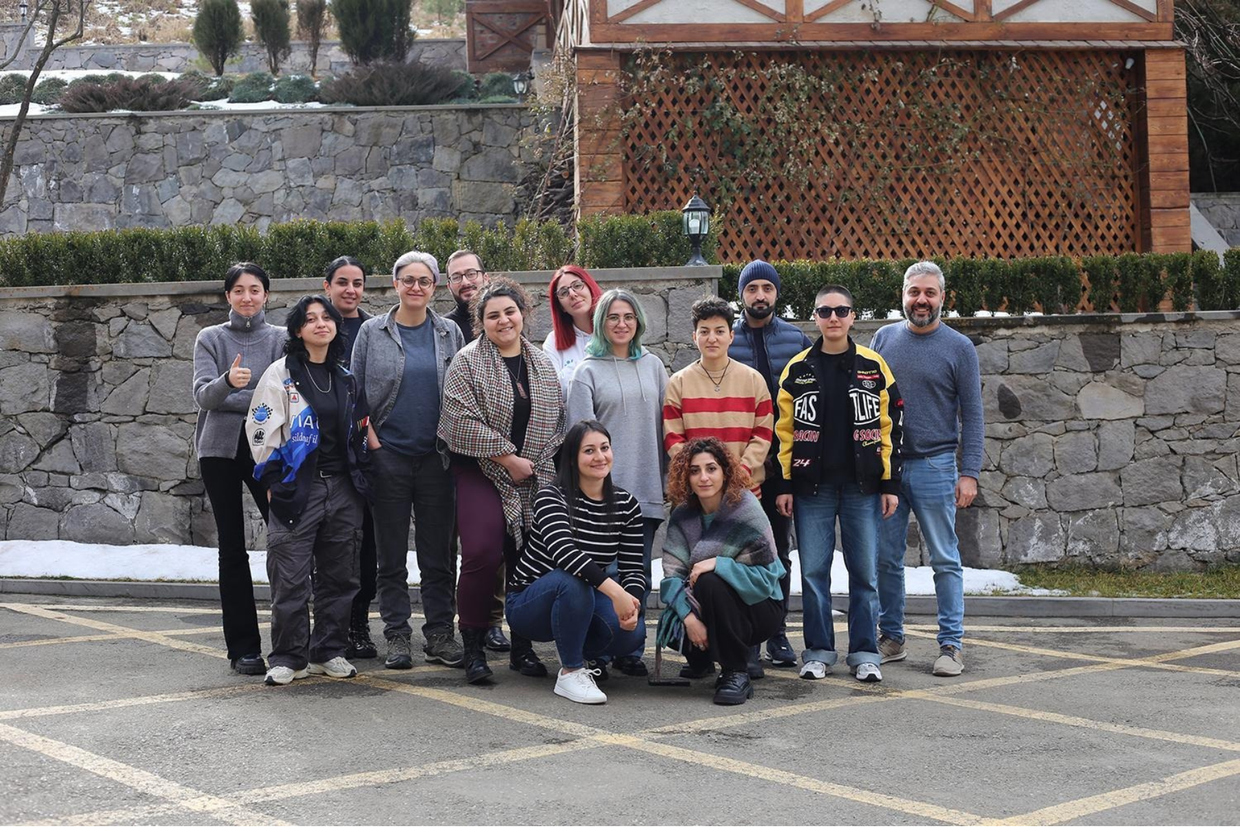
For Lilit Avetisyan, the organisation’s project manager, Pink Armenia’s purpose is both practical and deeply personal.
‘Pink is a space where you are not alone, and all the other members share this and other common values. When something happens, you are not alone as a community member’, she says.
Avetisyan’s background in psychology shaped her role. After hearing repeated stories of conversion therapy, she shifted toward broader activism: ‘I decided I should be involved more in the organisation and use resources to address these issues’.
Pink Armenia’s governance structure is a core element of the organisation’s resilience. Pink has 12 Members in its General Assembly now who have academic and working backgrounds in human rights, women’s rights, LGBT activism, sociology, humanities, performance art and others. The organization also has a Board consisting of five individuals chosen by and within Pink’s General Assembly. The organisation is led by a Chairperson who is elected by the Board and approved by the General Assembly. Also, anyone from the staff members can be elected as a Chairperson. No staff member is in General Assembly or is a Member of Pink.
‘We don’t have this rigid thing where the founder of the NGO stays the leader of the NGO forever’, Aghajanyan says. ‘We have constantly changing leadership. Each person brings their own style and vision of leading the organization and it is amazing. This diversity of perspectives helps us stay adaptable and responsive to new challenges’.
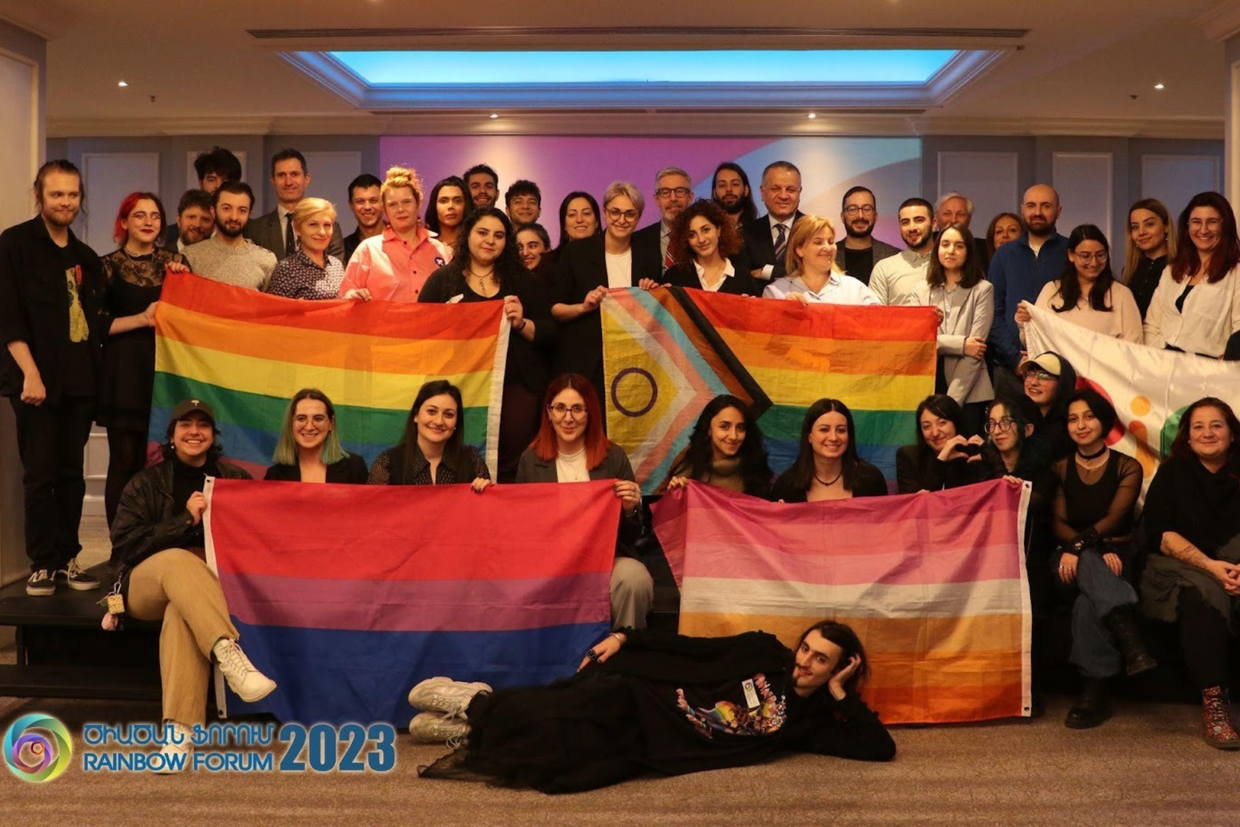
Pink Armenia does not work alone. The organisation is part of a broad human rights defender ecosystem that includes Socioscope, Real World Real People, the Women’s Resource Centre (WRC), and the Human Rights House Yerevan.
These partnerships began early, with the Advocacy and Research Group on AIDS, which brought LGBTQ+ activists, feminist groups, and HIV+ rights defenders together.
According to WRC, such organisations recognised early on that gender, sexuality, and health rights were deeply interconnected.
‘Only a rights-based, intersectional approach could bring change’ they say.
The partnerships had tangible results. Together with several other organisations, Pink co-founded the Coalition to Stop Violence Against Women, helped establish Human Rights House Yerevan, a protection and solidarity hub, and launched Armenia’s first public AIDS awareness march.
Building on this activism, the network also invested in research to support evidence-based advocacy. One key partner is Socioscope, a research organisation founded by three women sociologists in 2008. Its researchers see their role as translating raw data into policy.
‘We develop policy briefs, evidence-based recommendations, and hold closed meetings with decision-makers,’ Socioscope notes.
Together with Pink Armenia, Socioscope launched an extensive research project on Sexuality in Armenian [Con]texts. The research traced how sexuality has been understood historically, countering claims that LGBTQ+ identities are ‘foreign imports’.
‘Our study shows these issues have deep roots and have been publicly debated throughout Armenian history’, Socioscope says.
Responding to domestic violence
Pink Armenia’s work with partner organisations and their joint research underscores the extent to which many LGBTQ+ people require support, particularly those experiencing violence at home. The organisation’s monitoring shows that domestic, or family-based, violence is one of the most common forms of abuse against LGBTQ+ people.
In its 2024 annual reporting, Pink Armenia documented 65 rights violations — 38 of which occurred within families. Many involved minors.
‘When survivors are under 18, the abuser is often a parent. Legally, you need a guardian’s consent to intervene. So some young people wait to turn 18 just to leave home. Until then, we cannot safely remove them’, Avetisyan says, noting the difficulties in providing support.
For adults, Pink offers a package of services that includes social work support, peer-to-peer counselling, legal counselling, and psychological support. Each year, the organisation provides around 250 social work counselling sessions, 200 legal counselling sessions, 1,000 psychological counselling sessions, and 60 peer-to-peer counselling sessions, reaching approximately 2,500 beneficiaries annually.
Pink Armenia’s psychologists, Aghajanyan notes, are trained specifically in trauma and LGBTQ+ mental health.
‘We have the most LGBT+ sensitive and experienced trauma-trained psychologists in Armenia,’ she says.
Although Armenia adopted a domestic violence law [The law on the Prevention of Domestic Violence, Protection of Persons Subjected to Domestic Violence and Restoration of Solidarity in the Family] in 2017, the Women’s Resource Centre (WRC), which is one of Pink Armenia’s long-time partners, says implementation still excludes queer people in practice.
‘When LGBTQ+ survivors are excluded, it reinforces a hierarchy of whose safety matters’, the WRC says. ‘From a feminist perspective, any system that fails one group of women or gender minorities, it fails all’.
The gaps are stark. Under the current legislation, sexual orientation and gender identity (SOGI) are not explicitly protected categories. ‘There is not a single legal document that even slightly mentions SOGI’, Aghajanyan says.
Pink’s advocacy team notes that adopting a comprehensive anti-discrimination law could significantly reduce such inconsistencies, even though important challenges would still remain.

Barriers in healthcare and employment
Beyond violence, LGBTQ+ Armenians face discrimination in essential services — within these, healthcare is one of the most difficult areas.
‘Healthcare workers don’t imagine you could be from the LGBT community,’ Pink Armenia staff members say. ‘So they ask questions assuming you are straight, married, and have children. They lack sensitivity and knowledge’.
Trans people face even sharper barriers, in large part because their differences are visible.
Hripsime Kizogyan, the executive director at Pink Armenia, says that there are cases when queer people are denied any medical services simply because they are trans. Another problem she mentions is that the doctors do not have enough information about trans people’s needs.
‘We also heard from people from the trans community that when it comes to gender affirming procedures, they always face a lack of education’, Kizogyan says.
Employment discrimination follows similar patterns. Some community members find work only when they can remain unseen.
‘We have some trans people working as designers or programmers from home, so no one sees them’, Aghajanyan says.
As Pink Armenia notes, discrimination starts at a very early age, for example, when children are at school. Notably, many community members face employment problems later on in life due to a lack of education as a result of discrimination in such learning spaces, leading them to stop their education early on.
Pink Armenia tries to help where it can — offering jobs, training, and sharing vacancies inside the organisation’s internal channels. They hire community members and they have a very diverse team.
From invisibility to a cautious presence
Pink Armenia staff report that online harassment is the most rapidly growing threat, especially during election seasons.
‘Queer topics are one of the main tools of political manipulation’, Kizogyan explains.
Extortion schemes, often targeting young people, have increased, according to Pink Armenia’s annual monitoring. The organisation has responded with digital safety campaigns, emergency guides, and direct case management. Staff are trained in digital security and trauma-informed approaches, and Pink takes pride in its measures to protect beneficiaries’ and staff’s safety and privacy.
Pink has also adopted a strategic communication policy designed with a research organisation, tailoring messages to specific audiences.
‘We very carefully choose when we talk about certain topics, how we talk, and who is talking’, Kizogyan says.

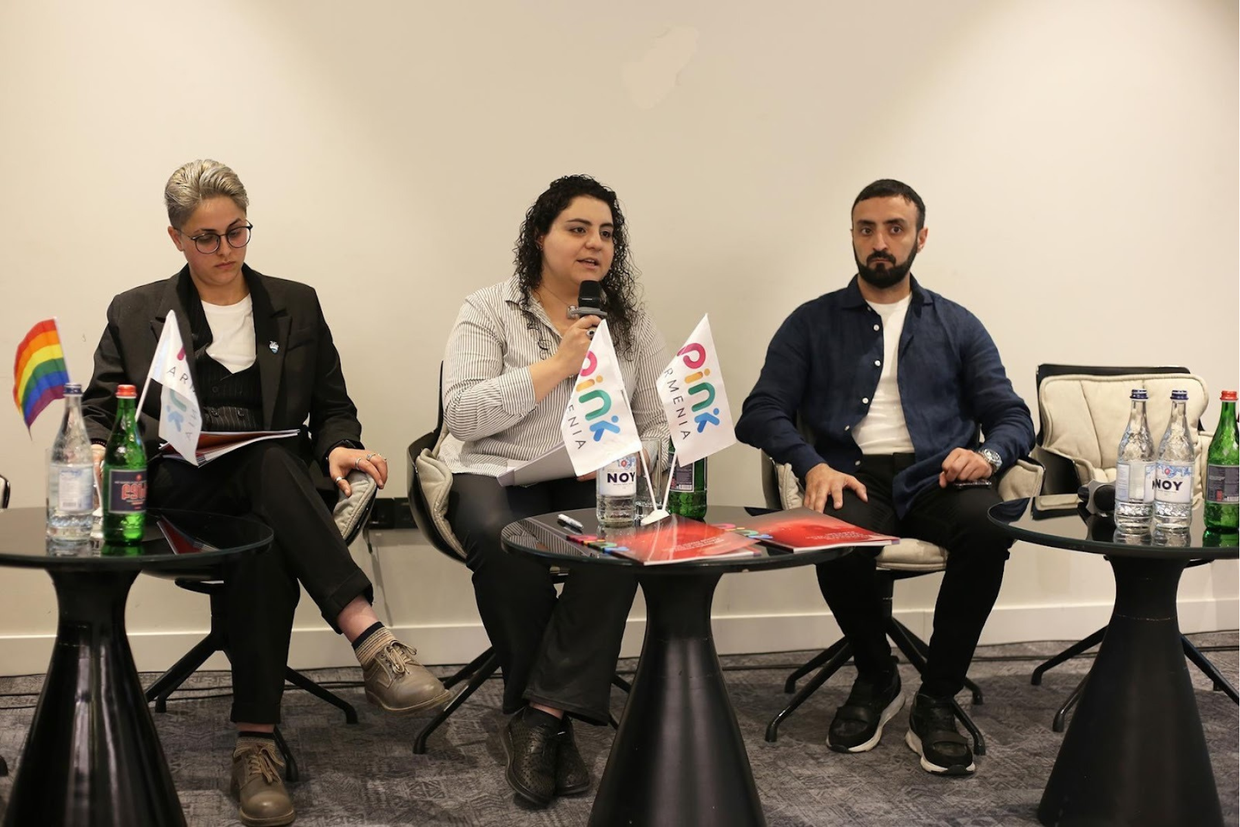
As mentioned, the long-standing narrative that LGBTQ+ people ‘do not exist’ in Armenia has begun to shift over the past decade. Even though some people still think that queer people should stay invisible, Pink Armenia believes that changing narratives marks a slow sociological change toward eventual acceptance. This shift has been aided by educational work with teachers, psychologists, journalists, medical professionals, and through other helping professionals. Another aid has been Pink Armenia’s annual national conference on gender issues, which draws together experts who present research on LGBTQ+ mental health, sensitivity practices, and gender studies. Pink Armenia also trains queer migrants, helping them gain skills to stay and work in Armenia.
Pink Armenia’s journey is inseparable from the wider movement it belongs to: feminist organisations, HIV advocates, civil society researchers, and the communities they serve. Together, they form one of Armenia’s most resilient human rights defender community.
Their work is often quiet, unseen, and carried out in environments where risk is very real. Yet the impact is profound: young people escaping violence, trans people finding safe medical referrals, and parents learning a new language for acceptance.
Pink Armenia emphasises that progress may be slow, but it is visible in people’s attitudes. For lasting change, long-term sustainability is crucial, ensuring that safe spaces, expert support, and community services remain available for years to come. Supporting local, community-based organisations like Pink is especially effective, because they understand the local context, have established trust within the community, and can respond quickly and appropriately to emerging needs.
By supporting Pink Armenia through platforms such as GlobalGiving, individual donations can help strengthen local safe spaces, ensure continuation of high-quality and sensitive services, and, of course, empower a community-led approaches that make real, lasting change possible.