Review | Self-Portrait Along the Borderline — exploring identity and belonging amidst conflict

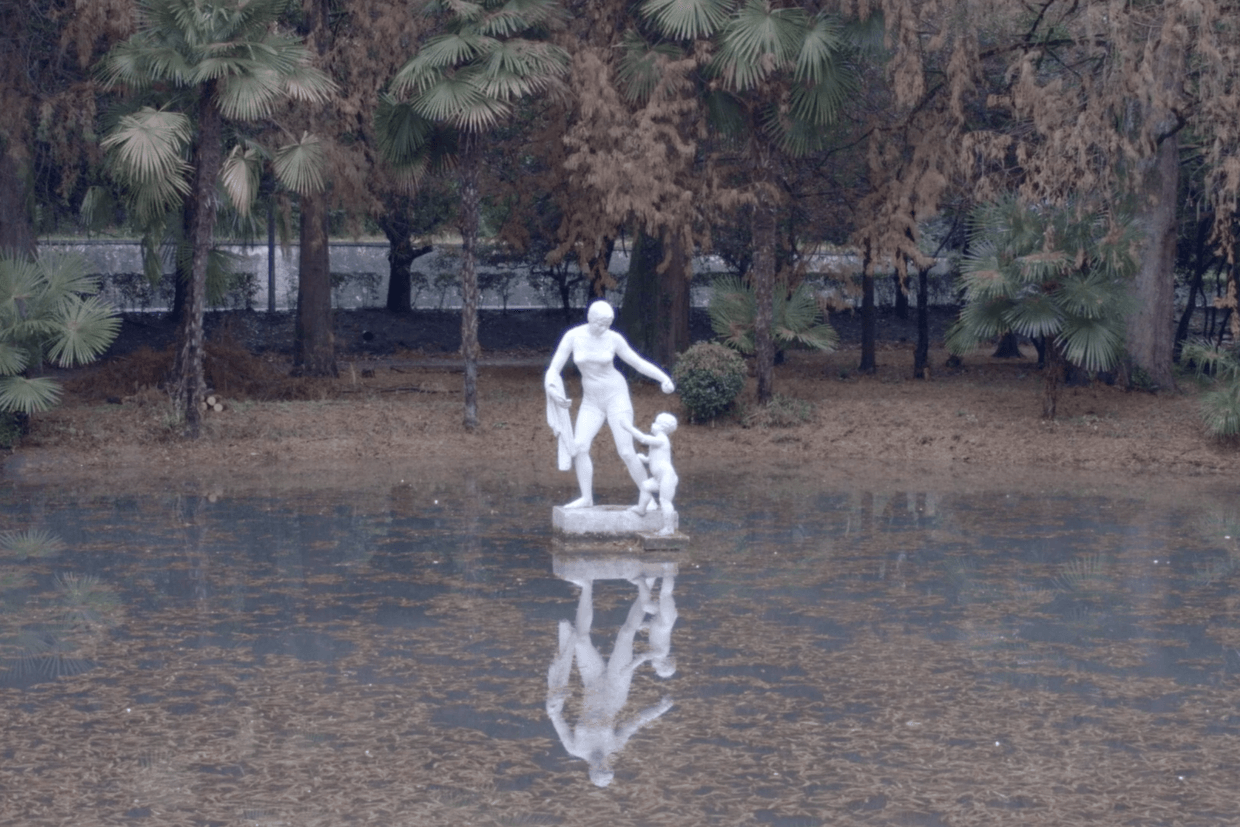
★★★★☆
Anna Dziapshipa’s 2023 collage documentary invites the viewer into her own story, examining personally what it means to be an Abkhaz–Georgian woman.
Dziapshipa’s latest film, Self-Portrait Along the Borderline, makes it clear from the opening lines that it will be a first-person narrative, one built around Dziapshipa’s own family history and experiences.
Born in Tbilisi in 1982 to an Abkhaz father and a Georgian mother, Dziapshipa grew up with a mixed identity that ensured she never fit in, especially in the aftermath of the War in Abkhazia (1992–1993). Due to her Abkhaz grandfather’s fame from playing football with FC Dinamo Tbilisi, those around her assigned only two narratives: she was related to this greater Dziapshipa, or was an Abkhazian refugee. But who is she as her own individual? And what does it mean to be both Abkhaz and Georgian in a society fixated on conflict?
Dziapshipa structures her attempt to explore these questions as a collage, using archival footage, both from her own family collection as well as more public footage, as well as footage she shot during a more recent visit to Abkhazia, tracing her family’s footsteps. The emphasis on the archives is notable, with Dziapshipa telling the audience early on in the film that she has always loved archival footage, viewing it as a way to try and ‘penetrate time’. This is just what this film appears to do, using the collages as a way creatively explore various concepts, such as when she compares her grandfather’s football games to the War in Abkhazia, using footage related to the former and audio of the second — in one apt comparison, a military commander says that if 100,000 Georgians are killed, they will exterminate entirety of the Abkhaz people, numbering some 97,000, the same number as could fill Tbilisi’s Dinamo stadium.
In another scene, footage of a wedding, implied to be Dziapshipa’s own, is replayed as she tells of a toast someone gave: ‘Today, we reconquered our share of Abkhazia’. As the memory shows, for Dziapshipa, her body is not always perceived as her own — indeed, here, it was seen as a ‘territory’, something to be ‘lost and reconquered’, a narrative that objectifies her existence and shows how, as an ethnic woman, her positioning in Georgian society is different.
Throughout the film, Dziapshipa engages with a recurring motif — that of a spider continuously spinning its web. This more abstract footage hints at the trap both Abkhazians and Georgians are building around themselves in the aftermath of the conflict, as contact between the two groups grows ever rarer.
Self-Portrait Along the Borderline, with its 50-minute run-time does not necessarily answer any questions, or provide clear solutions. Instead, it acts as the title suggests, as a portrait of Dziapshipa, someone stuck amidst along the border between two identities, and who will remain in this limbo until societal change emerges and real peace, rather than a frozen status, is sought.
Film details: Self-Portrait Along the Borderline (2023), directed by Anna Dziapshipa, will be screened by OC Media on 6 March.
For ease of reading, we choose not to use qualifiers such as ‘de facto’, ‘unrecognised’, or ‘partially recognised’ when discussing institutions or political positions within Abkhazia, Nagorno-Karabakh, and South Ossetia. This does not imply a position on their status.