★★★★☆
Karine Khodikyan’s uncanny and inscrutable short stories focus on lust, love, and death, and all the dysfunction that lies between.
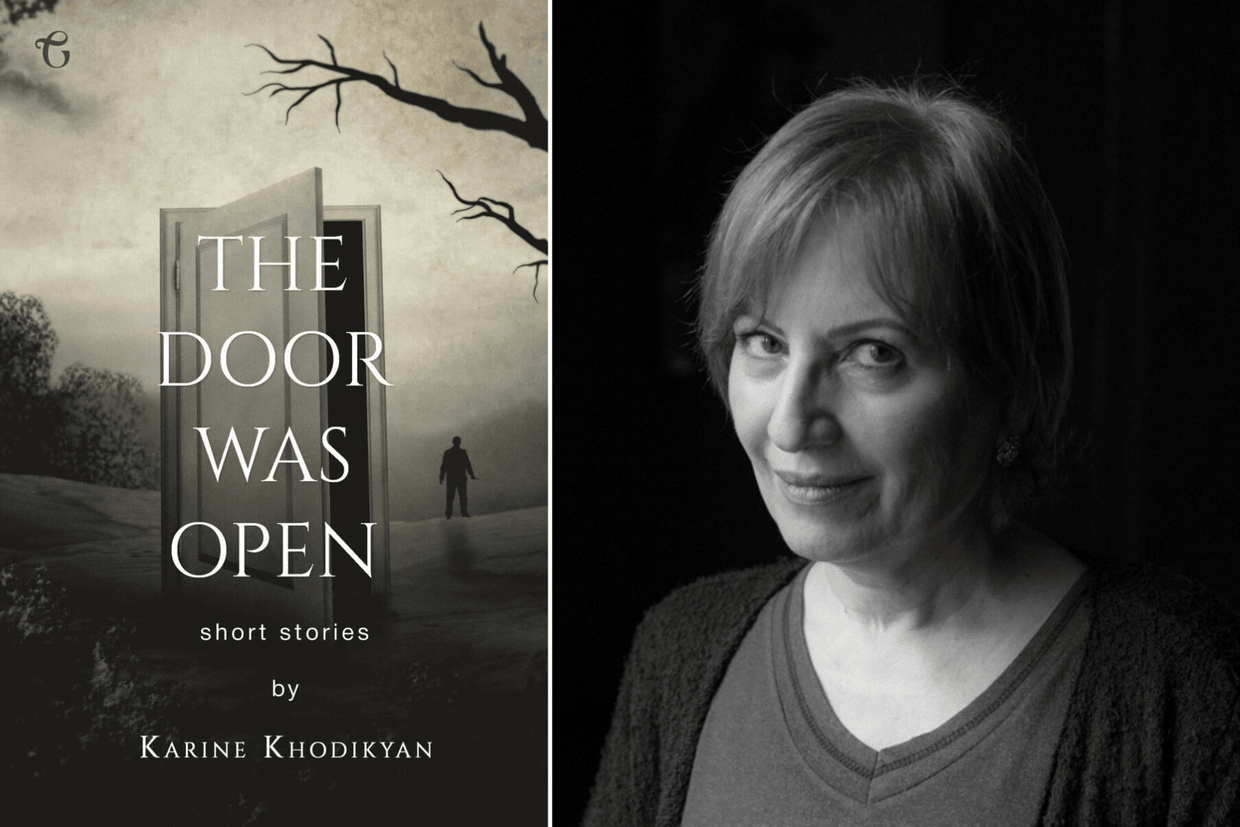
The eponymous short story opening Khodikyan’s collection lays the foundation for what is to come — twisted, abstract, and dark fairytales for a modern age, all of which centre womanhood in all of its facets.
In this title piece, a woman overcomes the association between her apartment’s entryway and her own grave through a dreamlike encounter with a serial killer. The woman’s fear of this half-naked man with cat-like eyes wars with sexual attraction, making for evocative imagery:
‘There was a monstrous power within that body, a beast that devoured itself with pleasure, ready at any moment to sink its claws into another body and feel the bloody pulsations of hot arteries in its nostrils. But that force also had powerful shoulders, a muscular neck, a sinewy body that could lose itself in a wave of mad passion, turning into a wave itself’.
The nine additional stories making up the collection relate similarly dark themes, as well as a general emphasis on centering women, even if the narrator is a man.
‘It is interesting to read a male writer describe the inner world and feelings of a female character, the more interesting is to read about the inner world and feelings of the male character depicted from a woman writer’s perspective’, Khodikyan said in an interview with the Zabel International Women Writers Forum.
Her collection does just that, providing a different perspective of traditional family life and the stereotypes assigned to women in Armenian society.
Notably, in her exploration of these roles, Khodikyan often opts not to name her characters, instead using generic terms such as ‘Man’ and ‘Woman’ or terms related to family status, such as ‘Mother of the House’, ‘Woman of the House’, and ‘Wife of the House’. In doing so, Khodikyan makes it easier for the reader to place themselves into the story, engaging with the thoughts and actions of the characters in a more cerebral manner.

Subscribe to the Culture Dispatch
A bi-weekly newsletter featuring film, book, and music recommendations from the Caucasus, handpicked by our team.
Indeed, many of Khodikyan’s stories are made up almost solely of conversations between her protagonists, asking the reader to think deeper on certain philosophical questions.
For example, in the sixth story ‘1st of March’, a family considers the role of the unnamed carpenter who made the cross Jesus Christ was crucified upon and whether he should hold any responsibility for his role in said crucifixion. Deeper questions emerge over who has the power to order others and whether those who give orders understand that those underneath them will also have to live with the repercussions — questions that directly relate to the larger story Khodikyan is telling: that of the 1 March 2008 protests and ensuing massacre. In her retelling, however, a more Kafkaesque story emerges, building tension while also embracing absurdity.
Khodikyan also repeatedly shies away from assigning a clear perpetrator; all of her characters share their own share of guilt, with many inhabiting cycles of violence that intertwine. In ‘I Wasn’t Going’, for example, a mother whose son was murdered becomes the mother of a murderer in a temporally abstract tale — both roles are explored, particularly the toll on the mother who loses her son in some form in either scenario.
At only a little over 100 pages, The Door Was Open makes for an easy entry into Khodikyan’s work, as well as that of modern Armenian women writers at large, at least for readers not afraid of delving into their deepest and darkest thoughts, examining the real questions that haunt us all.
Book details: The Door Was Open: Short Stories (2019), translated into English by Nazareth Seferian for Gagoslav Publications, with support from Armenia’s Culture Ministry. Buy it from the publisher here.