Georgia’s ruling party has presented draft legislation that would criminalise the ‘establishment of a perception’ that Georgia’s governmental bodies are illegitimate. The bill, potentially covering a wide range of activities, introduces penalties including up to three years in prison.
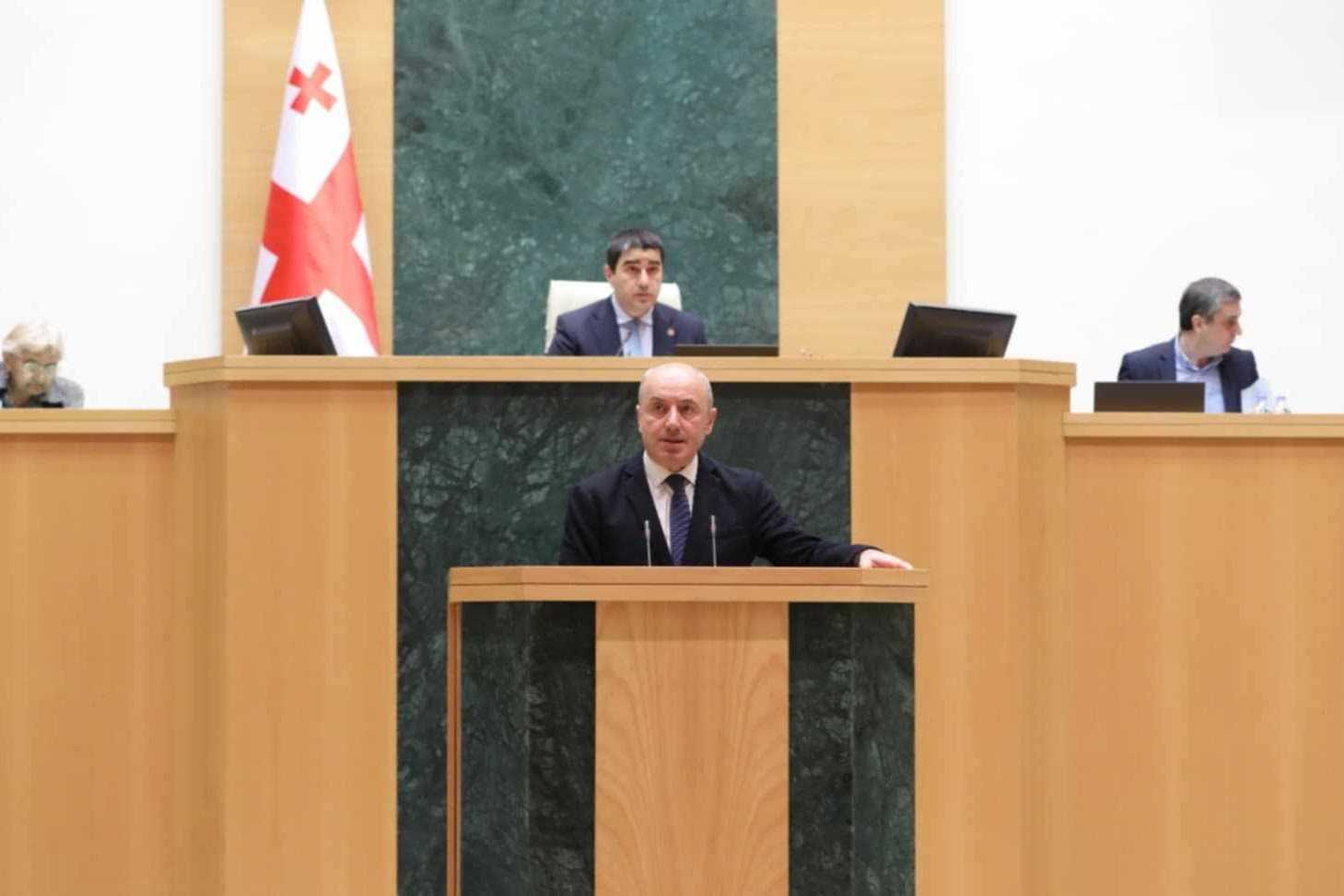
Intentions by the ruling Georgian Dream party to penalise the non-recognition of ‘constitutional bodies’ first became public in early February. However, on Monday, at a session of the parliamentary legal affairs committee, its chair, an MP Archil Gorduladze, unveiled the exact wording of the proposed draft.
According to Gorduladze, the party vowed to add a new Article 316¹ (prima) to Georgia’s criminal code, titled ‘Extremism against the Constitutional Order of Georgia’. The provision would apply to Georgian citizens, stateless persons with status in Georgia, and legal entities.
The article lists punishable acts as:
- systematic and public calls for ‘mass violations of Georgia’s laws, mass disobedience to state authorities, or the creation of alternative state authorities’;
- arbitrary, public, and systematic ‘presentation of oneself or another person as a Georgian authority’, or ‘other systematic actions by the same person’.
Gorduladze stated that for criminal liability to apply, these actions must be aimed at ‘establishing a perception of the illegitimacy of Georgia’s constitutional order or its constitutional bodies and must harm Georgia’s interests or create a real threat of such harm’.
The MP proposed penalties ranging from a fine, 400–600 hours of community service, or up to three years’ imprisonment.
In the case of legal entities, the same action would be punishable by a fine or liquidation and fine.
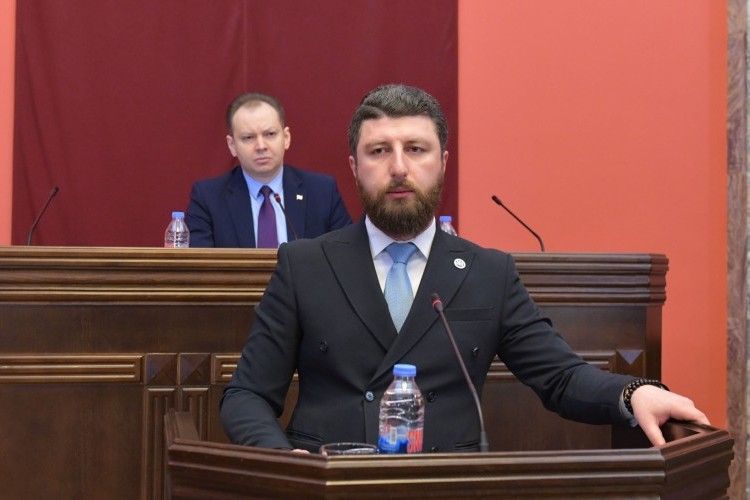
Gorduladze also proposed introducing a ‘motive of non-recognition of the constitutional order or constitutional bodies’ into the criminal code as an aggravating circumstance, so that if this motive is established when committing a crime, an additional year would be added to the sentence already imposed.
The committee, effectively controlled by the ruling Georgian Dream party and its allies, approved the text by an overwhelming majority. The text of the provision has not yet been published on the parliament’s website.
The provision is not a standalone legislative amendment but part of a broader package of restrictive changes Georgian Dream announced at the end of January affecting laws on grants, political associations of citizens, as well as the criminal and administrative codes. The changes were adopted in the first reading on 3 February.
It was that day when the ruling party MP Levan Machavariani proposed adding another provision to the package for its second reading, criminalising the non-recognition of constitutional bodies. The initiative was later publicly endorsed by Prime Minister Irakli Kobakhidze.
Monday’s session of the legal affairs committee, where Gorduladze presented the wording of the amendment, was part of the package’s second reading. When the committee stage is complete, the bill, likely including the new provision as well, will go to the plenary for a vote, followed by a third and final reading.
‘Silencing people by fear’
Georgian Dream’s latest legislative initiative has not emerged in a vacuum. It comes in the reality following the disputed 2024 parliamentary elections, after which, citing major violations, many opponents and critics still refuse to recognise the current government as a legitimate body of power. The ruling party dismisses such attitudes as irrational.
‘As Georgian Dream claims, they supposedly don’t have a recognition problem’, former chair of the Georgian Young Lawyers’ Association (GYLA) Nika Simonishvili told OC Media while assessing the ‘political context’ of the initiative.
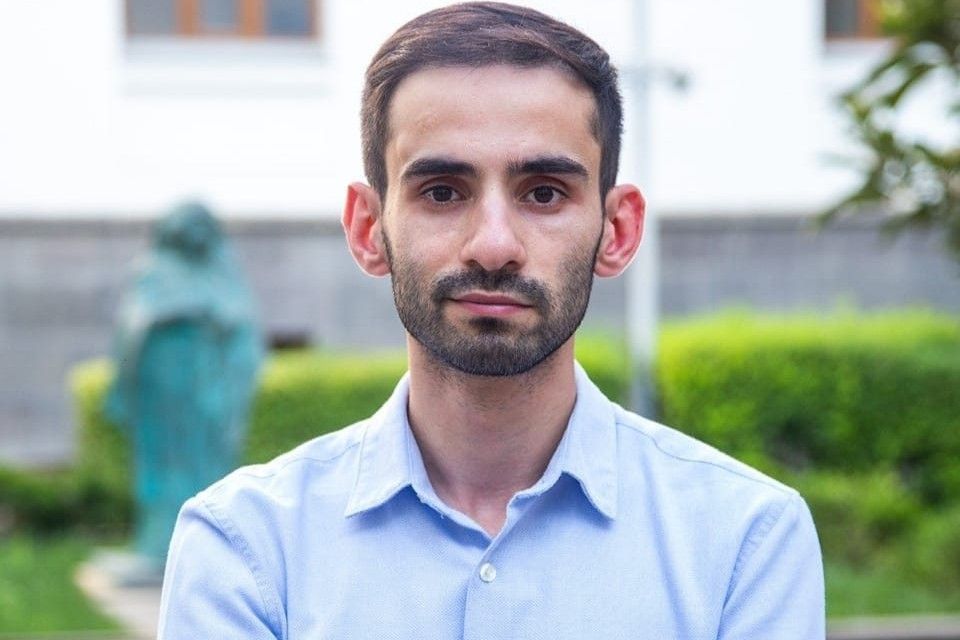
‘This amendment first of all confirms that they do have a recognition problem, and it seriously worries them’, he added, emphasising that ‘the only purpose of the [provision] is silencing people by fear’.
Simonishvili noted the initiative should be considered together with all the other changes that the ruling party has made ‘against assembly and expression’ in the recent past.
From political opponents to the civil society, activists, and state-critical media outlets, refusal to recognise, call into question, or at the very least avoid explicitly recognising the current government takes various forms.
These include directly referring to it as ‘illegitimate’, as well as using terms that suggest the current authorities rely solely on a single party, Georgian Dream, and the patronage of its billionaire founder, Bidzina Ivanishvili — for example, phrases such as ‘Ivanishvili’s government’ or ‘Ivanishvili’s representative’.
 OC Media
A prominent example is that of Georgia’s fifth president, Salome Zourabichvili, who refused to relinquish her status and to recognise Mikheil Kavelashvili as the sixth president. Kavelashvili was elected in November 2024 by the college formed in the parliament that emerged from the same year’s disputed elections.
A number of questions remain, such as: who could be punished under the new law once it is adopted? Could it apply to anyone — a politician, activist, journalist or someone else — simply for publicly stating that the Georgian Dream government is illegitimate?
Gorduladze went on to argue that the party would draw a ‘clear line’ between freedom of expression and crime.
‘The key factors are systematic nature and publicity. A performance expressed by a single individual, of course, will not be considered a criminal offence’, he said.
Simonishvili disagreed, noting that the initiative does not draw a clear line; rather, it further narrows the space around freedom of expression.
‘The content of the provision is so expansive that virtually any undesirable political expression could fall under it’, the lawyer said, adding:
‘This could affect the media, politicians, civil society organisations, individual persons, or any other legal entity’.
Commenting on the wording of the provision, Simonishvili said that the ruling party deliberately drafts laws with vague content that cannot be predicted in advance’.
‘Georgian Dream will use this provision wherever it sees fit’, he said.
OC Media
Attempts to draw parallels to Germany’s crackdown on fringe ‘cult-like’ group
In his reasoning for the proposed law, the ruling party representatives referred to Germany where a ‘certain political movement’ was banned in 2025 for creating ‘parallel governing structures’ and denying the legitimacy of the government.
They did not specify the group’s name, but the reference was apparently about the radical ‘cult-like’ group Kingdom of Germany (KRD), which seeks to return the country to a pre-WWI-era monarchy. The movement was banned in 2025.
According to Simonishvili, the German case has nothing in common with the Georgian context.
‘The [German] group was not talking about any party or government being illegitimate; [instead], it’s about the [claim] that the Federal Republic of Germany does not exist’, he notes, adding: ‘In the Georgian context, however, the discussion is about the illegitimacy of a specific party, [Georgian Dream], in the sense that it conducted elections illegitimately and [is carrying out] a full-scale takeover of state institutions’.
Explaining the need for legislative changes, Gorduladze noted that the current legislation punishes both the overthrow of the constitutional order and calls to do so. However, according to the parliamentarian, attention must also be paid to what he called the ‘preparation of fertile ground’ for the calls of overthrow.
‘We are faced with a situation in which, before individuals even reach such calls, they first create in society the perception that constitutional bodies do not exist, that legislation does not exist, and that the will of the Georgian people, expressed through the election of parliament, is non-existent’, he stated, citing as an example the 4 October 2025 protest in Tbilisi, when a small group of demonstrators attempted to storm the Presidential Palace.
In response, Simonivsvili emphasised that the overthrow of the constitutional order, including its preparatory stages, is already sufficiently regulated by law:
‘This is not about creating fertile ground for any of this; rather, it is about, essentially, restricting people’s political expression. No legal justification can be found for this initiative’.
Georgian Dream has significantly accelerated the adoption of restrictive legislation after the start of anti-government protests in late November 2024, which were sparked by the ruling party’s announcement that it was halting the country’s EU membership bid until 2028.
It has repeatedly claimed that the new bills are necessary to fight the ‘influence of external powers’. Nonetheless, critics of the ruling party have emphasised that these changes aim to undermine the media and civil society in an already fragile democracy.
Mikheil Gvadzabia