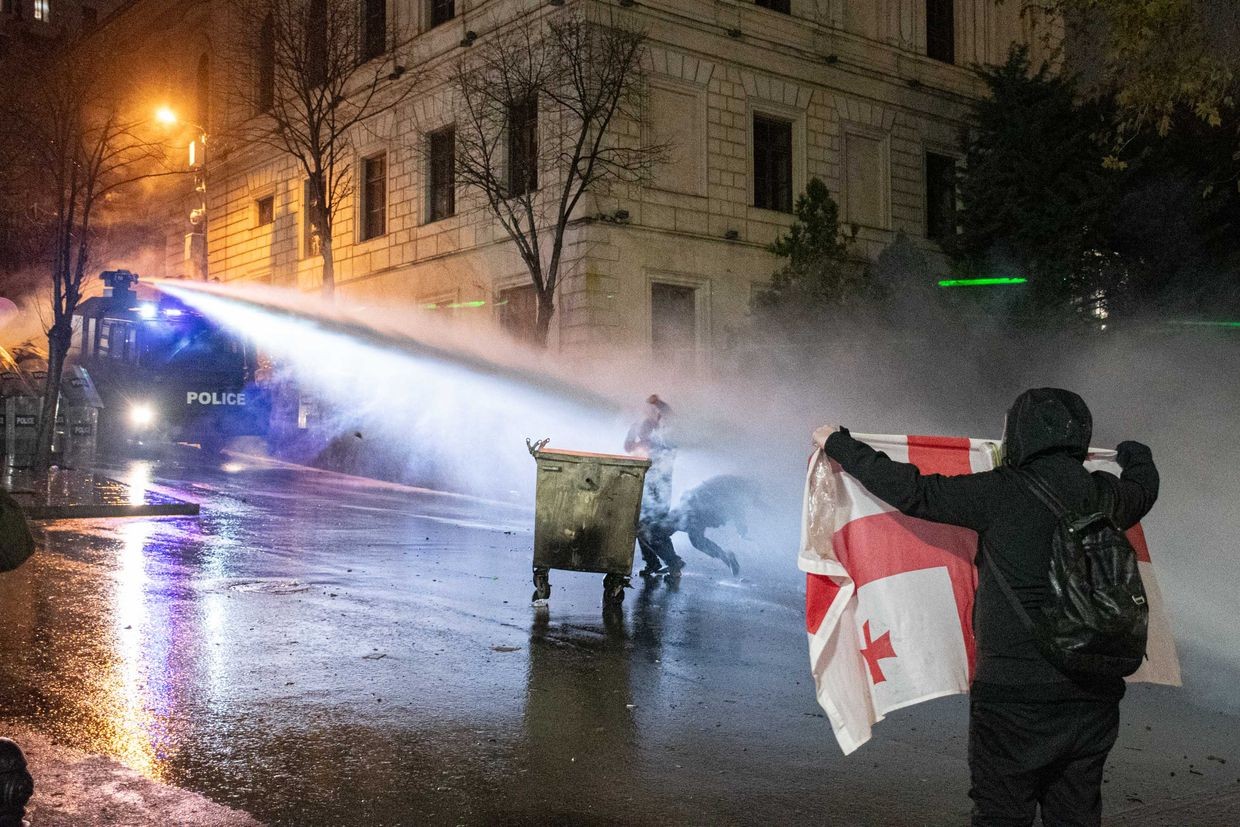
A BBC documentary published on Monday suggested that a WW1-era toxic compound was sprayed on Georgian protesters last winter. The report drew sharp criticism of the government from opponents, while the ruling party condemned the claims. Georgia’s State Security Service (SSG) has launched an investigation into the veracity of the claims.
The BBC spoke with chemical weapons experts, whistleblowers from Georgia’s riot police, and doctors, finding evidence indicating the use of an agent the French military referred to as ‘camite’. The agent has been out of use since the 1930s.
The one-hour documentary covered November–December 2024, focusing on the first week of protests in Tbilisi in response to Georgia’s EU U-turn. That period was marked by violent clashes between police and demonstrators, including police using tear gas, water cannons, and pepper spray, as well as brutal physical violence against protesters.
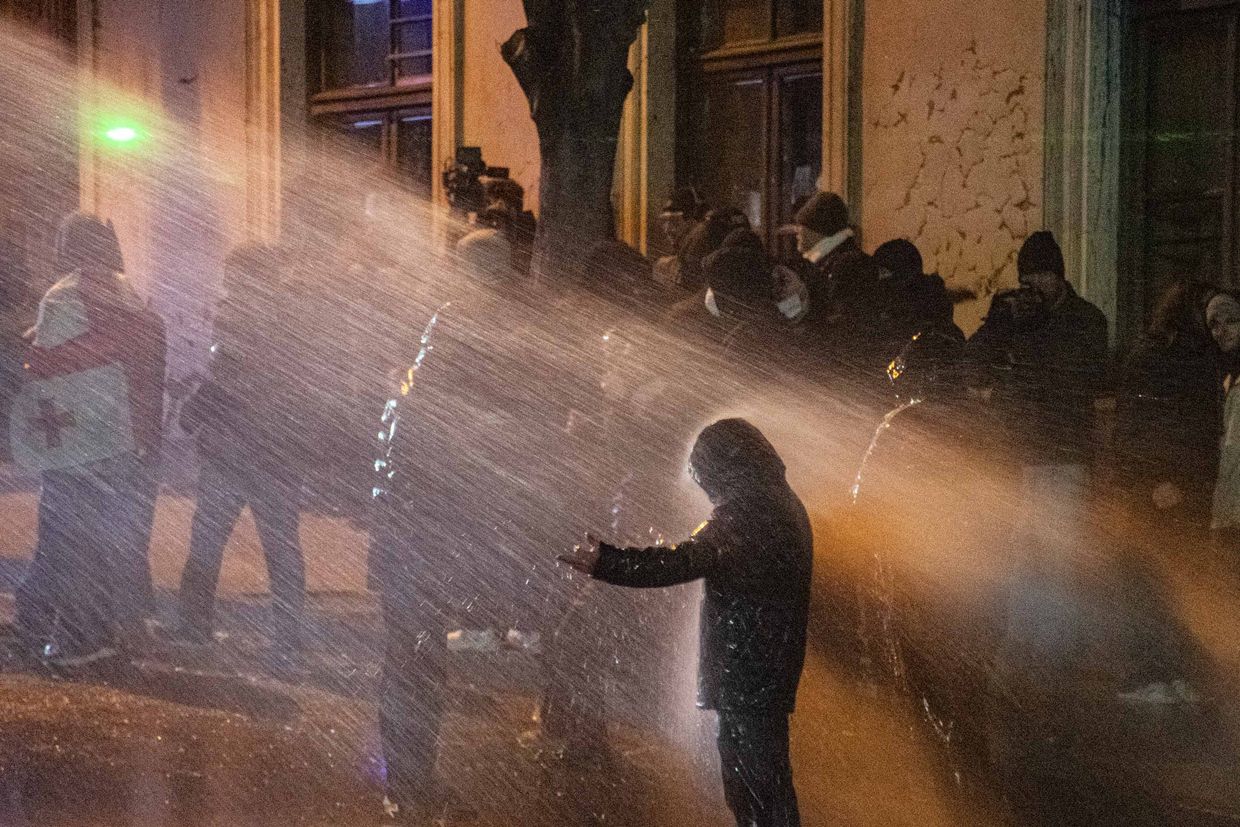
Both in the documentary and the accompanying article, the BBC noted that the demonstrators complained of several symptoms, including shortness of breath, coughing, and vomiting that ‘lasted for weeks’.
One of the BBC’s respondents, paediatrician and activist Konstantine Chakhunashvili, said his skin burned for days after being sprayed by water cannons — and felt even worse when he tried to wash it off. After he posted a survey, nearly 350 protesters responded, almost half reporting symptoms that lasted more than a month. His study was later reviewed and accepted by the Toxicology Reports publication.
How the BBC identified the likely chemical
According to the BBC, ‘several high-level whistleblowers’ from Georgia’s riot police helped them to identify the likely chemical used in the water cannons. Former weaponry chief Lasha Shergelashvili, who resigned from the agency in 2022 and now lives in Ukraine, suggested that it was the same compound he was asked to test for use in water cannons in 2009, describing effects far stronger and longer-lasting than tear gas.
He said the chemical continued to be loaded into water cannons until at least 2022, and colleagues still in the force told him it was used during the 2024 protests as well.
According to the BBC, Shergelashvili didn’t know the name of the chemical, but the channel obtained a 2019 riot police inventory listing two unidentified substances — ‘Chemical liquid UN1710’ and ‘Chemical powder UN3439’. The channel said that a former senior riot police officer confirmed the document’s authenticity and said these were likely added to the water cannons.
According to the documentary, UN1710 turned out to be a solvent. As for the second code, it was was ‘much harder to identify because it is an umbrella code for a whole range of industrial chemicals, all of which are hazardous’. But the ‘only’ chemical BBC found ‘to have ever been used as a riot-control agent is bromobenzyl cyanide, also known as camite, developed by the Allies for use in World War One’.
The weapons experts the BBC consulted concluded that ‘given there are safer and more conventional riot-control agents available to police, an obsolete and more potent agent could be classed as a chemical weapon’.
In response, the Georgian authorities called the findings ‘absurd’, saying that the police had acted legally in response to the ‘illegal actions of brutal criminals’.
‘I had nose bleeds almost every day’
Concerns over the substances used during the winter dispersals have been raised previously. At the time, the Georgian Young Lawyers’ Association (GYLA) demanded details from the Interior Ministry, stating that the police ‘actively used chemical agents, including tear gas and chemical irritants mixed into water cannons’ during protests.
Among those who continued experiencing symptoms after the dispersal was OC Media co-founder Mariam Nikuradze, who had been reporting from the scene when she was hit by a water cannon twice. The first time was when a water cannon targeted journalists standing on the fountain near parliament — Nikuradze fell, her camera broke, and she was soaked, but ‘there was no burning or anything’ since ‘the water was clear’.
However, the situation changed during another use of the water cannons.
‘[That time] the flow didn’t directly hit me, but it passed very close by me and water sprinkles covered my face — it started immediately burning. I lost orientation, I couldn't move, and froze there despite the riot police approaching’, she told OC Media.
A colleague brought Nikuradze to an ambulance where she stayed for around 15 minutes trying to regain her senses.
‘My eyes and face were burning, but worst of all was the throat burn, which was insufferable. Showering that day was also painful, as the substance didn't easily come off and continued burning’, she said, adding:
‘From that very day for almost four or five months I had nose bleeds almost every day. Then one day it disappeared, but I always associated this nose bleed with the poisoning that day’.
Among those recalling burns from water cannon exposure in the BBC film was activist Gela Khasaia. In October, he was detained on criminal charges of assault and now faces up to six years in prison. Khasaia has denied the accusations, while his allies have called him ‘yet another political prisoner’.
Georgian Dream’s furious response
The BBC report sparked a widespread reaction in Georgia, spreading quickly on social media alongside sharp reactions from the government critics.
On Monday evening, eight Georgian opposition parties issued a joint statement urging ‘trusted international institutions’ to conduct an independent investigation to ‘establish the facts, identify those responsible, and prevent further use of such substances’.
‘If confirmed, this would constitute a severe violation of international norms, human rights obligations, and Georgia’s commitments under international conventions’, the parties said, adding that ‘in a country where all state institutions are subordinated to a single political party, an impartial internal investigation is unrealistic’.
In turn, SSG said it had launched an investigation based on two charges: abuse of official authority and aiding a foreign organisation in hostile activities. It is expected that the SSG will target the respondents interviewed by the BBC about their experiences.
‘The goal of the investigation is to establish in detail what information the BBC relied on in the interviews it used, the claims voiced, and how relevant that information may be’, the agency said.
According to the SSG, the film contains elements of two different crimes: first, endangering citizens’ lives and health if the claims about chemicals are confirmed; second, ‘grossly harming Georgia’s national interests, international image, reputation, and are aimed at undermining state interests’.
In its statement, Georgian Dream labelled the BBC a ‘fake media’ turned into a ‘propaganda tool of the deep state’. It recalled the recent controversy over edits to US President Donald Trump’s remarks and subsequent resignations at the network.
The ruling party also announced plans to pursue legal action against the BBC in international courts.
‘We will use all legal means to hold the so-called media accountable for spreading dirty, false accusations’, Georgian Dream said, adding that the BBC presented ‘no facts to support the allegations’ and largely ignored detailed answers provided prior to publication.
 Mariam Bogveradze