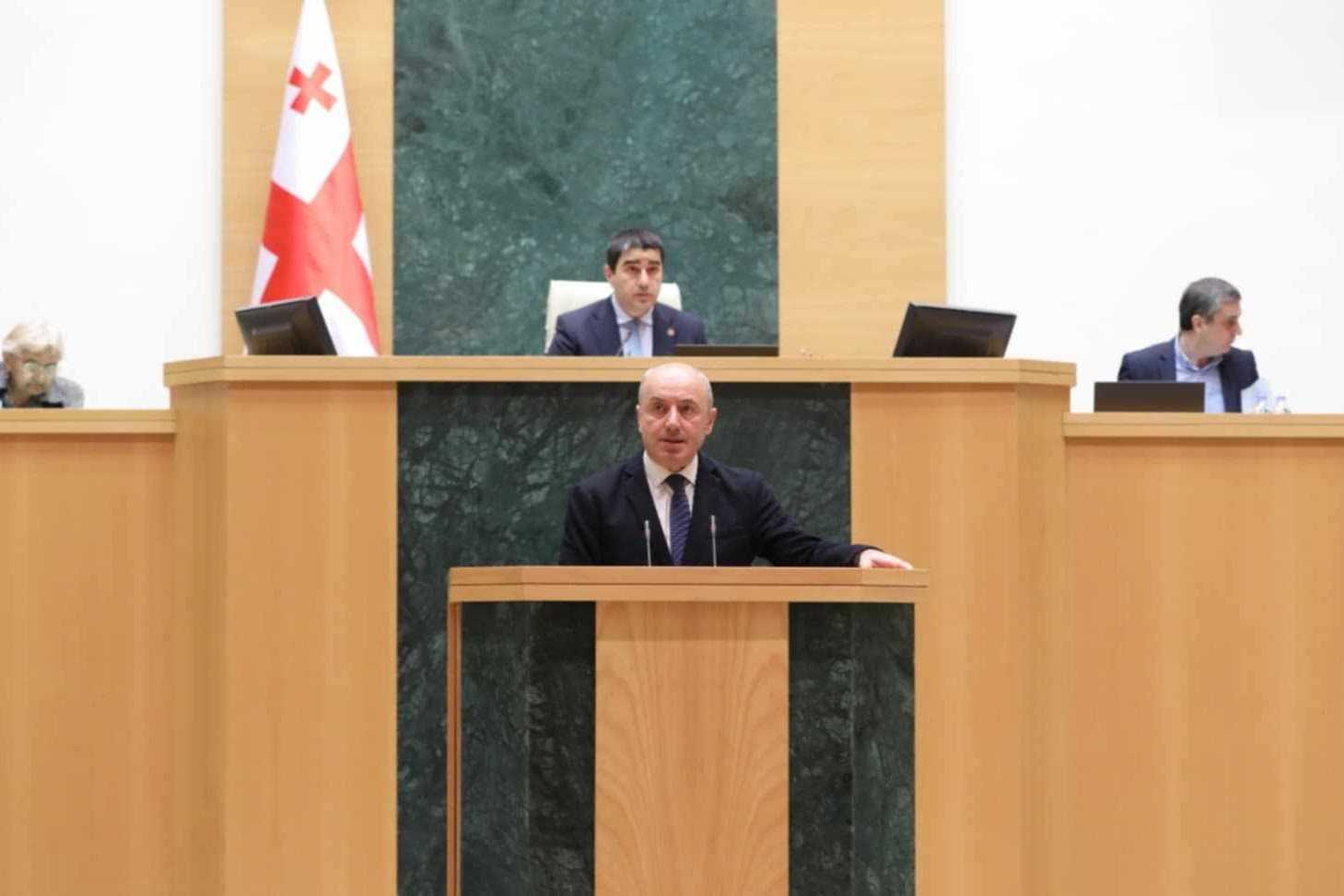
Formerly imprisoned ex-minister Akhalaia detained again over alleged role in 4 October protests

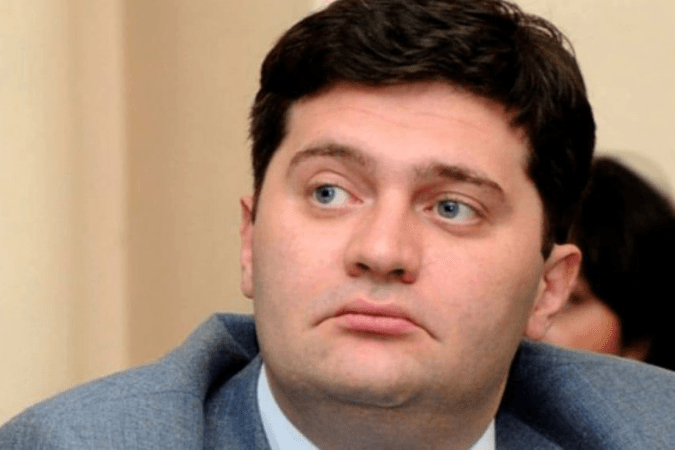
Georgia’s State Security Service (SSG) has announced the detention of Bachana (Bacho) Akhalaia, who served as defence minister under the former ruling United National Movement (UNM) party. Akhalaia, who has already spent years in prison on charges related to his time in office, has been accused of being the ‘chief organiser’ of the failed ‘peaceful revolution’ on 4 October.
The SSG announced Akhalaia’s detention on Thursday evening, following reports of police mobilisation outside his home in Tbilisi. The agency said that Akhalaia’s wife Ani Nadareishvili was also detained briefly, but later released, adding that the investigation will determine whether she was involved in the ‘crime’ together with her husband.
‘The decision regarding [the release of] Nadareishvili was made despite Bachana Akhalaia completely refusing to give any testimony’, the SSG said, framing Akhalaia’s silence as meaning that he ‘himself did not rule out his wife’s possible complicity in the crime’.
On 4 October, in parallel to the partially boycotted municipal elections, tens of thousands gathered on Tbilisi’s Liberty Square to attend an anti-government demonstration, branded previously as a ‘peaceful revolution’.
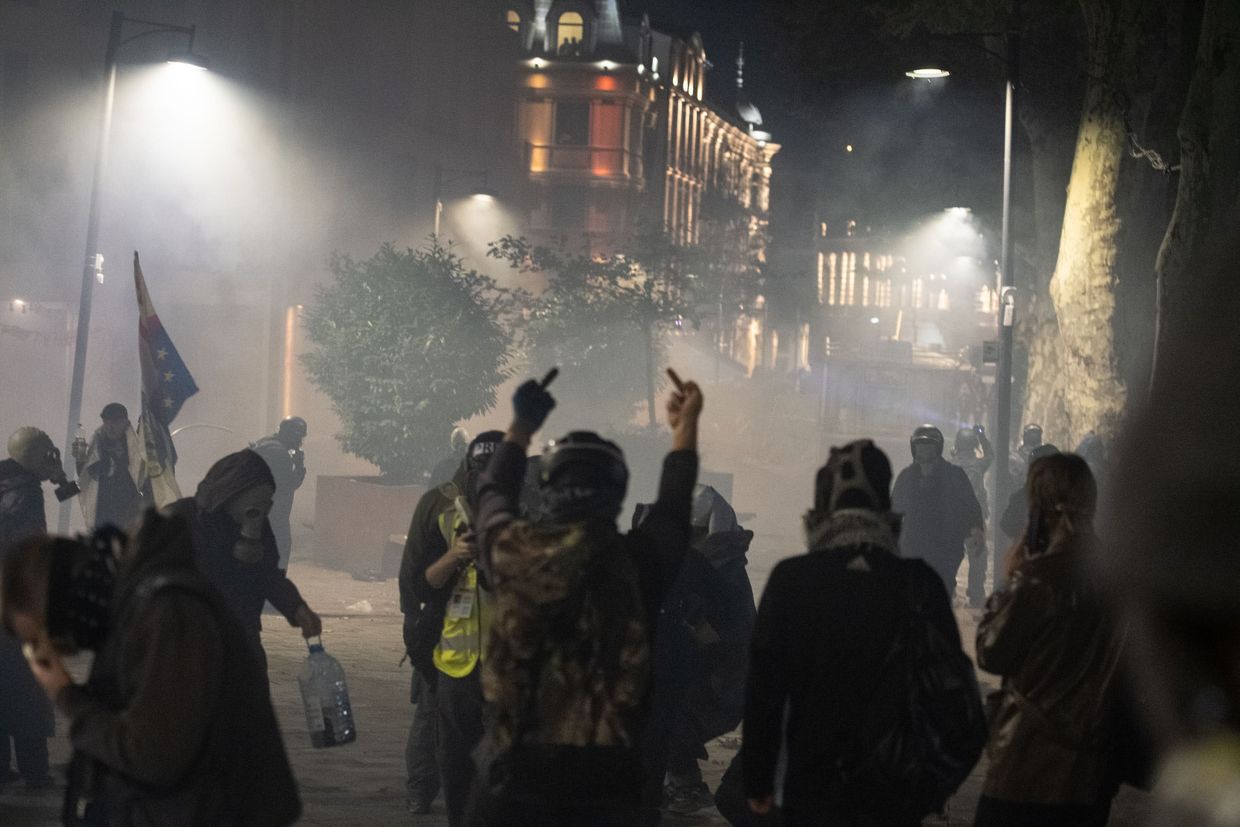
Later that evening, opposition figure Paata Burchuladze declared the government illegitimate, and opposition politician Murtaz Zodelava urged male protesters to march on the nearby presidential residence. Some then attempted to breach the building, prompting police to use tear gas, water cannons, and pepper spray, with clashes continuing into the night.
The Georgian government has since described the unrest as a coup attempt, blaming the domestic opposition and ‘foreign intelligence services’. All five individuals who were positioned as members of the protest’s organising committee have been detained, including Burchuladze andZodelava, as well as the opposition politicians Paata Manjgaladze and Irakli Nadiradze, and retired Colonel Lasha Beridze.
Dozens of other protesters were jailed at various stages on charges including group violence and attempting to seize a strategic facility.
 Mikheil Gvadzabia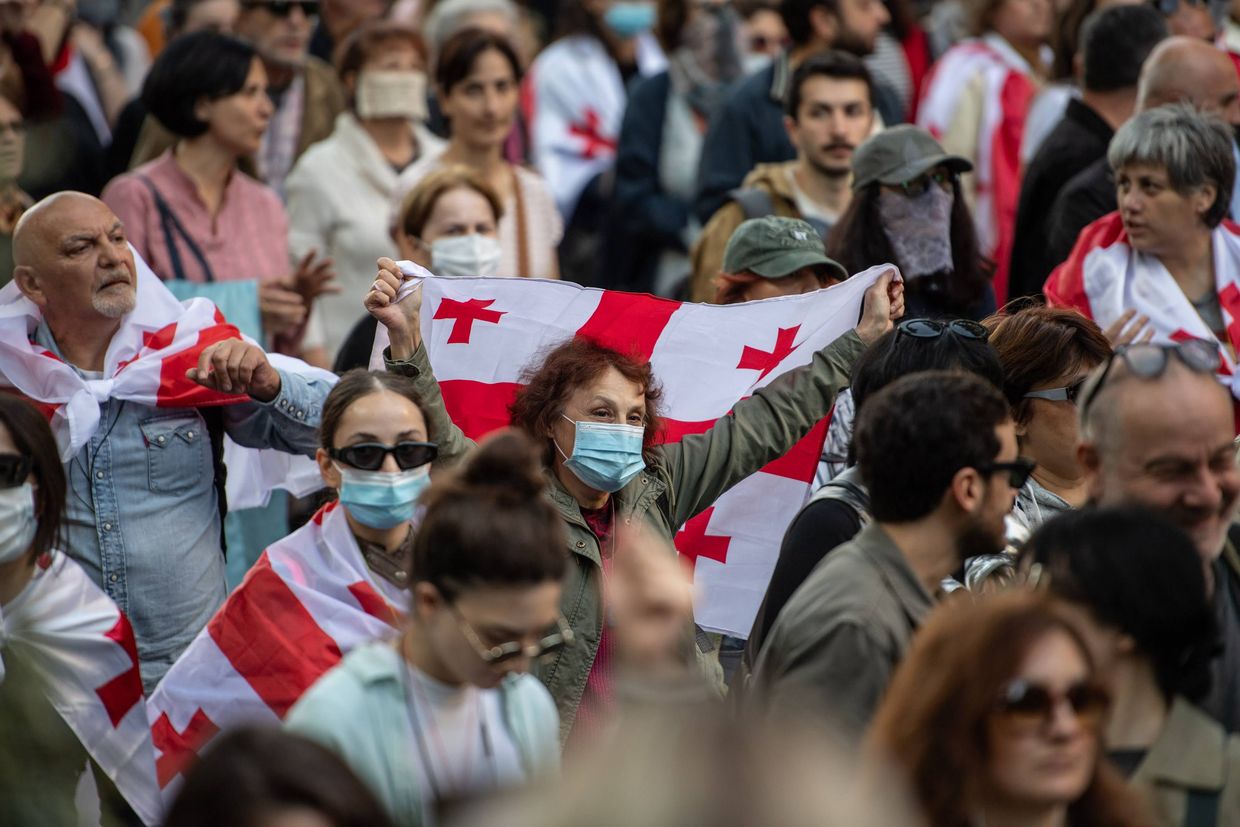
How did the SSG substantiate Akhalaia’s alleged culpability?
According to the SSG, Akhalaia was in contact, to varying degrees, with all five detained protest organisers prior to the 4 October events, ‘via internet applications’.
The agency did not disclose the content of the alleged communications or present any recordings, but said it had established the timing and frequency of the contacts ‘with minute and second-level precision, based on internet traffic identification data’.
According to Thursday’s briefing, the SSG’s main ‘evidence’ against Akhalaia consists of the connections that, the agency claimed, took place between the five’s internet applications and the IP/Wi-Fi address of Akhalaia’s wife, Nadareishvili.
The agency named the period of communications as running from 28 September until the detention of the five, with the number of sessions reportedly being 157 with Zodelava, 110 with Burchuladze, 29 with Manjgaladze, 26 with Beridze, and 21 with Nadiradze.
The SSG claimed that communications between Nadareishvili’s WiFi address and Zodelava occurred several times on the very day of 4 October. The last connection, according to the SSG, happened nine minutes before Zodelava and Burchuladze made ‘violent calls’ which, the agency said, ‘provides a solid basis for drawing the corresponding conclusion’.
It was mentioned during the briefing that Beridze was in contact with Akhalaia while at the presidential residence during the attempted ‘breach’.
‘Accordingly, [Beridze] was taking directives from Bachana Akhalaia’, the SSG added.
It also said that on the same day, after ‘recordings allegedly showing a conversation between Bachana Akhalaia and Paata Burchuladze about toppling the government began circulating from various sources’, the form of communication with Zodelava changed and reportedly continued through the phone of a ‘relative of the Akhalaia family’.
The agency likely referred to an audio clip aired by pro-government Imedi TV on the evening of 4 October, which the channel said it received by email and allegedly captured a conversation between Akhalaia and Burchuladze about the unrest. The clip’s authenticity was not confirmed by the channel, and the fact-checking outlet Myth Detector found it to be largely, if not entirely, AI-generated. Akhalaia has said ‘not a single sound’ from the recording belonged to him.
‘As you can see, based on the evidence obtained, the identity of the chief organiser of the criminal events on 4 October in Georgia is unequivocally established’, the SSG concluded, referring to Akhalaia.
At the briefing, the SSG further mentioned the alleged acquisition of a large quantity of weapons and explosive devices in a forest near Tbilisi, referencing an alleged criminal conspiracy the SSG first announced on 5 October.
According to the SSG, the investigation is examining both ‘the connection of this fact to the case of overthrowing state power’ and Akhalaia’s ‘possible complicity’ in it.
Hints to Akhalaia by the government circles before his detention
Akhalaia and his wife were first summoned for questioning by law enforcement six days after the protests, on 10 October. Akhalaia was called to the Criminal Police of the Interior Ministry, while Nadareishvili was summoned to the SSG.
At the time, the ministry said Akhalaia was summoned to provide a voice sample and testify as a witness regarding the 4 October events, while Nadareishvili said she was questioned about the episode involving weapons allegedly discovered in the forest.
At the time, in response to questions about his alleged involvement in organising the protests, Akhalaia told journalists ‘I’m very ashamed — deeply, deeply ashamed — that I wasn’t involved in anything’.
Before Thursday’s detention, Akhalaia and Nadareishvili were mentioned on several occasions by pro-government media in the context of 4 October.
On 29 September, the pro-government TV channel Rustavi 2 reported that Zodelava and Burchuladze met at Akhalaia’s apartment in connection with planning the 4 October protests.
Earlier, on 12 September, the pro-government media outlet Prime Time claimed that Akhalaia, together with former UNM officials, was preparing a plan to seize the parliament for 4 October.
The outlet also suggested a possible link between Akhalaia and the hexogen explosives allegedly brought into Georgia at the time, as reported by the SSG. Akhalaia called the report a ‘stunning lie’, while the SSG said the same day that ‘recent developments surrounding him are of interest to us and constitute a subject for investigation’.
OC Media
Leaders of the ruling Georgian Dream party have also made statements regarding Akhalaia. Following the release of the Imedi recording on 4 October, Prime Minister Irakli Kobakhidze said, ‘We’ll see how the investigation proceeds, but the content is, unsurprisingly, telling’.
On the day Akhalaia and Nadareishvili were summoned to law enforcement, the Parliamentary Speaker Shalva Papuashvili pointed to Nadareishvili ‘being active’ on social media, claiming that through her posts she was effectively conveying Akhalaia’s messages.
‘Complete nonsense’ — Akhalaia’s wife, the ruling party and others said
After being released following a brief detention, Nadareishvili said that ‘we are in communication with everyone’ and emphasised her family connections, but called the SSG’s claims there were dozens of calls between Akhalaia and the 4 October initiators ‘complete nonsense’.
‘They didn’t even determine Bacho’s phone number’, she told the opposition-leaning TV Pirveli, stating that in October, when Akhalaia was summoned to the Interior Ministry, the agency called her instead of her spouse, saying they didn’t have Akhalaia’s number.
‘How can they determine that this isn’t my phone or that it does not belong to someone but Bacho? Where do they get that from — it’s just speculation, isn’t it?’ she added, pointing to the SSG’s reliance on the IP address registered in her name as one of the key evidences.
According to Nadareishvili, her husband’s detention was preceded by him being barred from crossing the border three weeks earlier, when he was travelling to Poland.
‘They gave no explanation [for the rejection]. They knew very well all our movements and who was visiting us. We’ve been under a microscope for a long time’, she said.
Reacting to the detention, UNM member Ani Tsitlidze said that the SSG needed to bring a new ‘scarecrow’ in the form of Akhalaia after it failed to portray the jailed 4 October organisers ‘as enemies of the state in the eyes of the public’.
She described the SSG’s remark that Akhalaia said nothing about his wife’s innocence as a ‘blackmail’, implying that if he did not admit to the crime, his wife would be detained as well.
Tsitlidze also hinted that Akhalaia’s detention with the recent scandals with the involvnemt of the ruling party, including calls for an international investigation into the possible poisoning of protesters during the 2024 Tbilisi demonstrations and the recent arrest of former SSG chief Grigol Liluashvili on bribery charges.
Mikheil Gvadzabia
The ruling party and its associated welcomed Akhalaia’s detention. Chair of the Georgian Dream parliamentary faction Irakli Kirtskhalia thanked the SSG for its ‘unprecedented investigation’, while Davit Kartvelishvili, a member of the ruling party’s ally People’s Power, said the operation confirmed the government’s ‘consistent enforcement of the principle of the rule of law’.
Reacting to the detention, Prime Minister Kobakhidze highlighted Akhalaia’s role in the UNM government and added that ‘the return of these people to power would mean the return of sadism to government’.
‘We will do everything to ensure the rule of law is enforced, and today is a demonstration of that’, he told Imedi on Thursday.
Who is Akhalaia
During the UNM government, Akhalaia held several senior state positions. In 2005–2008, he served as head of the Penitentiary Department, and in 2008-2009 as deputy defence minister. From 2009 to 2012, he was defence minister, and in 2012 — just months before the UNM lost power — he was appointed interior minister.
Soon after Georgian Dream came to power in 2012, Akhalaia was detained. In 2013, he was sentenced to three years and nine months in prison over the violent suppression of the 2006 Tbilisi prison riot, which left five people dead; then-president Mikheil Saakashvili later pardoned him.
In 2014, however, the Tbilisi City Court sentenced Akhalaia to 7.5 years in prison for abuse of power in another case, and in 2018 he received another, nine-year sentence in the case concerning the torture of Colonel Sergo Tetradze, who was detained in 2011.
Akhalaia was released from prison in 2022 and has since largely stayed out of public life.
Eduard Marikashvili