Georgia calls on Venezuela to revoke recognition of Abkhazia and South Ossetia following Maduro’s removal

Georgia’s Foreign Ministry has expressed hopes that Venezuela would revoke its recognition of Abkhazia and South Ossetia following the US’ capture of Venezuelan President Nicolás Maduro.
Commenting on recent developments in Venezuela, the ministry said it was ‘closely following’ the situation in the country, ‘with the hope that future processes will unfold in line with the best interests of the Venezuelan people’.
‘Given that the Venezuelan authorities recognised Georgia’s occupied regions, Abkhazia and the so-called South Ossetia, as independent states in gross violation of international law, we express hope that recent developments will lead to the reversal of this unlawful decision, in line with Georgia’s national interests and international legal principles’, the statement read.
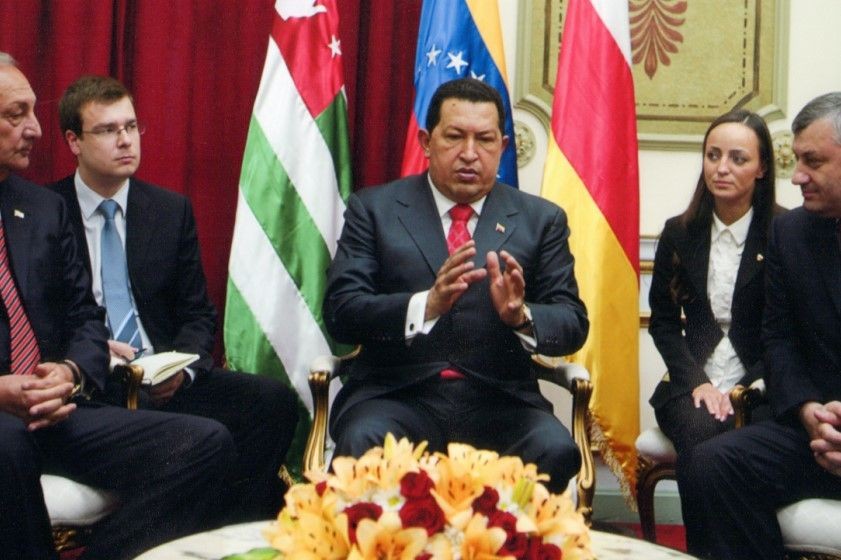
Venezuela recognised the independence of Abkhazia and South Ossetia in September 2009, just over a year after the August 2008 War and Russia’s recognition of both territories as independent states, under the late President Hugo Chávez. Chávez announced the decision in Moscow during a meeting with the then-Russian President Dmitry Medvedev.
The recognition was not reviewed after Maduro came to power in 2013, and Venezuela has since remained one of only five UN member states — alongside Russia, Nicaragua, Syria, and Nauru — to have recognised Abkhazia and South Ossetia.
The decision, which Georgia condemned, set the framework for Tbilisi’s stance toward Caracas and guided its approach in the rare instances when Georgian authorities publicly took a position on the South American country. Recently, however, the situation has become more complex amid the ruling Georgian Dream party’s deteriorating relations with the West.
After the disputed 2018 presidential election in Venezuela, Georgia did not recognise Maduro as president and joined numerous other countries by expressing the ‘full support’ for Juan Guaidó, one of the opposition leaders at the time, who declared himself president in January 2019.
Georgia’s Foreign Ministry refused to recognise the results of Venezuela’s 2020 parliamentary elections as well, condemned them as fraudulent, and stated that it stood by the Venezuelan people in their pursuit of freedom and democracy.
However, Tbilisi’s earlier stance — which was no longer as bold during Venezuela’s later elections in 2024 and 2025 — did not prevent Maduro from congratulating Georgian Dream on its ‘exemplary and stellar’ victory in the disputed 2024 Georgian parliamentary elections. By that time, the Georgian government already had worsened relations with its traditional international partners, including the US and the EU, due to the country’s democratic backsliding.
Commenting on the vote, Maduro reproved Washington’s critical responses to the Georgian elections, asking, ‘do you think the people of the world want to be treated like slaves, like a colony?’
In response, the ruling party distanced itself from Maduro’s statements, with Georgian Dream’s then-executive secretary, Mamuka Mdinaradze, saying: ‘This is the 10,000th time we’ve been asked to answer for someone else’s actions’. At the same time, he framed Maduro’s statements as a ‘success’ of Tbilisi’s international policy of non-recognition towards Abkhazia and South Ossetia.
‘If the person who recognised so-called South Ossetia and Abkhazia has seen the reality that nothing happened here [regarding the elections], tomorrow he will also see the reality that Abkhazia, Samachablo, and the Tskhinvali region are an inseparable part of Georgia’.
US forces captured Maduro in Caracas on Friday, along with his wife, during an operation accompanied by air raids, and transported him to US territory. He is expected to face criminal prosecution there.
For ease of reading, we choose not to use qualifiers such as ‘de facto’, ‘unrecognised’, or ‘partially recognised’ when discussing institutions or political positions within Abkhazia, Nagorno-Karabakh, and South Ossetia. This does not imply a position on their status.