How sexual extortion turns intimacy into terror in Georgia
Criminal prosecutions related to sexual extortion cases have nearly doubled since 2020, though the real number of cases is almost certainly higher.

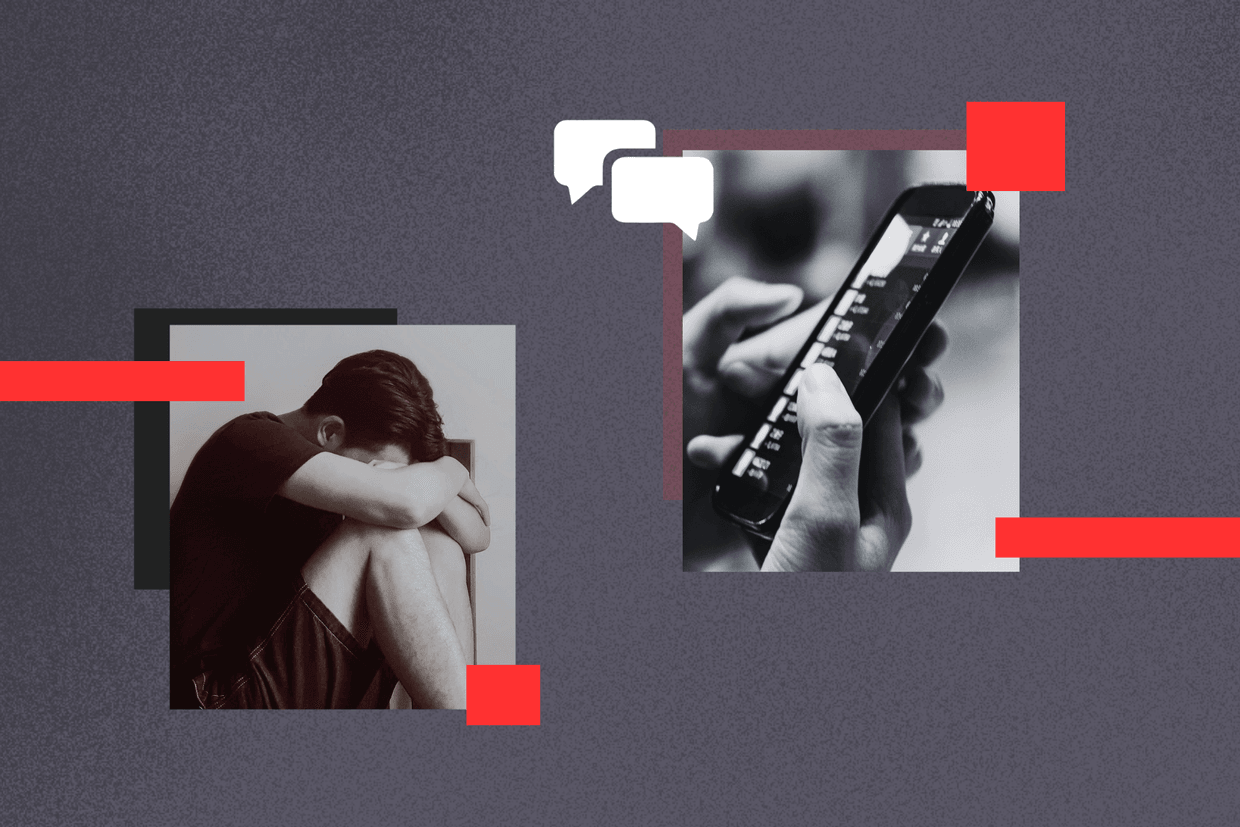
The man would come every night, Giorgi remembers, and stand outside his apartment building sending threatening messages.
‘If you don’t meet me and get into the car’, the man wrote, ‘I’ll spread your nudes. Everyone will find out about you. I’ll come up to your home and cut you’.
The story did not begin with threats, however. Giorgi, whose name has been changed for security reasons, was 14 when the two met. At first, it seemed almost harmless: two weeks of talking about music and films, about colours, books, summer plans. They met once for coffee, simply to get to know each other. Then the flirting moved online.
‘If you can’, the man said, ‘send me naked photos of yourself’.
The man sent provocative pictures first, then Giorgi responded with some of his own. He was a child, he didn’t understand what he was doing, he tells OC Media. He trusted the man; he believed it was a relationship.
The man was 30. To gain the trust of a minor, he spent three weeks messaging, arranging meetings, learning details: Giorgi’s phone number, his address, everything about his family.
What began as flirtation became blackmail that lasted nearly a year. When Giorgi refused to send more images, the threats began.
‘I’ll destroy your future’, the man told him. ‘I’ll kill you. Everyone will find out about your faggotry.’
Giorgi was based outside of Georgia’s capital Tbilisi — even today, his family does not know he is queer. He believed that if they found out, he would not survive. No one would protect him, he thought, except perhaps his mother or his grandfather. Fear kept him trapped.
The threats were followed by an attempted rape.
‘We were in the car somewhere no one would hear’, Giorgi says. ‘I kicked him in the stomach and ran. My face and body were scratched. I realised I had to tell someone, or go to the police’.
In the end, he went to a friend, a step that helped him escape. Only later did he learn the man had been using a false name, hiding not only his identity but the fact that he had a wife and children.
When Giorgi’s friend threatened to report him, the man disappeared. But the traces of that year of violence still affect Giorgi’s mental health today.
‘I even tried to kill myself. My mother helped me more than once, but she blamed it on adolescence. I was secretly seeing a psychologist when my displacement allowance [a monthly state support of ₾45 ($17) for IDPs] was transferred. That helped me get out of this state’, Giorgi says.
Even so, he adds, he still can’t trust anyone.
‘I don’t even have a dating app on my phone. If a man stands next to me on public transport, I think he has a knife in his hand, and that he will stab me in the back’.
Rising cases
According to the United Nations, digital violence — including the non-consensual sharing of intimate material — has become a global crisis. Georgia is no exception. Criminal prosecutions have nearly doubled in five years: from 44 cases in 2020 to 78 in 2025, according to the Prosecutor General’s Office.
The real number is almost certainly higher. Sexual extortion thrives in silence. Many victims never report, fearing they will be blamed, disbelieved, or that their images will spread further. Some don’t realise that what happened to them is a crime.
In Georgia, violations of private life are punishable under four separate articles of the Criminal Code, with penalties ranging from fines to ten years imprisonment:
- Article 157 — unlawful violation of private information or personal data (3–7 years)
- Article 157¹ — breach of secrecy of private life (4–7 years, up to 10 with aggravating circumstances)
- Article 158 — violation of confidentiality of private communications (up to 4 years; 7 if disseminated)
- Article 159 — violation of secrecy of correspondence or telephone conversations (up to 3 years; 7 in aggravating circumstances)
One of the most common violations of private life is non-consensual pornography, or the online distribution of sexually explicit material without the consent of the person depicted. The perpetrator is often a former partner who obtained photos or videos during a relationship and later shared them to humiliate the victim or as an act of retaliation. However, the offender is not always an intimate partner, and revenge is not always the primary motive. Victims include both women and men, among them queer people and young children.
Scanning the Special Investigative Service’s Facebook page, it is clear that violations of private life appear more frequently than almost any other category of crime.
For example, in September 2023, the service reported a case in which an offender met a 13-year-old girl on social media. During their conversations on Facebook, he demanded that she film her body and send him the footage, threatening to wait for her near her school and physically assault her if she refused. He then used these materials as leverage, threatening to share them with her mother and family unless she sent additional explicit content. Under these threats, he forced the girl to perform sexual acts with a toothbrush and film herself doing so. The perpetrator was arrested only after the child’s mother learned about what had happened and contacted law enforcement.
In September 2024, a 32-year-old man was arrested on charges of pedophilia, sexual extortion, and committing obscene acts against children. He created fake accounts on Facebook and Instagram, contacted dozens of girls aged between 10 and 18 living in different cities across Georgia, introduced himself as a peer, and, after gaining their trust, coerced them into sending intimate photos and videos.
If they refused, he threatened to kill their family members and blackmailed them by saying he would share their nude images with friends and relatives. After obtaining the material, the accused forced the children to carry out sexual acts involving their intimate body parts. One of his victims was his own relative, a 15-year-old girl, whom he also contacted through a fake account while concealing his identity. He later distributed her images to her neighbours and friends.
 Shota Kincha
In December 2024, a man was detained for spreading intimate footage of an activist who had been arrested during a protest. Investigators say the 46-year-old man acquired the video of the victim from a fake Facebook account. He then posted the video as a comment on a public post with thousands of views, intending to humiliate and damage their reputation.
Another widely publicised case involved 45-year-old Igor Kekelia, a teacher in Poti. In December 2025, an employee of the Interior Ministry contacted him and told him that private footage allegedly featuring him had been circulated on social media. He was questioned the same day, and an investigation was launched under charges of a violation of the secrecy of private life.
When Kekelia asked what footage they were referring to, police reportedly told him: ‘We haven’t seen the footage either, help us find it and identify the original source’. After the case became public, Kekelia was dismissed from Poti Public School No. 15, a decision he has appealed against.
Where the law falls short
Mari Varamashvili, a criminal law specialist whose work focuses on combating sexual crimes and protecting the rights of victims, tells OC Media that despite some progress in recent years and amendments to the Criminal Code, public awareness of crimes related to violations of privacy remains low. Many people still do not realise that such actions are even criminal.
According to Varamashvili, more was done in the past in terms of prevention — schools hosted meetings and children were informed as the most vulnerable group. In recent years, however, she says this work had become less effective. The situation, she says, is particularly difficult in the regions, where these topics remain more taboo, and the lack of information is especially pronounced. She notes that many people also fail to recognise that what they believe are ‘harmless actions’ — such as saving, downloading, or sharing someone’s private photos or videos — also constitute a crime. For this reason, she argues, constant communication in clear, accessible language is essential so that the public understands how even seemingly minor actions can cause serious harm.
Varamashvili also draws attention to institutional problems. In Georgia, there is no specialised helpline, no mandatory rapid takedown mechanism, and no effective victim-protection system. Nor is there institutional consistency. Originally, these crimes were investigated by the Special Investigative Service. After the agency was abolished in March 2022, responsibility for investigating violations of private life was transferred to the Interior Ministry and the Prosecutor General’s Office.
Varamashvili says the abolition of the Special Investigative Service has made work in this area more difficult. The agency had originally been established specifically to handle cases involving violations of privacy and was staffed with specially trained personnel, which made its work more effective. Following the reorganisation, although the 1-9-9 hotline continues to operate, cases were transferred to a department within the Tbilisi Prosecutor’s Office. The new structure, however, no longer maintains the same level of specialisation or professional capacity that previously existed, she says.
Mariam Nikuradze
Another serious legal gap, according to Varamashvili, is the failure of current legislation to regulate deepfakes — intimate content of real people created using artificial intelligence. Under existing norms, the crime must be based on real, authentic material, which means that in cases involving fabricated content, investigative bodies often conclude that no crime has occurred.
‘In such cases, the response is that the material is not real and, therefore, it is assumed — by investigators and lawmakers alike — that it cannot cause the same level of stress or harm as the dissemination of real material. This is complete absurdity’, Varamashvili says. ‘Such actions are deliberately intended to humiliate a person, force significant changes in their way of life, and cause suffering’.
She adds that investigations are further slowed by the difficulty of obtaining information from social media platforms. At this stage, the state’s cooperation within international legal frameworks exists in practice only with Meta platforms (Facebook, Instagram, WhatsApp), while no such cooperation mechanisms are in place with platforms like TikTok or Telegram. In her view, expanding cooperation with all major platforms is essential in order to speed up access to information and enable timely investigative responses.
In cases involving minors, Varamashvili says she categorically refuses to allow a child to be questioned in a standard police setting and insists that all investigative actions be conducted using the Barnahus method. Barnahus is a child-friendly environment that eliminates the stress associated with police spaces and ensures safe conditions for questioning. However, she notes that the relevant department of the Tbilisi Prosecutor’s Office does not cooperate with Barnahus in practice, and such cases are not referred there. As a result, children are often questioned in closed, unfriendly environments, causing additional trauma.
Ultimately, she identifies one of the main systemic problems as the fact that many harmful actions are not explicitly defined in the law.
‘This is precisely why accountability is often avoided — cases frequently do not go beyond the stage of a basic interview record’, she says. In practice, acts such as sustained online harassment or cyberstalking are sometimes treated as minor incidents rather than recognised and investigated as criminal offences, further limiting effective legal response.
Inside the trauma of online abuse
For Elene Koridze, a mental health specialist at the Georgian Centre for Psychosocial and Medical Rehabilitation of Torture Victims (GCRT), the line between physical and digital violence vanished long ago. Through her work, she has identified a new, metastatic form of trauma: digital violence. Koridze observes that the hatred streaming from a screen is as real and devastating to the human psyche as physical assault.
‘We no longer have the luxury of separating the digital and physical worlds’, she says. ‘The internet is our primary street today. And just as we instinctively look for a traffic light when navigating a city, we must learn to move through this digital chaos with the same caution’.
Koridze says that when a person is threatened with their private life becoming public, this can affect the deepest layers of human existence — it uproots the fundamental belief that the world is safe and that the individual is accepted. In this context, the primary weapon of blackmail is shame — the agonising realisation that one’s most intimate moments may become a subject of public judgment.
‘One of the most basic human needs is to be accepted’, Koridze explains. The abuser targets this very foundation. Here, shame is not merely discomfort; it is the paralysing fear of being mocked, rejected, and cast out.
In Georgian culture, wherein society treats such subjects with particular severity, this fear is further intensified. Koridze describes the cascade of symptoms triggered by blackmail: acute anxiety, deep depression, and Post-Traumatic Stress Disorder (PTSD). Yet, perhaps the most painful consequence is the total collapse of trust.
‘When this collapse occurs, it becomes extremely difficult to trust others — the outside world, and ultimately, oneself’.
Nino Apakidze
Against the backdrop of this personal disintegration, reality grows even bleaker: state services are virtually non-existent, and the support organisations that previously acted as islands of safety are now on the verge of criminalisation. In such moments, the individual is left alone, facing their trauma in complete isolation.
However, within this vacuum, Koridze offers two remarkably simple yet vital paths to survival: sharing and psychoeducation.
The first and most critical recommendation is to speak out. The goal of blackmail and digital terror is to isolate the individual. Koridze advises that if immediate professional help is unavailable, we must find at least one person we trust. Sharing breaks the cycle of shame in which the blackmailer intends to trap the victim.
Separately, during trauma, people often feel they are ‘going crazy’ or losing control. Koridze explains that, in these moments, psychoeducation serves a stabilising function.
For Koridze, the takeaway is clear: digital violence does not end when the screen goes dark. Its effects linger in the body, in relationships, and in a person’s sense of self. In a context where institutional support is weak or absent, understanding these mechanisms becomes not a luxury but a form of protection. Naming the trauma, sharing it with others, and learning how it operates are often the only ways to resist isolation — and to begin restoring a sense of safety in a world where the boundary between online and offline harm has long since disappeared.
Protection only after publicity?
Giorgi, having been a victim of systemic violence in the past, advises people in similar situations not to remain alone in the face of an offender: to contact the police, share what has happened with someone they trust, and, if necessary, seek support from organisations that provide assistance. Silence, he says, only empowers perpetrators.
Lawyer Tornike Migineishvili, who is currently representing Kekelia, also stresses that victims of such crimes need both psychological and legal support.
‘This is not the kind of problem you can solve on your own […] By the time you enter the investigative process, you are already psychologically shattered and perceive everything differently. Just as, for example, people whose children have died or been killed […] something similar happens in these cases too. The stress is so overwhelming that for a certain period a person is simply not able to engage in these procedures. That is why they need someone who can look at the situation from the outside, objectively, and help them’, Migineishvili tells OC Media.
Migineishvili also emphasises the importance of publicity: ‘We could have stayed silent about Igor Kekelia’s case, but instead we made it public. So that tomorrow, if someone's private footage is spread, they know it is not a catastrophe. Everyone has a private life’.
But publicity, he adds, should not be a prerequisite for justice.
Migineishvili emphasises that in Georgia, such cases are investigated effectively only after they become public. When the media takes interest, ‘the investigation immediately begins to work differently’. And while effective investigations would have a preventative impact, ‘there is no political will to enforce it’.
What to do if you are targeted:
If someone threatens to disseminate intimate photos or videos of you:
- Call 112 or go to your nearest police station to file a report.
- Document everything: save messages, screenshots, and any evidence of threats.
- Seek support: contact organisations that provide legal and psychological assistance to victims of digital violence.
- Don’t face this alone: tell someone you trust—a friend, family member, or counsellor.