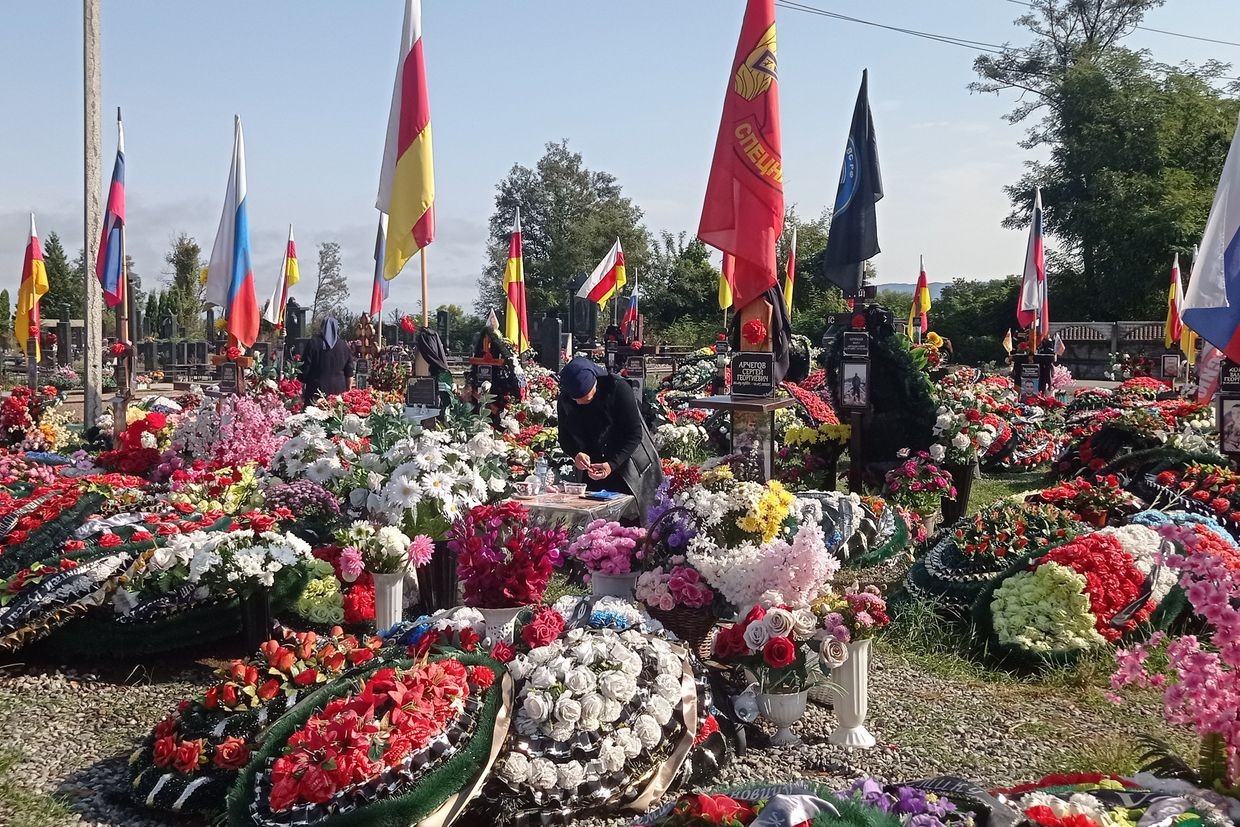
An analysis of deaths among Russian soldiers from the North Caucasus has found that death rates in the region were among the lowest in Russia across five republics. North Ossetia was an outlier, recording a third higher than the national average.
Human rights organisation Memorial examined figures compiled by a joint project of journalists and volunteers from Mediazona and the BBC. According to the data, by the end of February 2026, 194,498 deaths had been confirmed. Using an alternative methodology based on inheritance cases, the estimate rises to approximately 219,000 people.
On average across Russia, 1.35 people per 1,000 inhabitants have been killed in the war. In Karachay–Cherkessia, the figure is at 0.86; in Kabardino-Balkaria, 0.67; in Daghestan, 0.62; in Ingushetia, 0.42; and in Chechnya, 0.3. Only Moscow has a lower proportion of deaths than Chechnya.
For comparison, in the regions with the highest relative losses, 5.24 people per 1,000 have been killed in Tuva, 5 per 1,000 in Chukotka, and 4.36 in Buryatia.
‘Contrary to widespread belief, people from the Caucasus are by no means “Putin’s first infantry’’ ’, the authors stress.
These figures, Memorial notes, do not support the commonly held view that regions with predominantly non-Russian ethnic populations account for the highest numbers of those sent to war and, consequently, those killed.
North Ossetia stands apart from the other North Caucasus republics. There, 1.8 people per 1,000 inhabitants have been killed — around one third higher than the national average. The authors attribute this to a historically rooted military tradition and the presence of military infrastructure in the republic.
‘The population of Ossetia, since the time of the Caucasian War, has seen itself — and has been perceived by the Russian authorities — as a pillar of Russia in the Caucasus, and has willingly joined the army. Most units and structures of the 58th Army deployed in the North Caucasus, including its headquarters, are based precisely in North Ossetia. Yet even the relative losses in North Ossetia — the highest in the North Caucasus — are still 2.5 to 3 times lower than those in the regions at the top of the list’, the authors write.
The researchers recall that since the start of Russia’s full-scale invasion of Ukraine in February 2022, official casualty figures have remained extremely limited. The most recent data released by the Russian authorities — 5,937 deaths — was published on 21 September 2022 and no official updates on Russian losses have been provided since.
The comparatively low mortality rates among residents of the North Caucasus — and thus their limited participation in the war — are attributed by the researchers to several factors. According to Memorial’s experts, official data on employment and income are significantly distorted, as labour migration, family support networks, and a ‘strong informal economy’ play a major role in the region.
‘Firstly, a significant share of the population in the North Caucasus has, since Soviet times, been engaged in seasonal work or employed in the northern regions. Even today, relatives who have moved elsewhere in Russia or work away from home support families in their native regions. This is facilitated by traditionally strong and extensive family ties. Secondly, the informal economy — unregistered business activity outside taxation and official accounting — remains widespread. The proceeds of this sector increase household incomes that are not captured in official statistics. Thirdly, despite the Soviet legacy of undermining traditional ways of life, there is no established tradition of open alcohol consumption or social approval of it in the North Caucasus (with the possible exception of North Ossetia–Alania)’, the experts note.
Another factor is historical memory and attitudes towards war.
‘We can state, based on information from our sources, that in a number of North Caucasus regions the war is not popular, and people are reluctant to join the military’, the authors say.
According to their data, anti-war sentiment is particularly pronounced in several republics. In Ingushetia, for example, ‘there were very few willing to sign contracts and go to fight’. At the same time, ‘recognised and influential religious authorities did not speak either for or against the war — which is interpreted by society as a lack of support’.
In Chechnya, the situation is more difficult to assess due to the political regime. However, according to Memorial, ‘the general mood in the republic is sharply anti-war, and there are few willing to go and fight’. Even isolated protests are seen as indicative.
‘In September 2022, Grozny saw the only protest in many years — a women’s demonstration against the war and mobilisation. The very attempt to hold such a protest under a totalitarian regime speaks volumes about public sentiment in the region’, the authors note.
The researchers also do not rule out political factors behind the relatively low levels of mobilisation in the North Caucasus. In particular, they suggest that the federal authorities may be deliberately limiting recruitment pressure in the region.
‘It could be assumed that the federal authorities, aware of anti-war sentiment in the North Caucasus, mindful of the region’s capacity for rapid self-organisation and mobilisation in response to external threats, and remembering the armed conflict that engulfed much of the region in the 2000s and has not fully ended, have chosen not to provoke the population unnecessarily’, the study says.
The overall conclusion of the research is unequivocal.
‘The widespread stereotype in Russia and in foreign media that the North Caucasus is among the “most war-involved regions of Russia” is not supported by available statistical data collected by independent researchers. Residents of the North Caucasus generally do not seek to go to war — in any case, significantly less so than in other economically deprived regions, and less than the national average’, the authors conclude.