
2.5/5★
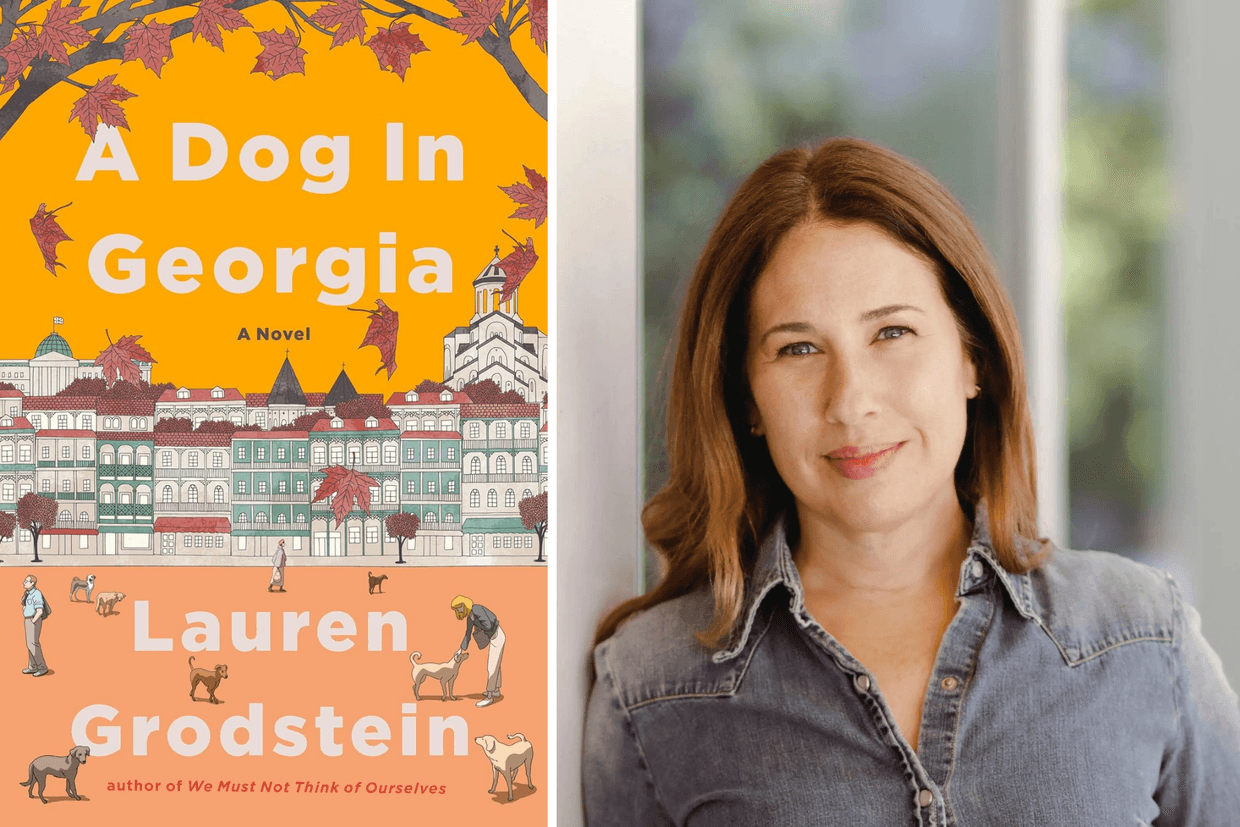
A Dog in Georgia promises a story of self-discovery set against Georgia’s political turmoil, but instead delivers an uneven narrative where the country feels more like a convenient backdrop.
There are not many books about Georgia — set in Georgia, or even mentioning Georgia — in English. As an enthusiastic Georgian bookworm, any new literature is intriguing — yet Lauren Grodstein’s 2025 novel A Dog in Georgia just led to one recurring thought: ‘Girl, get a grip’.
The premise is familiar enough. Amy Webb is a 46-year-old American who, despite having spent most of her adult life in a swanky New York neighbourhood, repeatedly reminds Georgians and the reader she is from Minnesota in an apparent attempt to seem more relatable. When she discovers that her husband has cheated on her (again), she decides on a whim to travel to Georgia, in search of both herself and a missing dog. Think Eat, Pray, Love, but with dogs.
The dog that draws Amy to Georgia is named Angel (Angelozi), whose videos she has been obsessively watching on YouTube during a period of insomnia. The symbolism of dogs in Amy’s life is laid on thick from the start. The novel opens with her encountering a mysterious stranger in a park who claims to understand animals and tells her that her own dog is miserable. The moment unsettles her and begins the spiral that eventually leads her to Tbilisi.
Amy is presented as someone who has always felt a deep connection to animals. She volunteered at animal shelters as a teenager and regularly fosters rescue animals. If this makes you expect a story where dogs are important, however, you will be disappointed, as the animals turn out to be largely incidental to the narrative and mostly irrelevant.

Subscribe to the Culture Dispatch
A bi-weekly newsletter featuring film, book, and music recommendations from the Caucasus, handpicked by our team.
Set in 2023 — right after the ruling Georgian Dream party first attempted to introduce a foreign agents law — what initially promises to be an interesting journey gradually becomes a clumsy attempt to portray Amy’s personal crisis against the backdrop of Georgia’s ongoing struggle for democracy and her tentative connection with people who speak passionately about tavisupleba — self-rule, as it is explained to her.
She repeatedly expresses surprise that the people she meets speak English. When her husband or stepson mention facts about Georgia, her instinctive response is simply: Where did you learn that? Amy, who considers herself an experienced food writer, arrives knowing nothing about Georgian cuisine or wine and shows little to no curiosity about learning.
In truth, the setting could have been almost anywhere. Armenia, Azerbaijan, Lithuania, Montenegro, Kyrgyzstan, Bolivia, Pakistan — anywhere that is not Italy or France. Georgia itself rarely feels essential to the story.
At first I wondered whether Amy was intentionally written as an exaggerated portrait of a sheltered, privileged American abroad. But as the plot grows increasingly improbable, drifting at times into near-fantastical territory, it begins to feel like uneven writing rather than a deliberately unlikeable protagonist.
In the span of a single week in Georgia, during which she rarely leaves central Tbilisi, Amy manages to reconsider her entire life. She cheats on her husband with a Russian deserter lodging in her host Irina’s house. She encounters a Brit living in Georgia who generously (read: patronisingly) explains the nature of Georgian people. She finds herself caught up in protests on Rustaveli Avenue. She befriends her host’s 17-year-old daughter, the fiercely anti-Putinist Maia, and later saves her from the police by bribing an officer with the $1,000 in cash her husband gave her before the trip. Somewhere along the way she also locates the missing dog, though by this stage it feels beside the point.
As a Georgian reader, I could clearly see the writer’s attempt to portray a political moment to elevate the already told story. But the execution doesn’t live up to that ambition and instead comes across as orientalist — Georgian characters are exaggerated, cartoonish versions of Georgian people, given stereotypical backstories.
While it is commendable to have more novels published focused on women in their forties, this one won’t be among my favourites.
Book details: A Dog in Georgia (2025) by Lauren Grodstein. Buy it from the publisher here.