3.5/5★
This debut work is an exploration of girlhood, leaning into an internal, almost private narrative that speaks to a collective female experience.
Anastasia Chanturaia, a young Georgian actress, recently debuted her original work Persephone (Where the Light Forgets Me) at the Haraki Theatre, being both the author of the text and the director.
While the play’s official description frames it as a research-based, gender-sensitive observation of the contemporary world, the experience feels much more like an internal search built on personal experience, which also narrows the audience, as such narratives are rarely intended for a wider crowd. It is a work that finds a resonance within specific patterns of relationships and experiences common to women in general, largely because Chanturaia dares to wonder if the mythological Persephone herself might have shared these same jagged experiences of girlhood. Otherwise, the performance has little to do with the Persephone myth.
The play opens with Chanturaia in an embryo position. We see her waking up, literally tasting (licking) herself as she begins the process of starting her life. In the small, intimate space of Haraki, watching this feels like looking in on someone’s most private moments. Despite the starting position, the narrative is not linear, and we don’t meet the character as a child — instead, it is an awakening into a fragmented story of girlhood.
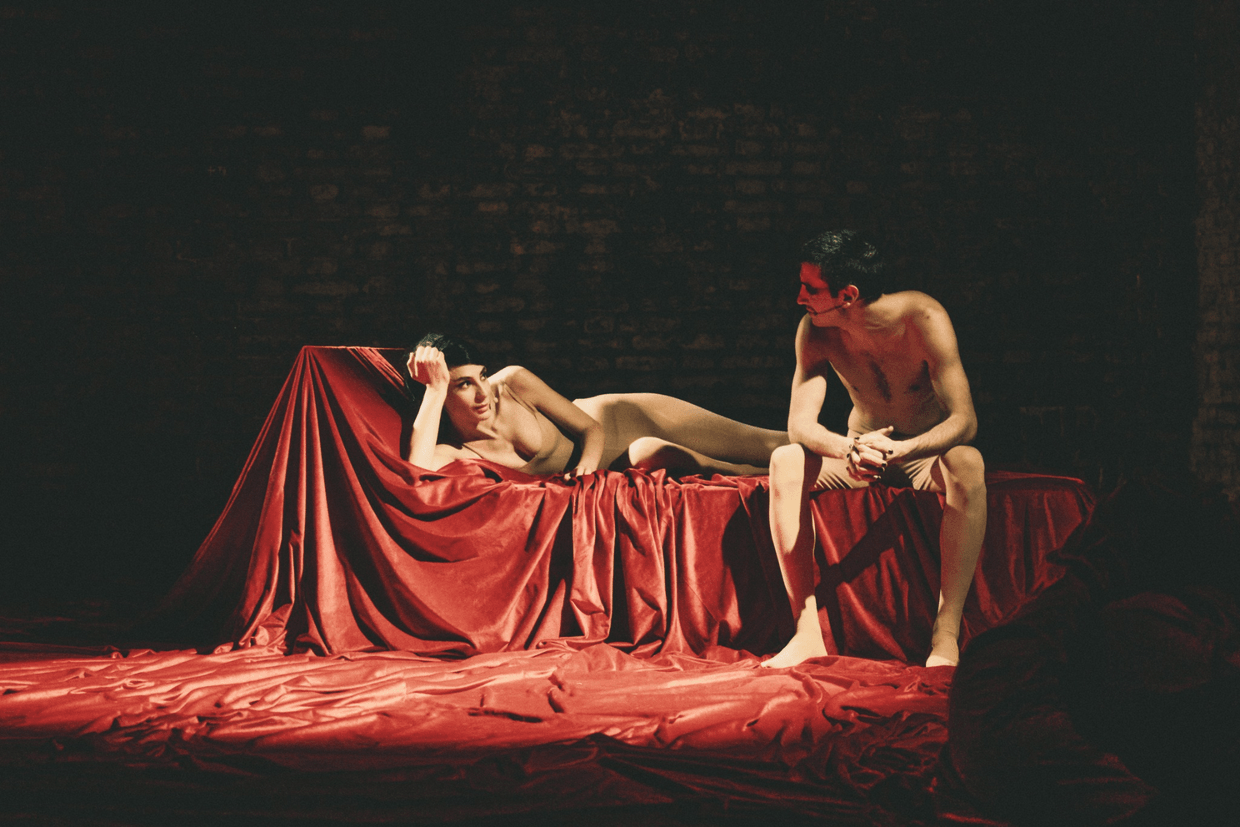
Chanturaia is soon joined on stage by actors Gviko Baratashvili and Nika Japaridze. After the initial awakening, all three begin to move together in a rhythmic, synchronised manner that feels like a video game or a digital loop. As the movement progresses, the play transitions into the reality of an adult woman’s life, introducing the words and experiences she encounters. It is here that the ‘hell’ of the girl’s own mind and society starts to emerge through her interactions with the two men. Baratashvili and Japaridze don’t play single characters. They act as archetypes — sometimes toxic partners, sometimes critics, and sometimes the haunting echoes of childhood traumas and that constant, desperate call for a father who never arrives.
This ‘hell’ is anchored by a literal and figurative plea that repeats all the time: ‘მა, მამიკო, მამიკო, სად ხარ?’ (‘Dad, daddy, where are you?’). In Chanturaia’s script, the father is never a physical presence or even a real character — he is a ghost who affects Chanturaia’s life by his absence.

Subscribe to the Culture Dispatch
A bi-weekly newsletter featuring film, book, and music recommendations from the Caucasus, handpicked by our team.
The soundscape — crafted by GABISKIRIAMALIA, Liza Dzagania, and Saba Padiurashvili — is essential here. It moves between the aggressive noise of the outside world and a rare, quiet calmness, making the audience feel the protagonist’s internal shame and the uncomfortable eroticism of her experiences.
The scenography by Tamar Nadiradze, draped in red velvet, evokes an underworld that is both luxurious and suffocating. The scenes shift between total darkness and moments of intense brightness. Interestingly, it is these well-lit parts that feel the most awkward and shameful, forcing the audience to look directly at that which creates the most uncomfortable feelings, leaving nowhere to hide. While there are rare, yellowish moments of calm, they are brief — overall, the play is defined by an overarching sense of anxiety.
While some theatre critics have argued that the texts were cliché — which is partially true — the idea behind it seems to be that this is exactly how trauma operates. Trauma is a loop of the same familiar, painful patterns that repeat over and over.
The actual myth of Persephone only surfaces toward the end of the play. It is here that the main character reflects on the goddess herself, wondering how Persephone truly felt with Hades while she was in the dark and when she was calling for her father for help. This reflection leads to the appearance of a towering, monstrous figure of red velvet, looking like a woman, acting as a representation of the collective weight and the ‘monster’ of womanhood that has been built throughout the performance.
The play eventually reaches a so-called conclusion, though given there is no clear story, a traditional resolution feels impossible. Instead, Chanturaia offers a kind of realisation: you may never find what you have lost (a phrase Chanturaia repeats a lot during the play), but you can learn to recognise it — and what you recognise is you.
Finally, the play comes full circle, returning Chanturaia to the embryo position where she began. This is not just a metaphor for being trapped in a cycle of trauma, but rather suggests that the wounds shaping a woman’s life often trace back to the very beginning. Even as an adult who finally understands and recognises herself, she may still look at the world through the vulnerable eyes of a newborn.
Persephone (Where the Light Forgets Me) was staged at Haraki Theatre in Tbilisi. It was presented with English subtitles. The next performances are scheduled for 31 March and 1 April 2026.