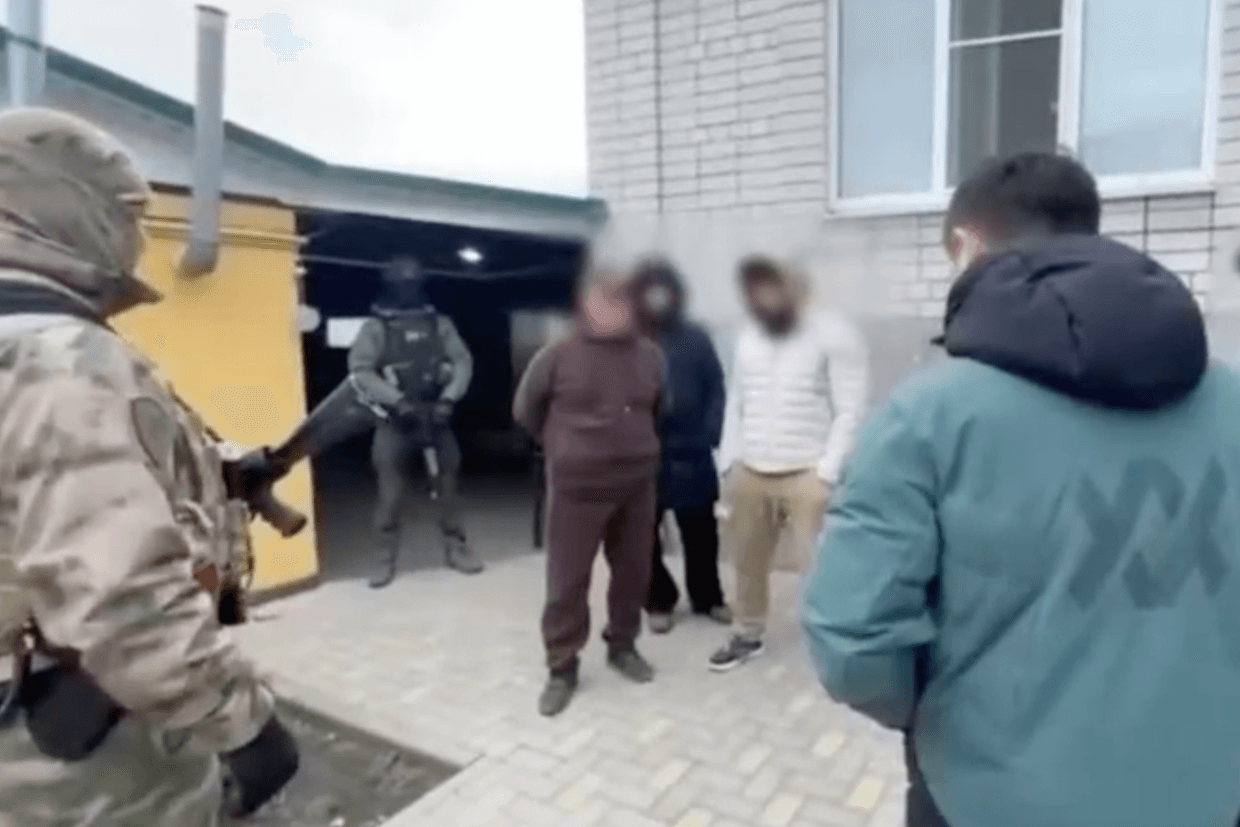
In Karachay–Cherkessia, security forces have detained a 30-year-old resident of Cherkessk on suspicion of extremism and public calls for terrorism. According to regional branches of the Interior Ministry and the Investigative Committee, the criminal case was opened over his comments and voice messages posted online, which were said to contain ‘anti-Russian statements’.
The detention of the Cherkessk resident, whose name has not been disclosed, was carried out by officers of the Interior Ministry’s Centre for Combating Extremism (Centre ‘E’), together with the regional Federal Security Service (FSB) directorate and with the support of National Guard troops (Rosgvardiya). The press service of the Interior Ministry for Karachay-Cherkessia said that law enforcement officers were alerted by the suspect’s activity on an online platform.
According to the investigation, the man used his father’s mobile phone in 2024 to register an account ‘on one of the popular internet resources’. He later posted comments and voice messages which, according to expert analysis, contained elements of incitement to hatred and hostility towards ‘a particular group of persons’, as well as ideas ‘aimed at undermining statehood’.
Security officials claim that in some of his messages the man advocated the ‘creation on the territory of Eurasia of a new state based on ethnic, national and religious principles’. In addition, according to law enforcement authorities, some of his statements allegedly justified the activities of an organisation banned as terrorist in Russia.
The man has been charged under the article of the Russian criminal code on ‘public calls for terrorism using the internet’, which carries a sentence of five to seven years’ imprisonment, as well as under the article on ‘incitement of hatred or enmity’, which provides up to five years in prison.
The Investigative Committee stated that during questioning the detainee ‘fully admitted his guilt’. A court has placed him under a travel ban and ordered proper conduct as a preventive measure.
Criminal prosecutions over online publications are regularly reported in other regions of the North Caucasus. According to the independent media outlet Caucasian Knot, at least seven residents have been sentenced to prison terms over the past four months alone. The actual number of such sentences is likely higher, as not all cases of alleged justification of terrorism appear in publicly accessible court databases.
For example, on 31 March 2026 a military court in Rostov-on-Don sentenced Daghestani native Magomed Abdurakhmanov after finding him guilty of promoting terrorism. He was given three years in a general-regime penal colony for two comments posted online.
On 18 December 2025, a court press service reported that another resident of Daghestan, Omar Ismailov, had been sentenced to four years’ imprisonment for publishing a text in a channel he administered that justified terrorist activity.
In May 2025, the Supreme Court of Kabarda-Balkaria transferred another minor from pre-trial detention to house arrest in a justifying terrorism case. The defendant, a first-year student at the Kabarda-Balkaria Agro-Industrial College from the Cherek district, was, according to her lawyers, ‘just 16 years old at the time of the alleged offences’. The court took into account that prior to her arrest she ‘looked after her younger brothers and sisters and cared for her mother suffering from cancer’, while the prosecutor had insisted on keeping her in custody.
In July 2025, defence lawyers sought to ease the preventive measure for a minor from Makhachkala arrested on charges of justifying terrorism. His mother told the court she was willing to act as a personal guarantor, but the Supreme Court of Daghestan left the teenager in a detention centre.
When deciding on preventive measures, courts rely on the classification of criminal offences by severity. Justification and promotion of terrorism are classified as serious crimes, while similar calls for extremist activity fall under offences of medium gravity.