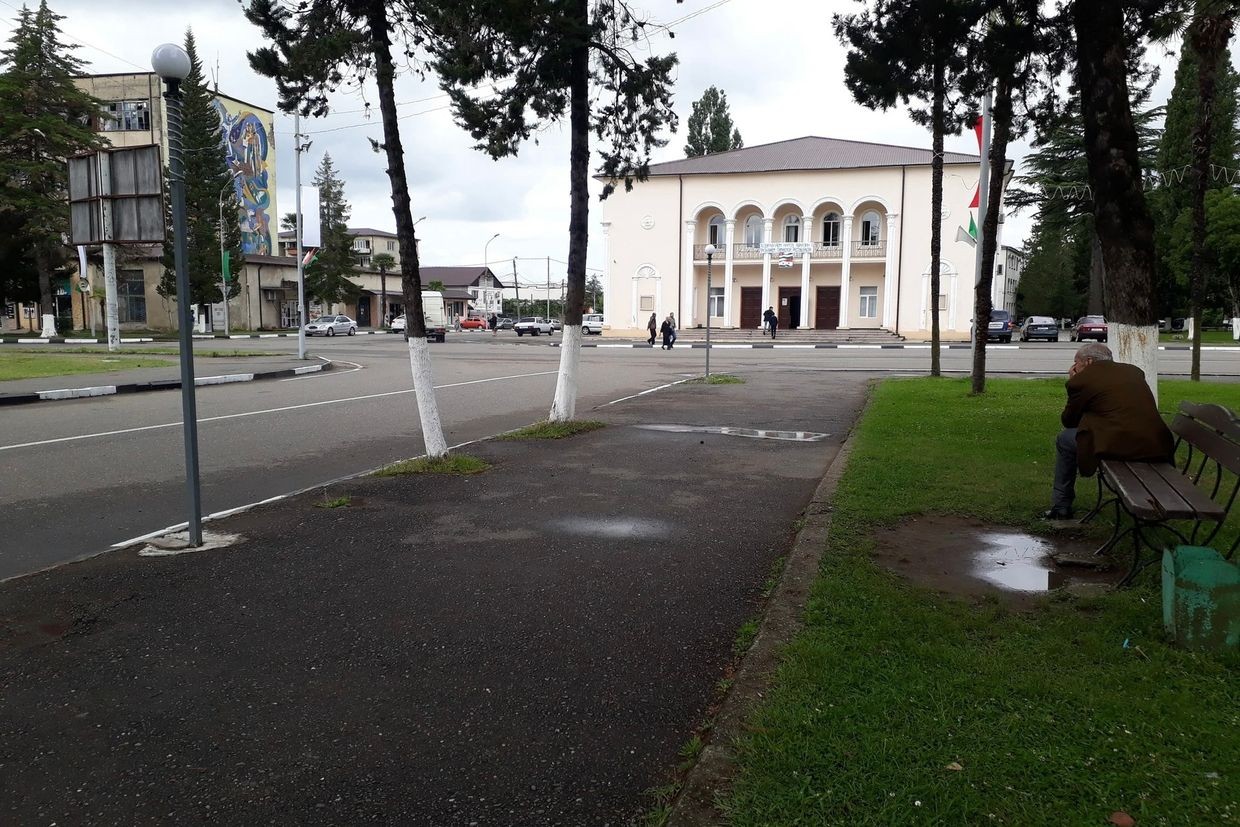
‘In 2008, a fence was erected in the back of my yard, which is just at the River Enguri [Ingur]. Neither we nor the cattle could go into the river to swim’, a 65-year-old man from the village of Otobaia, in Abkhazia’s eastern Gali (Gal) district, tells OC Media.
After the War in Abkhazia (1992-1993), he and his entire family returned to their village, intending to rebuild their home. For many years, crossing between Abkhazia and Georgian government controlled areas was easy — but following the August 2008 War, when Russian forces entered Abkhazia and the boundary demarcation was run through his own yard, things have grown increasingly difficult.
‘Many times have my cows or pigs crossed this line, and of course we couldn’t turn them back, because Russian soldiers immediately run to catch them if anyone crosses this line’, he says.
The Gali district is an area historically neglected by both Abkhazian and Georgian officials, though both recognise it as being a part of their territory. Located along the River Enguri, the district has a total population of around 30,000 people, according to 2023 census data. The vast majority, roughly 98%, are ethnic Georgians, representing the bulk of the Georgians who remain in Abkhazia since the war.
Every year, there is a population outflow, especially among young people.
In 2024, Konstantin Piliya, the head of the Gali District administration, told JAMNews that this was ‘one of the most serious problems we have’, adding that they were ‘doing everything to create conditions for them to stay here’.
The town of Gali and its wider district form a geographical area that has long been neglected by Sukhumi (Sukhum) and Tbilisi, with most Georgians having seemingly forgotten about it.
Occasionally, some type of tragedy occurs that manages to break through the radio silence and capture the attention of Georgian media — causing short, predictable emotional outbursts — but they rarely lead to significant policy changes or the formation of real plans for how to help better the lives of Gali residents.
As the status quo remains, generation after generation remain caught between opposing forces, and must deal firsthand with the difficulties of the conflict.
Perhaps most illustrative of this is the constant struggle that Gali residents face when trying to cross the boundary.
The first thing one encounters after crossing the Enguri Bridge out of Abkhazia is an apparent copy of a famous monument to non-violence — a gun with a twisted barrel — originally created by Swedish sculptor Carl Fredrik Reuterswärd in 1980 after he learned about the murder of John Lennon.
There are scant details on when the replica was installed — or why — besides that it occurred sometime during the presidency of former Georgian President Mikheil Saakashvili.
As a symbol of non-violence, in a contested territory marked by unresolved war, the monument serves as a poignant reminder. But of what, no one is really sure.

‘During COVID, Abkhazia suddenly became another country’
For 33 years, the residents of Gali have observed how the dynamics of crossing the boundary have changed. One of the most noticeable moments was the onset of the COVID-19 pandemic in 2020, which marked a significant step backwards in the ease of crossing.
According to a 2022 report by the Georgian human rights organisation Social Justice Centre (SJC), additional checkpoints began to appear in 2009 — namely the Shamgona-Tagiloni, Khurcha-Nabakevi, Orsantia-Otobaia, and the Pakhulani-Saberio crossings. However, from 2016 onwards, the Abkhazian government began abolishing these crossing points. As of 2022, only two crossings remained — the Enguri Bridge and the Pakhulani-Saberio crossing.
The closure of the crossings has significantly worsened the situation in Gali, especially in terms of human rights and access to healthcare. It has led to increased fines for illegal crossings, with fines tripling since 2017, and administrative detention for repeated violations. Residents who do not have documents or whose crossing point is closed have to take dangerous routes, such as crossing the Enguri River or taking mountain trails — such unauthorised crossings have claimed many lives over the years.
The COVID-19 pandemic further exacerbated the situation, as authorities in Abkhazia and South Ossetia restricted crossings, and the Georgian government enforced quarantines, forcing people to cross into Georgian-controlled territory in secret for emergencies.
‘The Enguri Bridge, the only way for residents of the Gali region to connect with the rest of Georgia, was closed in late February 2020, immediately after the first case of COVID-19 was detected in Georgia, and was only fully reopened on 5 July 2021. This decision has caused thousands of people to suffer and claimed four lives’, RFE/RL journalist Lana Kokaia, herself from Gali, wrote in 2022.
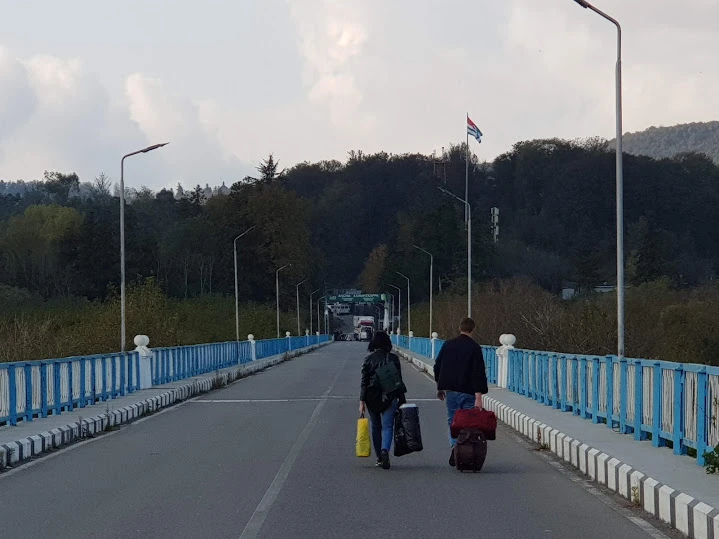
Although the COVID-related closures are now in the rearview mirror, many Gali residents still feel lingering resentment over the hardships they experienced at the time.
‘As you know, during the COVID-19 pandemic, the border was closed for more than a year’, a 53-year-old woman from Gali tells OC Media. ‘This fact further deepened our already existing distrust of the Georgian side. This led to the fact that our needs were completely ignored during such a difficult time’.
The woman works in agriculture, like the vast majority of the population of Gali district. She says that during the pandemic, in isolated Gali, it was difficult to purchase the necessary equipment, most of which was located in Zugdidi, across the boundary in Georgian-controlled territory.
‘In addition to the fact that we did not have access to many services and our needs were not met, it also became quite difficult to obtain medicines during the pandemic’, the woman says, adding that buying medicine in Zugdidi had previously been the norm.
A 30-year-old man from the village of Kvemo Barghepi (Barghap) tells OC Media that he had connections with friends living in Tbilisi who were asking representatives of Georgia’s Ministry of Health and IDP Affairs to open the boundary crossings or to cancel the mandatory two-week quarantines.
‘Quarantines, as a rule, were imposed on foreign or Georgian citizens arriving from another country during the pandemic. We, people from Gali, did not expect that this rule would apply to us’, the man says.
‘The Georgian side often says that “Abkhazia is Georgia”, but during COVID, Abkhazia suddenly became another country and quarantine was mandatory? I think that there was more corruption here than caring for the health of people from Gali. We begged them to open the border. But the Georgian side did not do this, which ultimately resulted in a tragic outcome’, he says.
In April 2021, four Gali residents drowned in the Enguri River while trying to cross into Georgian-held territory. Then-Prime Minister Irakli Gharibashvili declared 7 April to be a day of mourning.
‘They cannot defend themselves’
However, the COVID-19 pandemic simply exacerbated pre-existing issues, residents of Gali tell OC Media.
In particular, they say that there is a lingering sense of distrust from Georgian border guards, which sometimes spills over into outright hostility.
The same 2022 report by the SJC noted that a number of Gali residents reported that Georgian border guards aggressively searched all personal items during crossings. A 29-year-old woman from the border village of Nabakevi (Bataigvara) explains to OC Media that the Georgian authorities mocked her or spoke with her in a patronising manner.
‘Sometimes people present their ID card, passport, or existing Abkhazian residence card or passport. I remember such a case when a Georgian border police officer very rudely, without giving any reasons, opened my friend’s bag and rudely threw his Abkhazian document at him and said, “Go show this to your Abkhazians” ’.
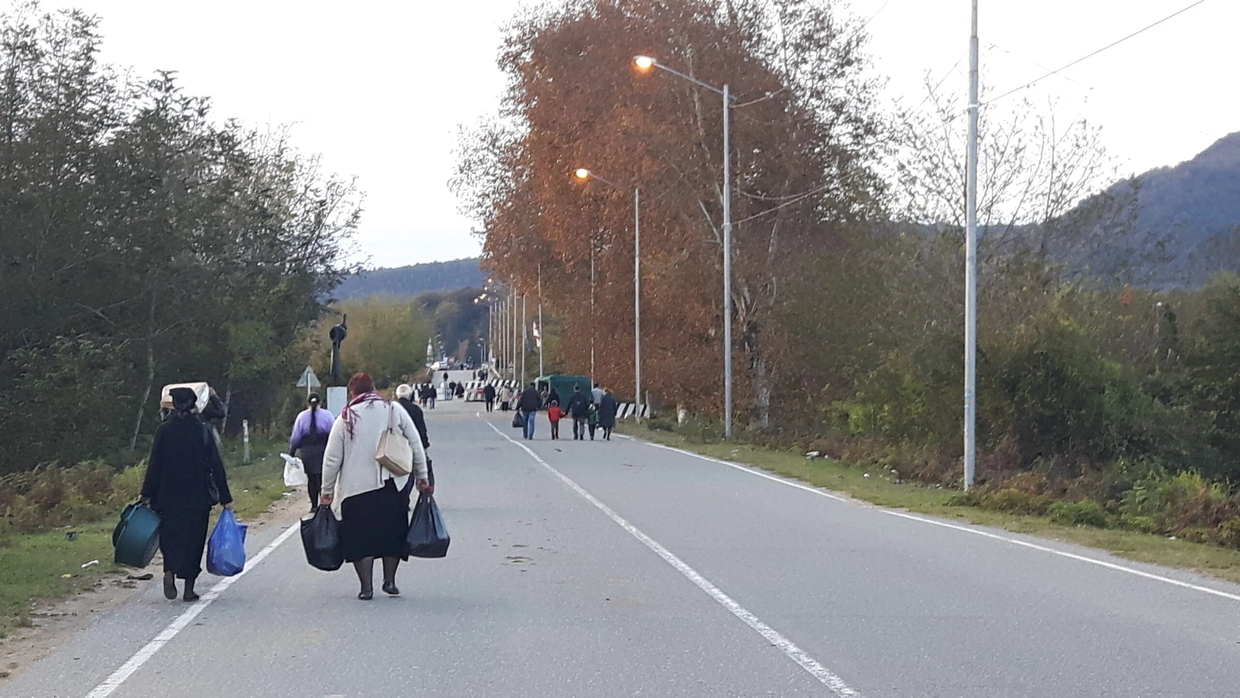
Until 2021, those who used the checkpoint did not have to present an identity document to the Georgian police. When the woman asked why it became mandatory to present an ID card every time, no one could give a satisfactory answer.
‘One border guard told me that this process has been going on since the end of the war, which is a big lie. No one remembers anything like this. Another police officer told me at another time that since the traffic from and to the occupied territory has grown, they need approximate statistics on border crossings. The third police officer didn’t even answer me and just told me that I was asking too many questions and it was better to mind my own business. As you can see, the attitude is not at its best level’.
A 20-year-old student, also from Nabakevi, who often has to go through border control because she studies in Zugdidi and returns to her village in the Gali district on weekends, shared similar sentiments with OC Media.
She also commented on the non-violence monument — the gun with the twisted barrel — saying she found it funny, if not outright satirical or altogether insincere that it exists.
‘Maybe once, it sincerely carried its symbolic meaning and sent a message of peace to the Abkhazians, but in the last few years I have realised that all this is a façade. A few metres from this monument stands a passport control booth, where the Georgian police, by aggressively checking the documents and bags of ordinary people, supposedly solve the long-standing problem of smuggling’, the student says.
She gave several examples where she and her family members or acquaintances were not allowed by the Georgian border police to transport furniture from Zugdidi to Gali, adding that the restrictions could apply to any range of products, including produce.
‘At the very beginning of the checking process, even women were checked by men. I have repeatedly protested about this and told those around me that this is not normal’.
The student says that it has been several years since women police officers appeared in this process.
Another respondent, a 24-year-old man from the village of Saberio (Papanyrkhua), implies to OC Media that many more Gali residents have experienced poor treatment by the Georgian police, but are afraid to speak up. However, he added that he has been crossing to and from Abkhazia alone since he was 14 years old and has never experienced anything untoward himself.
‘People who have come from Abkhazia do not have the courage to speak up because of their low level of awareness. They cannot defend themselves, they cannot demand better treatment, because they have to live in oppressive conditions in Abkhazia’.
He said that he curated a project in Zugdidi where he and his colleagues explained to people from Abkhazia that they had the ability to petition the Georgian authorities if they had evidence of poor treatment.
‘But they cannot get out of this situation, and they easily play the role of the oppressed’.
‘The structure is crumbling’
Based on both comments made to OC Media and those collected in the SJC’s 2022 report, there is a consensus that Gali residents feel a general level of distrust to the police guarding the Georgian side of the border, which further fuels hesitance to cross into Georgian-controlled territory and adds to sense of neglect and hopelessness of the ethnic Georgian population of Abkhazia.
These factors are further exacerbated by the ever-changing political landscape in Georgia and the looming presence of the frozen conflict in the background, resulting in the isolation — and increased surveillance of Gali residents.
When taken altogether, it is no surprise that many in the area, particularly young people, ultimately opt to simply leave the Gali district.

Researcher and PhD Student in Urban Studies at Tbilisi State University Natia Kekenadze, who focuses on rural/regional development and the integration of IDPs, tells OC Media that this conflict is complex and multi-dimensional, yet while discussions around them can go on endlessly, the tangible changes must be done now.
‘One truth remains: the primary responsibility lies with the state and its authorities, who must take decisive action to resolve them’.
Kekenadze says that civil society plays an important role, but grassroots initiatives alone cannot shoulder what is ultimately the duty of the state.
‘Due to Georgia’s current political crisis, this long-forgotten frozen conflict and the peacebuilding process is becoming less and less of a priority. It is not even discussed daily with experts or those directly affected: IDPs, returnees, the people of Gali on where they see the solution for their daily struggles, especially mobility problems’.
Similar sentiments have been expressed by other researchers, who have also warned that Georgia’s shift away from the West under the ruling Georgian Dream party is making the problem worse.
Eliko Bendeliani, a conflict researcher working in the area for decades, says that Western support has quietly built a fragile ‘architecture of peace’ since the August 2008 War.
From dialogue projects for schoolchildren and university students to platforms like the Geneva International Discussions, small steps have kept threads of connection alive between Georgians, Abkhazians, and Ossetians. But this architecture, Bendeliani warns, is now collapsing.
‘Peace has been built grant by grant, conversation by conversation. But today, that structure is crumbling. With Georgia’s deepening political crisis — mass protests, electoral disputes, the suspension of EU membership hopes until 2028 — conflict resolution has slid off the agenda. If this architecture collapses, Abkhazia and South Ossetia will become even more dependent on Russia. The only space left for connection — education, exchange programmes, dialogue — is funded by the West. If that goes, everything else does too’.
For ease of reading, we choose not to use qualifiers such as ‘de facto’, ‘unrecognised’, or ‘partially recognised’ when discussing institutions or political positions within Abkhazia, Nagorno-Karabakh, and South Ossetia. This does not imply a position on their status.
 Lana Agrba