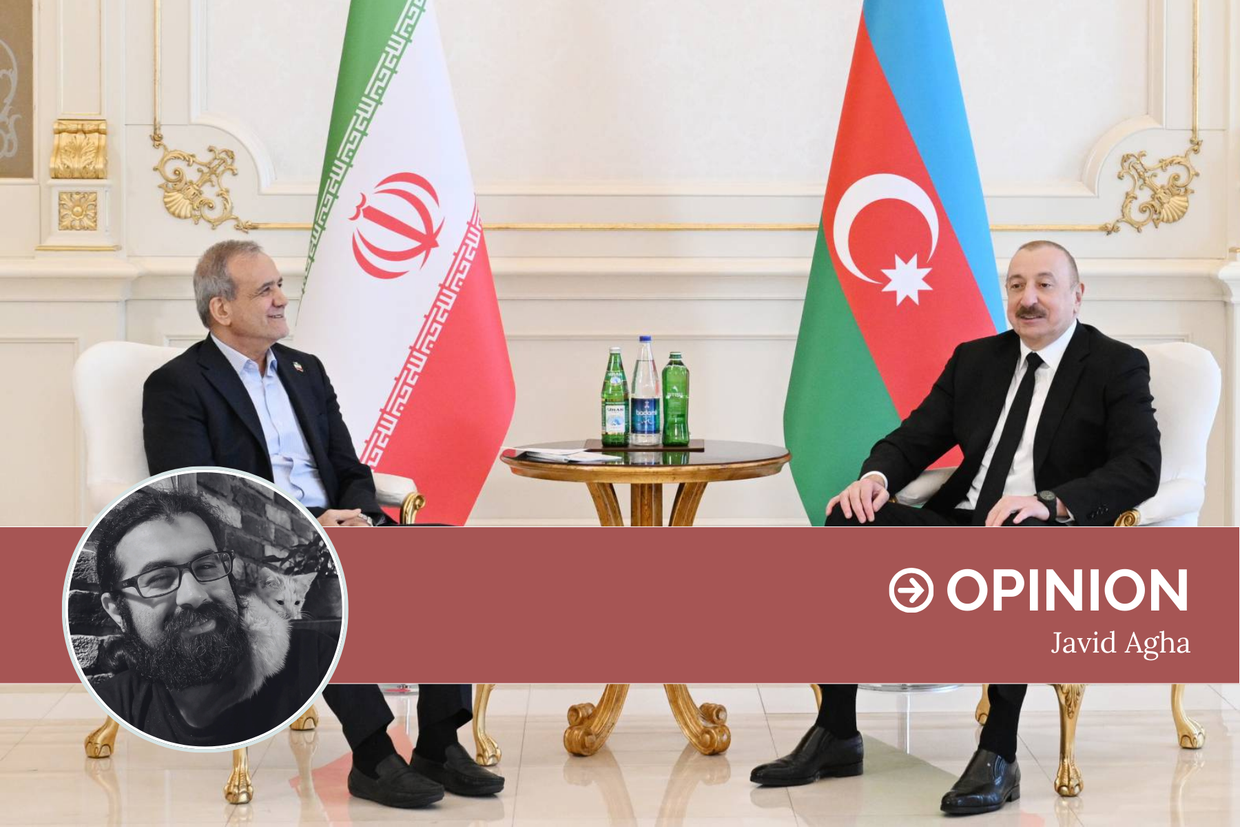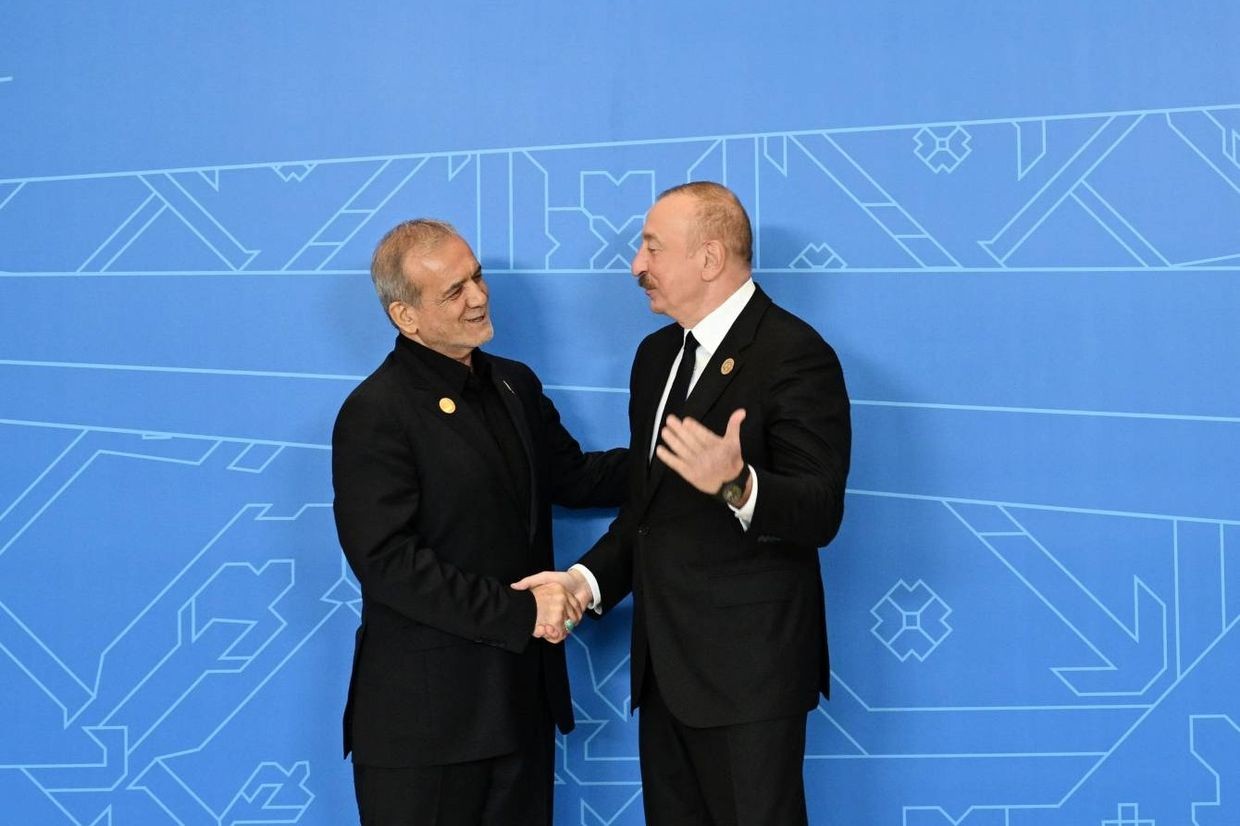
Iranian President Masoud Pezeshkian called his Azerbaijani counterpart Ilham Aliyev on Sunday evening and officially denied Tehran’s involvement in the drone strikes on the Azerbaijani exclave of Nakhchivan on 5 March — which Baku blamed on Iran shortly after the incident.
The phone call added a further layer of complexity on an already tense situation between the two countries, as rumours continue to swirl that Azerbaijan may be pulled into the war.
Previously, on Saturday, Azerbaijan’s security service (DTX) said it had foiled a terrorist plot organised by the Islamic Revolutionary Guards Corps (IRGC) against the Baku-Tbilisi-Ceyhan (BTC) pipeline and several Jewish sites in Azerbaijan. While the DTX released a video detailing the investigation on 6 March, accompanying information shared by the state-run media outlet Azertac said that several of the suspects had already been tried, convicted, and sentenced to prison, meaning the actual plot had been organised earlier, likely long before the drone strikes.
The terrorist plot was not mentioned in the readout of the phone call between Aliyev and Pezeshkian.
Instead, it said that Pezeshkian ‘expressed his gratitude to President Ilham Aliyev for his visit to the Iranian Embassy in Azerbaijan to offer condolences over the passing of the Supreme Leader [Ayatollah Khamenei], and numerous civilians, as well as for his intention to provide humanitarian aid to Iran’.
‘Noting that the incident involving [the] airstrike on Nakhchivan had no connection with Iran, President Masoud Pezeshkian emphasised that the incident would be investigated’.
There was no mention of who Pezeshkian may have claimed did carry out the drone strikes.
For his part, Aliyev ‘once again expressed his condolences over the death of numerous civilians in the recent events in Iran’ and ‘underlined the importance of investigating the incident that occurred in Nakhchivan’.
The conversation was immediately seen as a sign that both sides sought de-escalation, a sentiment that was further boosted by events on the ground on Monday, when the flow of cargo between Iran and Azerbaijan reopened and flights from Baku to Nakhchivan resumed.
Uncertainty remains
Even as these signs of rapprochement appeared to cool the tensions between Azerbaijan and Iran, there were still reasons to believe the period of escalation had not ended.
Perhaps most notably, there have been growing indications that Pezeshkian’s more conciliatory tone is at odds with the hardliners in Iran’s government.
On Saturday, Pezeshkian issued an apology for Iran’s strikes on its neighbours — that did not mention Azerbaijan — and said there would be no further attacks ‘unless those countries launch an attack on us’.
Nonetheless, his statement was shortly followed by further strikes against Gulf countries.
On the same day as Pezeshkian’s statement, a spokesperson for Iran’s military demanded that Azerbaijan ‘expel the Zionists’ from the country ‘in order to prevent the spread of insecurity in the region and not to endanger the security of its people and Islamic Iran’.
Pezeshkian’s conciliatory message also received some backlash within Iran, with other lawmakers describing it as ‘humiliating’ and a sign of weakness.
The selection of Mojtaba Khamenei, the son of the late Ayatollah, as the new Supreme Leader, was yet another sign that the hardliners remain in charge.
Meanwhile, as of Monday, the Azerbaijani Foreign Ministry has continued to explicitly state that Iran had carried out the drone strikes against Nakhchivan.
 Javid Agha