★★★★☆
In a country where cultural prestige is often performed, this play dares to laugh at the performance itself.
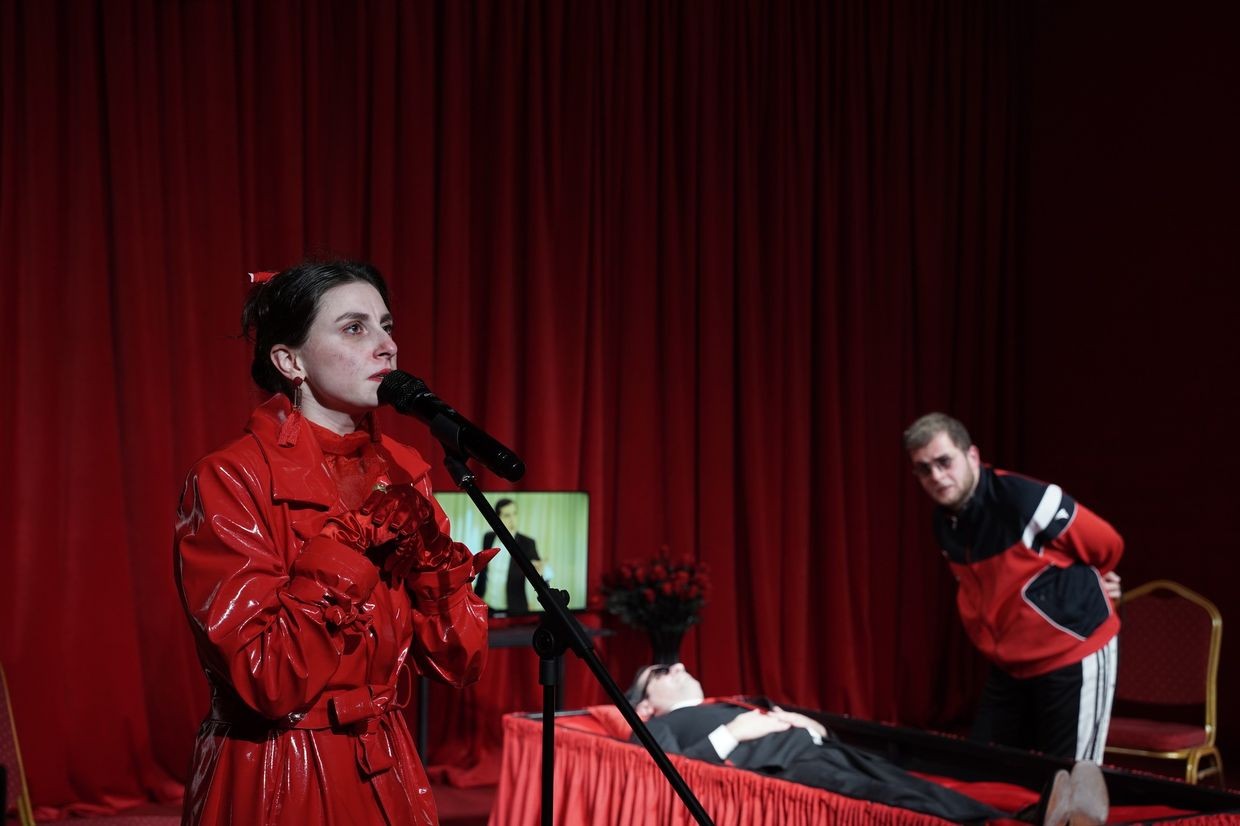
Pathetic Monologues, directed by Ilia Korkashvili and written by Temo Rekhviashvili, tells the audience about the funeral of Archil Kiacheli, a well-known actor whose legacy is being publicly shaped, polished, and claimed by others. The play uses his staged funeral as a satire on theatre itself: the pride, the protocol, and the expectation that everything, even grief, should look meaningful, controlled, and respectable. Here, the funeral feels like a performance, with well-known theatre figures arriving to offer rehearsed tears.
The play begins with two theatre workers preparing the stage for Kiacheli’s funeral. They talk about low salaries, a lack of support, and the expectation to create ‘high culture’ without real funding. Their conversation sounds familiar, something heard backstage, in offices, and online. It quickly becomes clear that this scene introduces a bigger question: how much of Georgian cultural life depends on image rather than reality?
A clear target of the satire is elitism within the arts and the politics that often surround it. Throughout the funeral, characters arrive to deliver official speeches, from government or cultural institutions, each trying to link the actor’s legacy to their own narrative. It becomes a commentary on how public figures are spoken for, claimed, and reshaped after they are gone. The fact that the dead actor occasionally opens his eyes to disagree with some speeches made at his funeral makes the scene funnier and sharper.
The tempo is slow and intentionally stretched, as Rekhviashvili openly intended. The direction embraces this approach. The monologues are long, sometimes too long, yet they hold attention because the pathos they carry becomes unexpectedly funny.

Subscribe to the Culture Dispatch
A bi-weekly newsletter featuring film, book, and music recommendations from the Caucasus, handpicked by our team.
The scenography breaks also expectations. In Georgia, funerals are usually framed in black but this stage is completely red — red curtains, red clothing, red space. The choice feels bold: red looks more like anger than grief, more like a warning than tradition. There is also little silence. Characters often sing the words they could just say, which works as commentary rather than decoration.
Rekhviashvili’s distinct style appears again in the way objects and non-human characters are allowed to speak. In this play, a stray dog tells stories about the dead actor. A TV broadcasting tower also shares its view, literally from above. In another of Rekhviashvili’s works, CO2, a candle and a disposable tissue become storytellers. It is a simple but effective idea, showing that the things people ignore sometimes understand them better than the institutions that claim to represent them.
The length of the play may not suit everyone, and the humour is subtle, not loud. Viewers looking for a fast plot or a clear emotional message may walk away unsure. Those uncomfortable with criticism of cultural traditions may also find it difficult. But for audiences willing to engage, Pathetic Monologues offers something valuable: a chance to laugh at the seriousness that often controls cultural life.
Pathetic Monologues premiered at Tbilisi’s experimental theatre company Haraki in 2024. The next performances are scheduled for 24 and 25 December 2025, with additional dates expected to follow.