★★★★☆
A single image from Repentance resurfacing at ongoing protests in Georgia captures the film’s critique of totalitarianism.
Georgian director Tengiz Abuladze’s 1984 feature Repentance, often described as a ‘prophecy of perestroika’, was completed three years before it finally reached the public. Censored and shelved by the Soviet government for alluding to the atrocities of the regime, it circulated in Georgia only through small screenings from illegally obtained videotapes. When it did emerge into the open, the film won the prestigious FIPRESCI Prize at the 1987 Cannes Film Festival, establishing its status as a landmark of Soviet-era cinema.
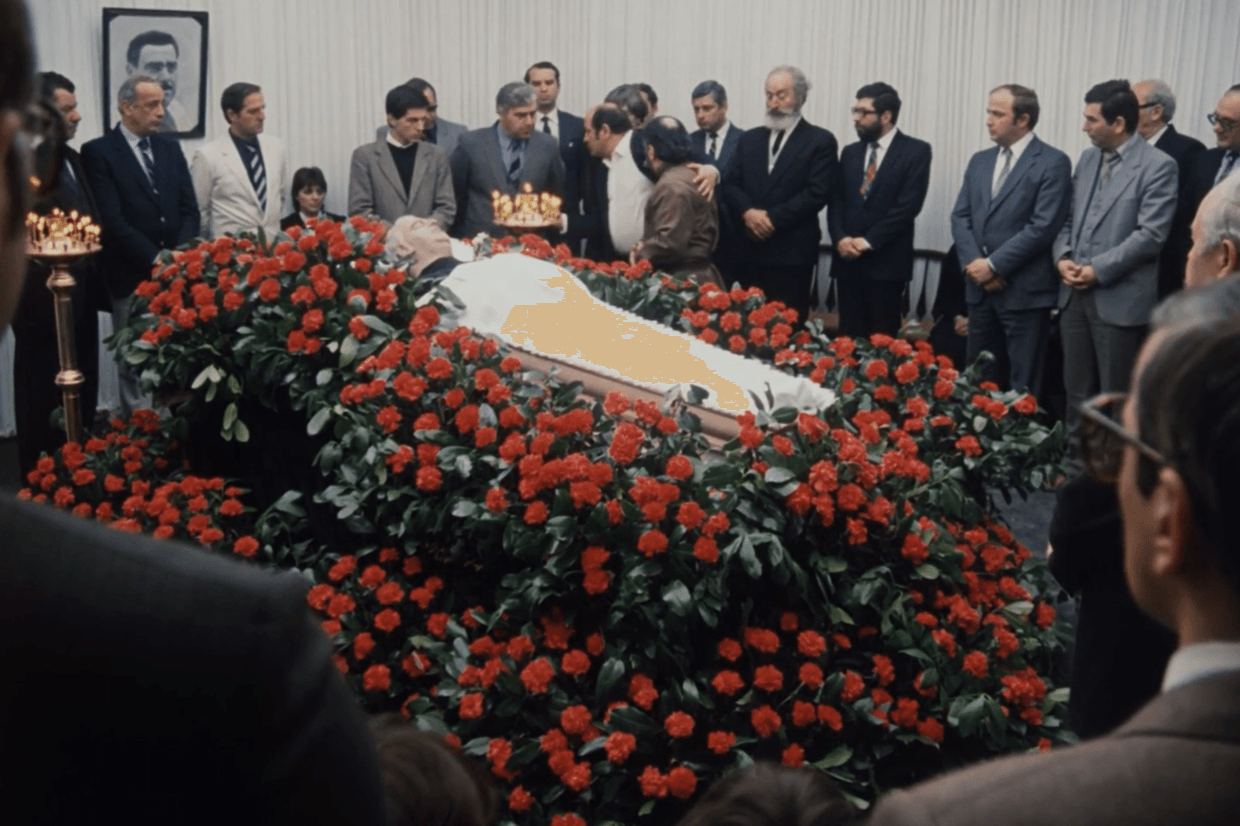
Repentance unfolds in an unnamed Georgian town, beginning with the death of its long-serving mayor, Varlam Aravidze (Avtandil Makharadze). After a lavish, heavily attended funeral, his family awakens the next morning to a horrifying sight: his corpse has been exhumed and deposited in their garden. Before they rebury him, the police take the body for investigation, during which one police officer remarks, ‘What times we are living in […] Even Varlam is arrested’, as his colleagues shush him.
The next night, Varlam’s young grandson Tornike (Merab Ninidze) stakes out the cemetery along with police, who emerge from their hideout and arrest the perpetrator, local woman Ketevan Barateli (Zeinab Botsvadze). At her subsequent trial, Ketevan declares that Varlam does not deserve burial at all, revealing that he orchestrated 1937-style repressions that claimed the lives of her parents and many others in the town.

Subscribe to the Culture Dispatch
A bi-weekly newsletter featuring film, book, and music recommendations from the Caucasus, handpicked by our team.
Through Ketevan’s testimony, the film descends into a series of visually striking flashbacks: her childhood fears, her father’s arrest and subsequent execution, the destruction of the church frescos her father admired, the suffocating atmosphere of repression, and her lifelong search for truth. These sequences are all grounded in real history, drawn from interviews with families of Georgians persecuted during Stalin’s terror.
Varlam’s middle-aged son, Abel (also portrayed by Avtandil Makharadze) refuses to accept the truth about his father’s crimes. His denial runs so deep that his lawyer attempts to have Ketevan declared insane. But Tornike, who was so adamant to find the person who assaulted his grandfather’s name, cannot reconcile with the family’s past. Drawn to Ketevan’s moral clarity, he sides with her — his decisions ultimately set in motion the unraveling of the entire Aravidze family.
The film is dense with symbolism. Even the antagonist’s surname, Aravidze, translates from Georgian as ‘no one’s son’, hinting at the rootlessness and moral emptiness of totalitarian power. Varlam himself is rendered as a grotesque composite of dictators: Stalin, Hitler with his clipped moustache, Mussolini’s theatricality. At moments, he even evokes Lavrentiy Beria, the infamous head of the Soviet Secret Police NKVD, with his predatory intensity and his professed love for opera.
Originally, the role of Tornike was assigned to Gega Kobakhidze, a young Georgian actor who was a part of privileged, yet disillusioned, group of youth who tried and failed to flee the Soviet regime by hijacking a plane. Their capture and imprisonment became one of the most widely discussed episodes in late-Soviet Georgian history — an event that, unintentionally, forever tied Abuladze’s film to the political trauma of its time.
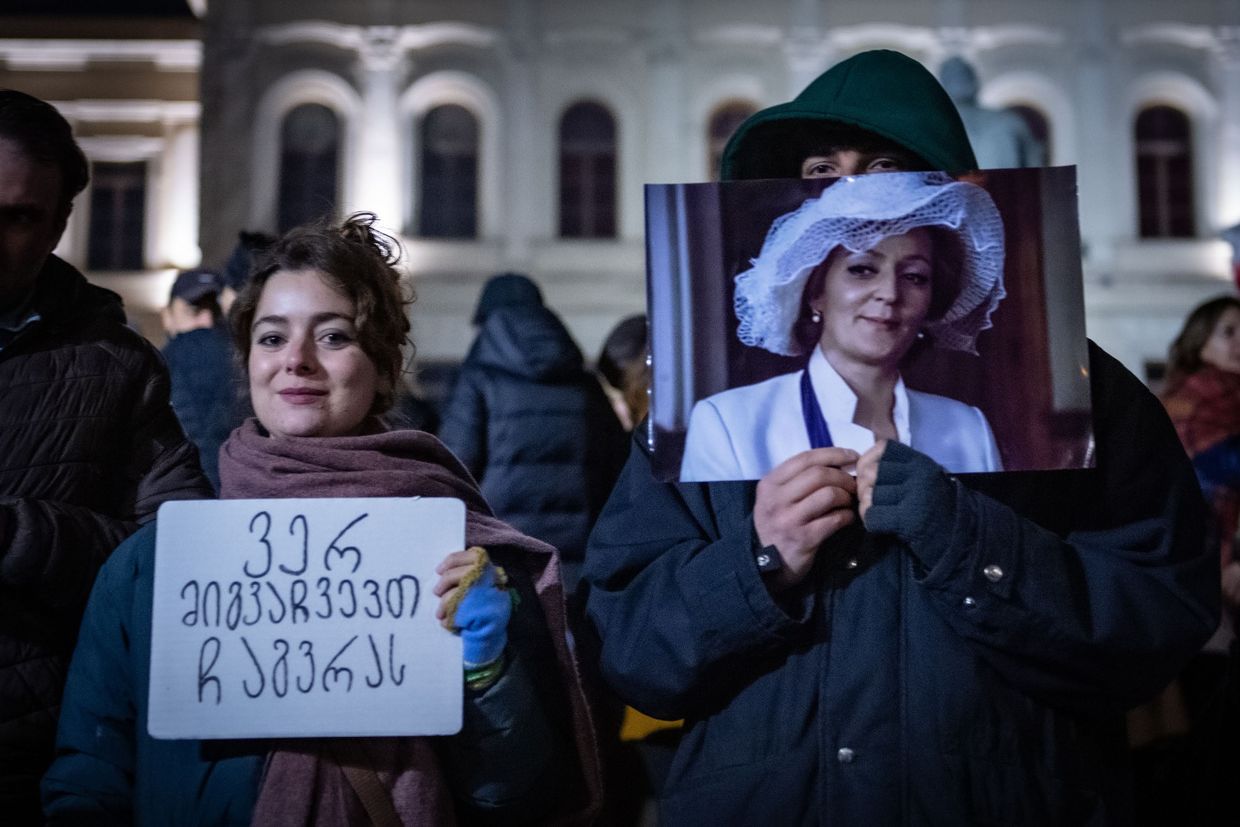
Seeing stills from the film during the ongoing anti-government protests in Tbilisi almost 40 years after its premiere is not accidental or merely aesthetic. It’s a reminder that the film’s critique of unaccountable power and inherited silence remains sharply relevant in Georgia’s current political climate.
The film carries a specific political vocabulary in Georgia, one that immediately signals themes of abuse of power, unaccountable leadership, and the moral consequences of totalitarianism. Holding up images from the film functions as a sharp political message: that the government, compared to the unaccountable, manipulative leadership embodied by Varlam Aravidze, won’t be forgotten or go unpunished.
Film details: Repentance (1987), directed by Tengiz Abuladze. It is available to stream on Klassiki.