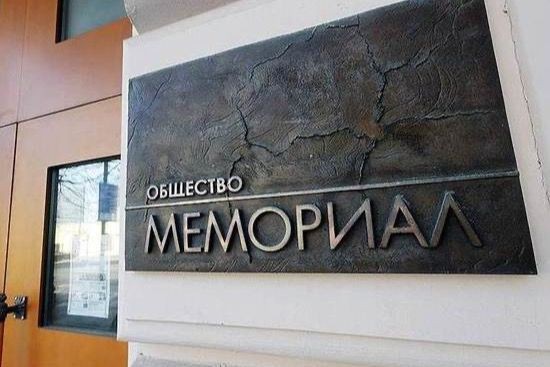
The Supreme Court of Russia has recognised the ‘international public movement “Memorial” ’ as an extremist organisation and banned its activities on the territory of the country. The lawsuit was filed by the Ministry of Justice of Russia and consisted of a closed-door hearing.
Diplomats from a number of EU countries, including France, Germany and the Czech Republic, were present at the hearing on Thursday.
Representatives of the Memorial Human Rights Centre, a Russian rights group that has long documented human rights violations in the North Caucasus and beyond, said that their lawyer had not been allowed to take part in the proceedings.
The court stated that the ruling was subject to immediate enforcement.
In a statement released the day before, Memorial said that no structure called the ‘international public movement “Memorial” ’ existed, and that the case had been classified as ‘top secret’, which made it impossible to review any of the case materials or specific allegation prior to the hearing.
Following the verdict, the group announced they would immediately cease all work on the territory of Russia, but insisted that they would continue their activities outside the country.
‘We are confident: they will not succeed — Memorial organisations and other civil society groups being destroyed in Russia will continue their work beyond its borders. Memorial will outlive Putin’s regime and will be able to return openly to Russia’, the statement said.
Residents of Russia may now face criminal liability for donating to Memorial organisations and fundraising campaigns or making transfers to accounts of individuals associated with Memorial. Reposting, commenting on, or liking of the organisation’s content on social media, sharing links to their website, or publishing images featuring Memorial symbols could also be a criminal offence.
Memorial’s lawyers also recommended people in Russia not search for their organisation’s website, its social media pages, or materials via search engines, remove any browser bookmarks for their sites, and unsubscribe from their mailing lists and social media accounts in order to remain safe.
The ruling is the latest part in a years-long campaign by the Russian government against Memorial. In December 2021, the Russian Supreme Court ordered the liquidation of Memorial International following an appeal by the Prosecutor General’s Office. The next day, the Moscow City Court issued a similar ruling against the Memorial Human Rights Centre. The grounds cited were violations of Russia’s ‘foreign agents’ law.
Memorial described the authorities’ actions at the time as politically motivated and disproportionate. Much of the organisation’s team continued its human rights work without a legal entity as the project Support for Political Prisoners — Memorial.
In 2023, the international association Memorial was established in Switzerland, with a stated aim of continuing the work of the previous structures.
In February 2026, the Russian authorities added the international association Memorial and the German organisation Zukunft Memorial to the register of ‘undesirable’ organisations.
Memorial was founded in 1989 by a group including Andrei Sakharov, a Soviet physicist and Nobel Peace Prize-winning human rights activist. It initially focused on researching historical political repression in the USSR, as well as monitoring human rights violations in modern Russia. In 2022, the organisation was awarded the Nobel Peace Prize.
A separate area of Memorial’s work was linked to the North Caucasus. Since the early 1990s, its staff monitored the situation in Chechnya, Ingushetia, Daghestan and Kabarda–Balkaria, documenting hundreds of cases of enforced disappearances, extrajudicial killings and torture, and providing legal assistance to victims.
During the First Chechen War in 1995, the group sent a monitoring mission to the region led by Sergei Kovalyov. Following its work, a report on the torture of detainees in so-called filtration camps was published. That same year, Kovalyov and his colleagues took part in negotiations during the hostage crisis in Budyonnovsk.
Memorial staff also investigated events in the village of Samashki in April 1995, where, according to human rights defenders, more than 100 civilians were killed. These materials were later used in appeals to international judicial bodies.
During the Second Chechen War, the organisation documented human rights violations and represented victims before the European Court of Human Rights (ECHR). Among the cases were the bombing of a refugee convoy in October 1999, the mass killing of civilians in the Staropromyslovsky district of Grozny, and the bombing of the village of Katyr-Yurt.
In subsequent years, Memorial recorded abductions and killings in Chechnya, including a case in which its staff member, Natalia Estemirova, was abducted and killed in 2009. The ECHR found the investigation into her murder to be ineffective.
In Ingushetia, human rights defenders monitored events surrounding the 2018–2019 protests linked to the border agreement with Chechnya. A number of participants were recognised as political prisoners.
In Daghestan, the organisation documented cases of disappearances and killings during counterterrorism operations. One such case was the investigation into the killing of the Gasanguseynov brothers in 2016. The ECHR found the Russian authorities responsible for their deaths and for an ineffective investigation.
In Kabarda-Balkaria, Memorial provided assistance to defendants in cases related to the 2005 attack on Nalchik. The ECHR awarded compensation to applicants, recognising the use of torture.