A Yerevan court has banned the screening and distribution of Our Road to Independence, a documentary about Armenia’s Declaration of Independence by its director, Tigran Paskevichyan. The Public TV holds the rights to the film, and has not broadcast or published it since its production in 2020.
The court ruling was issued on 27 March following a case launched in June 2025, by which the Yerevan court recognised Public TV’s exclusive property rights to the film, prohibiting its director, Paskevichyan, from using it in any form, including public screenings.
The court also ordered Paskevichyan to pay ֏40,000 ($100) to the Public TV to reimburse the state fee paid for the initial court proceedings.
The lawsuit concerned the screening of the documentary by Paskevichyan in May 2025, without the Public TV permission.
The two-episode documentary was produced for the 30th anniversary of Armenia’s Declaration of Independence, adopted on 23 August 1990.
According to the case materials, Paskevichyan’s company signed a contract with the Public TV in July 2020 and delivered the finished film in November of the same year. Under the agreement, the filmmaker transferred the film’s property rights to the Public TV, and received ֏4,240,000 ($11,000) in return.
During the court proceedings, Paskevichyan argued that he had previously attempted to discuss the film’s status with the director of the Public TV. He said that a letter he sent to the broadcaster’s director on 3 March 2023 requesting to ‘discuss issues related to the film’ remained unanswered.
Speaking with CivilNet, Paskevichyan stated that he had requested permission to screen the film in his letter.
In court, Paskevichyan also said that when he delivered the documentary in November 2020, as Armenia was defeated in the Second Nagorno-Karabakh War, he had himself proposed postponing its debut screening, ‘considering the moral and psychological state of society’.
Paskevichyan said that after Armenia held snap parliamentary elections in June 2021, the Public TV never aired it or uploaded it to its YouTube channel, despite ‘dozens of opportunities to broadcast the film’.
In a separate Facebook post, Paskevichyan accused the channel of ‘locking away’ the documentary for the past four and a half years.
‘How much must one hate the history and achievements of one’s own country to take such a petty step?’, Paskevichyan wrote, in what appears to be a statement directed at both the management of the Public TV and the Armenian authorities.
‘Nevertheless, I am not discouraged. [...] I am used to waiting, being patient, and enduring for as long as necessary’, Paskevichyan wrote in his post.
The filmmaker also recalled that his earlier documentary, Armenia’s Lost Spring, about the violent crackdown on opposition protests in March 2008, faced similar difficulties, but eventually was broadcast by the Public TV.
 Arshaluys Barseghyan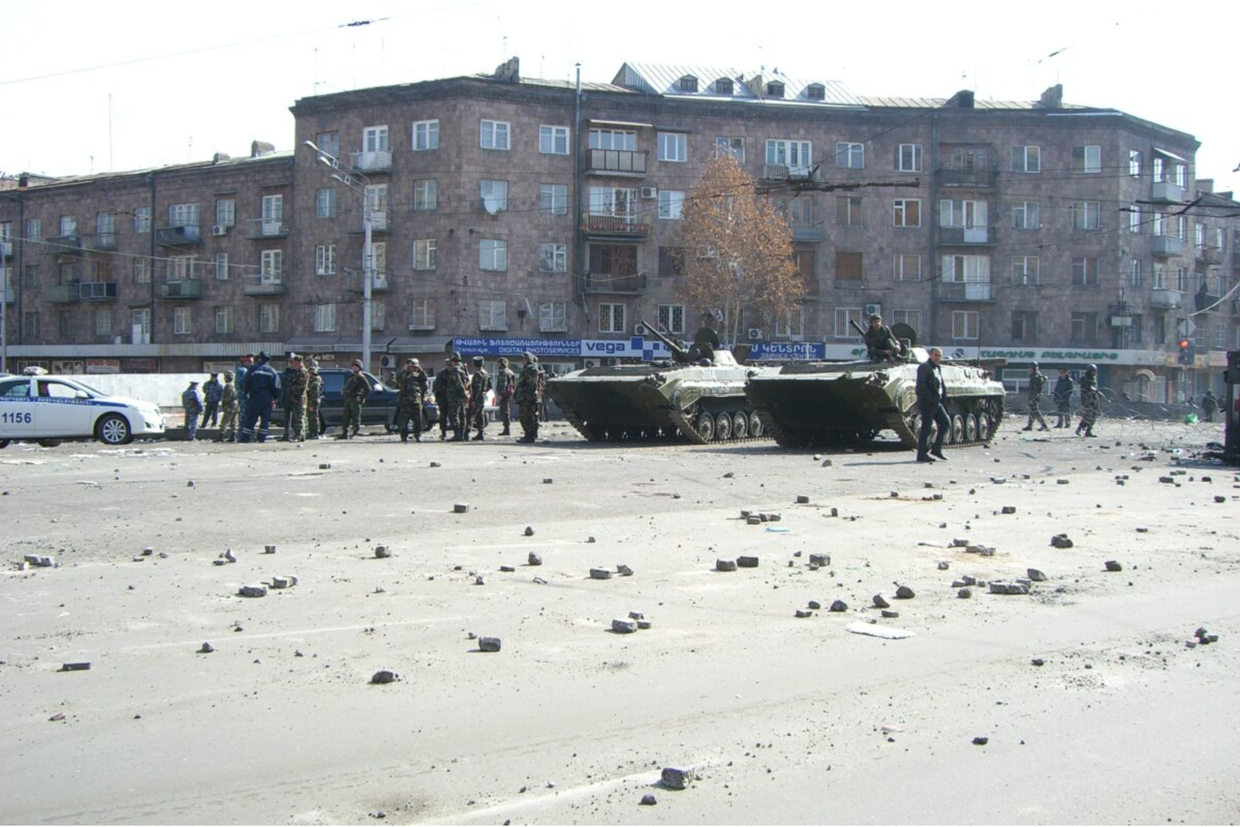
Despite the court ruling, Paskevichyan vowed to continue screening the film in other formats.
The dispute over the documentary comes amid ongoing debates in Armenia about references made to the Declaration of Independence in the country’s constitution. The document states it is ‘based’ on a joint decision made by Soviet Armenia’s Supreme Council and the Nagorno-Karabakh National Council on the ‘reunification’ of the two territories.
Azerbaijani officials, including President Ilham Aliyev, have repeatedly stated in past years that Armenia’s constitution contains territorial claims against Azerbaijan, demanding that Yerevan change it.
While the Armenian authorities have confirmed plans to hold a referendum on changes to the constitution, also hinting that references to the Declaration of Independence would be removed, they have continuously denied that they were doing so under Azerbaijani pressure.
Arshaluys Barseghyan