An International Republican Institute (IRI) survey has found that only 21% of Armenians believed that national security and border issues were a main problem, compared to 44% in June 2025, months before Azerbaijan and Armenia made huge strides towards cementing a peace deal.
The survey, published on Friday morning, covered a variety of issues, including Armenia’s foreign relations, how Armenians viewed leading politicians in the country, and the upcoming parliamentary elections in June.
While the survey suggests that Armenians were less concerned about national security issues, they still appeared to view the topic as the most pressing problem Armenia was facing, with 21% listing it as important.
Unemployment came second at 18%, followed by the economy and cost of living at 11%, and low wages at 9%.
Asked which country they believed posed the greatest political threat to Armenia, 80% answered Azerbaijan, a slight drop from the previous year’s 87%. Turkey and Russia followed at 69% and 29% respectively.
The majority of those who would vote for the opposition in the coming elections, 51%, were that Armenia should be pro-Russian, while maintaining relations with the West at 51%.
Most of those who said they would vote for the ruling Civil Contract party, 45%, said that Armenia should be pro-Western, while still maintaining relations with Russia.
The survey also found that more Armenians believed that their country was heading in the right direction compared to the previous year — 47% of respondents believed that Armenia was moving in the right direction, a jump from 36% in June 2025.
Support for the Trump Route, or TRIPP, which would connect Azerbaijan to its exclave of Nakhchivan through Armenian territory, appears to be low.
IRI found that the majority of Armenians either strongly oppose (34%) or somewhat oppose (13%) the implementation of the Trump Route. On the other hand, 24% strongly supported the project and 20% somewhat supported it.
According to the survey, 20% of respondents viewed lack of security as a main disadvantage of the project, 16% viewed the ‘free entry of citizens of enemy countries’ as a disadvantage, while 7% listed ‘danger of losing’ the southern Syunik province as a main disadvantage.
Karapetyan rises as contender for Pashinyan
With elections coming up in June, the survey appears to have found that Samvel Karapetyan, a Russian–Armenian billionaire, is set to be Pashinyan’s primary contender.
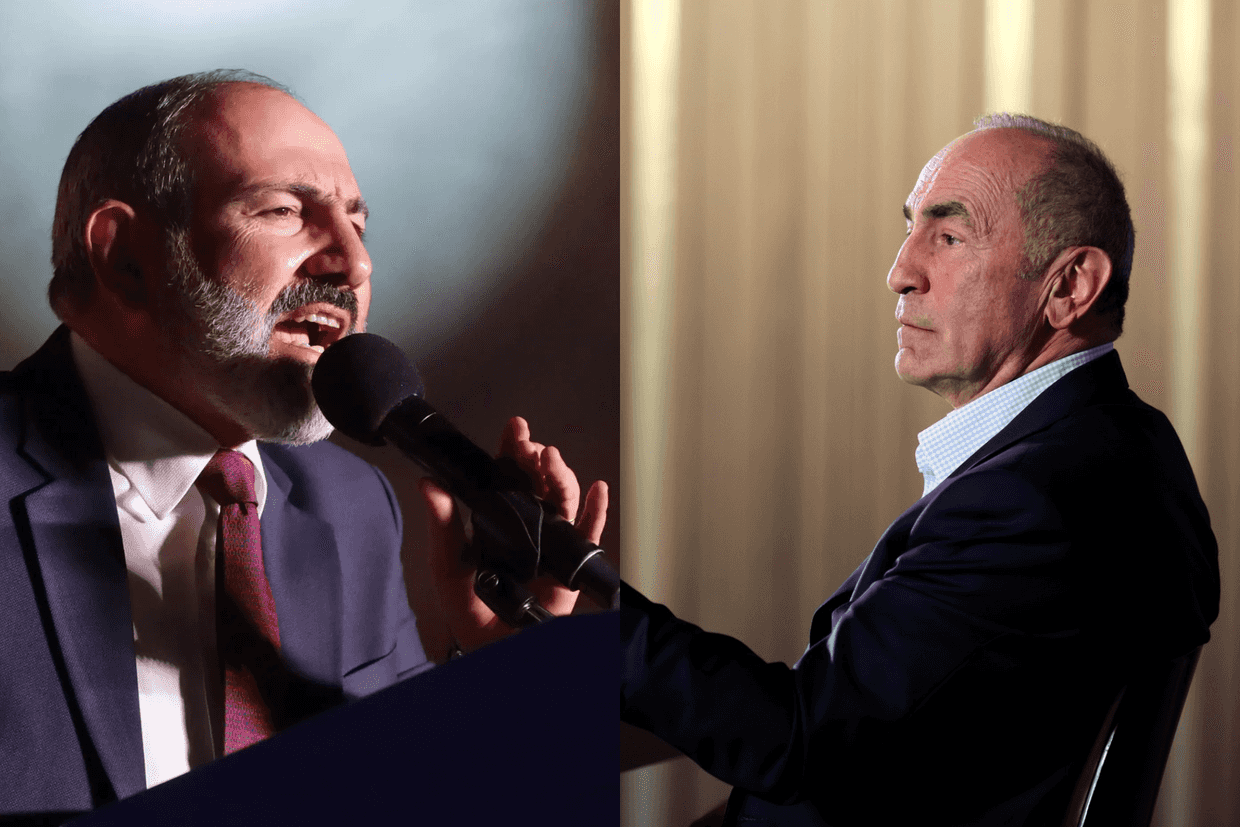
Asked which politician they trusted the most, 20% of respondents chose Prime Minister Nikol Pashinyan, followed by Karapetyan at 10%.
Karapetyan, who is currently under house arrest, was detained in June 2025 after making public statements siding with the Armenian Apostolic Church amid its confrontation with Pashinyan and his ruling Civil Contract party.
The detained billionaire has been in the spotlight ever since, having been named prime ministerial candidate of his newly formed Strong Armenia party in mid-February.
Robert Kocharyan, Armenia’s former president and Pashinyan’s main contender in the 2021 parliamentary elections, ranked third at 5%, while 48% answered that they trusted no one.
The June 2025 survey ranked Pashinyan first at 13%, followed by Foreign Minister Ararat Mirzoyan at 5%, and Kocharyan at 4%.
The survey shows that Armenians were most satisfied with the work of the Armed Forces, with 39% being very satisfied. Notably, it found that 39% of Armenians were very satisfied with the work of the Armenian Church — a slight increase from 34% in the June 2025 survey.
The Armenian authorities and the Church have been embroiled in a heated conflict since mid-2025, with Pashinyan and other senior government and party figures accusing Catholicos Karekin II and other senior clergy of breaking their celibacy vows, rendering them ineligible for office.
In early January, Pashinyan launched a ‘reform’ of the Church, renewing his calls for Karekin II’s resignation.
Additionally, the survey found that 10% of Armenians viewed wrong foreign policy as the biggest failure of the government, followed by its pressure on the Church at 7%.
Asked who they would vote for if elections were held next Sunday, 24% of Armenians answered that they would vote for Civil Contract and Pashinyan, followed by Karapetyan’s Strong Armenia at 9%.
 Mikheil Gvadzabia