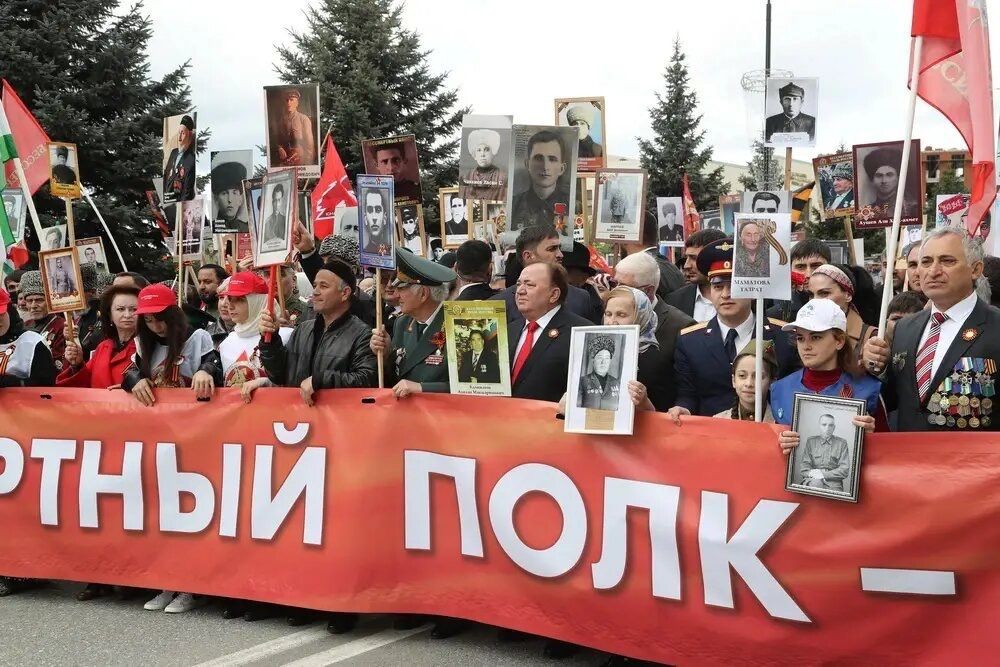
Two republics in the North Caucasus, Ingushetia and Adygea, have officially announced that they will not hold traditional in-person Immortal Regiment marches commemorating those killed in World War II, citing security concerns.
In Ingushetia, the Immortal Regiment march traditionally held on Russian Victory Day, 9 May, will take place online. The change in plans was announced by Ingush Head Makhmud-Ali Kalimatov, who cited ‘security priorities and the current situation’ in the region.
In-person marches, in which participants traditionally walk through the streets carrying portraits of relatives who took part in WWII, will not be held this year. In his statement, Kalimatov stressed the need for a ‘serious approach to organising festive events’ in light of existing risks.
According to Kalimatov, residents of Ingushetia will be able to take part in the action by uploading photographs of frontline soldiers and home front workers to dedicated online platforms and social media, where a virtual column of remembrance will be created.
Authorities in Ingushetia said that a series of events dedicated to Victory Day on 9 May is planned in the republic in April and May. Particular attention will be given to the town of military glory Malgobek, where various initiatives are planned, including financial support for families of participants in the full-scale war in Ukraine.
In his address, Kalimatov also stated the importance of linking historical memory of the Second World War with contemporary events, in particular with the participation of Russian soldiers fighting in Ukraine.
Out of 97,000 natives of Ingushetia, 21,700 took part in the Second World War. More than 6,500 of them were killed.
Another North Caucasus republic, Adygea, has also announced the cancellation of the Immortal Regiment march in its traditional in-person format. No other republic in the region has announced similar plans.
The Immortal Regiment is a public initiative held on 9 May and dedicated to the memory of World War II veterans. It involves people taking to the streets carrying portraits of their relatives — soldiers, officers, home front workers, and others whose lives were affected by the war. Columns of participants move through central streets of cities and towns, forming a march focused on personal and family remembrance.
The initiative originated in 2012 in the city of Tomsk and later spread to other regions of Russia and abroad. Over time, the march became widespread and has been held in different countries, involving both local residents and members of Russian-speaking communities.
Regions are now given the authority to determine the format of the event based on the situation on the ground. In recent years, in-person marches have been cancelled or restricted in a number of Russian regions. Authorities have cited security concerns, including the threat of attacks from Ukraine. In 2023, the Immortal Regiment march in Ingushetia was held in its traditional format, but in subsequent years formats have been adjusted.
In 2025, in-person marches were held mainly in eastern regions of Russia, including Chita, Magadan, Blagoveshchensk, Barnaul, Khabarovsk, Tyumen, Khanty-Mansiysk, and the Kamchatka region. In other regions, events were held online or cancelled.
This year, some regions, including the Leningrad region, are considering holding in-person marches with additional security measures. As for Moscow, no final decision has been announced at the time of publication. In previous years, when in-person events were not held in the capital, the event took place online.