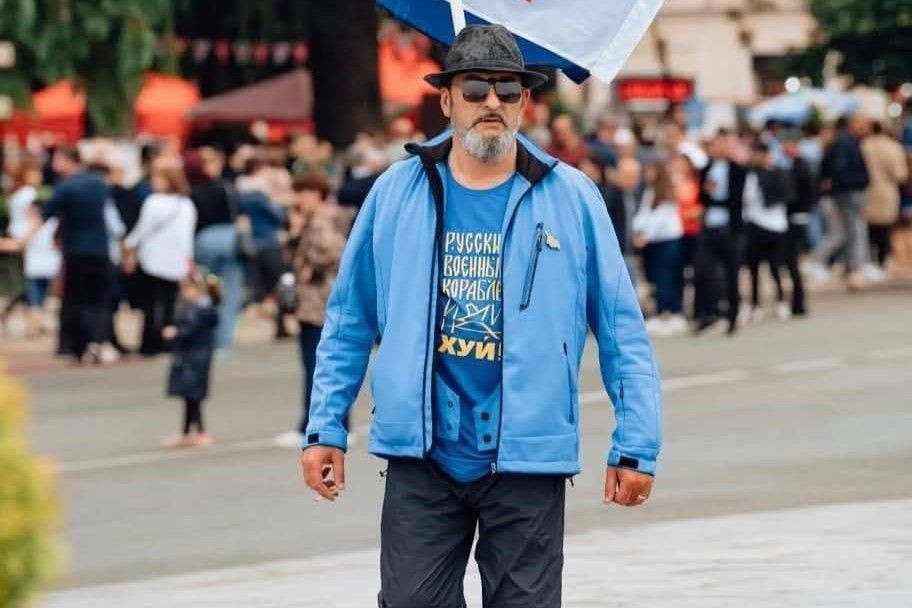
A second Georgian anti-government protester, Shalva Esartia, has been criminally charged for repeated protest-related offences during protests, including blocking the road and disobeying the police.
If found guilty, Esartia could face up to a year in prison.
Esartia, who regularly takes part in the daily anti-government protests in the western Georgian city of Zugdidi, was detained by local police on 17 March. He was accused of failing to yield to a pedestrian.
At a court hearing on Friday, Judge Ekaterine Bebia remanded Esartia in pre-trial detention for 50 days. The next court hearing is scheduled for 5 May.
Esartia’s sister, Tamar Kankava, told OC Media that prior to his detention, the activist had been on his way to a protest at Zugdidi’s central square. Georgian and EU flags were displayed from his car, and protest songs were playing loudly — which he says he often does on his way to demonstrations.
According to Kankava, after arriving at the protest site near the regional administration building, police approached him claiming they had already called on him to pull over while driving.
A verbal altercation began after officers told Esartia he would be fined for a traffic violation. Esartia protested, demanding that police present evidence and saying he did not trust the ‘militsiya’ — the Soviet-era police.
Following the altercation, the activist was detained and forcibly placed into a police vehicle. In a video filmed at the time of the arrest, other activists can also be seen protesting the actions of the police.
 OC Media
According to Kankava, Esartia’s blood pressure spiked while he was being taken to the police station, prompting the need to call an ambulance. She also said he was transferred from Zugdidi to a detention facility in Mestia, more than a three-hour drive away.
Kankava did not rule out that there may have been no space in the Zugdidi facility, but noted that transporting her brother over such a long distance, given his elevated blood pressure, could have posed a risk.
Esartia was accused of disobeying police orders — which is an administrative offence — but was eventually charged under a criminal provision stipulating that disobedience to police by a person who has already been penalised twice for the same offense is punishable by up to one year in prison.
Esartia was first detained on charges of disobeying police in January 2025, and again in December of the same year. The first time, he was fined; the second time, he was sentenced to seven days in detention.
The Zugdidi-based Civil Solidarity Fund described the classification of the case as criminal as ‘completely incomprehensible and legally absurd’, adding that ‘protest expressed in an emotional context at the time of detention should not be viewed through a criminal law lens’.
‘The aggravation of the charge points to selective justice and a particular interest in punishing the individual’, the organisation said.
Mikheil Gvadzabia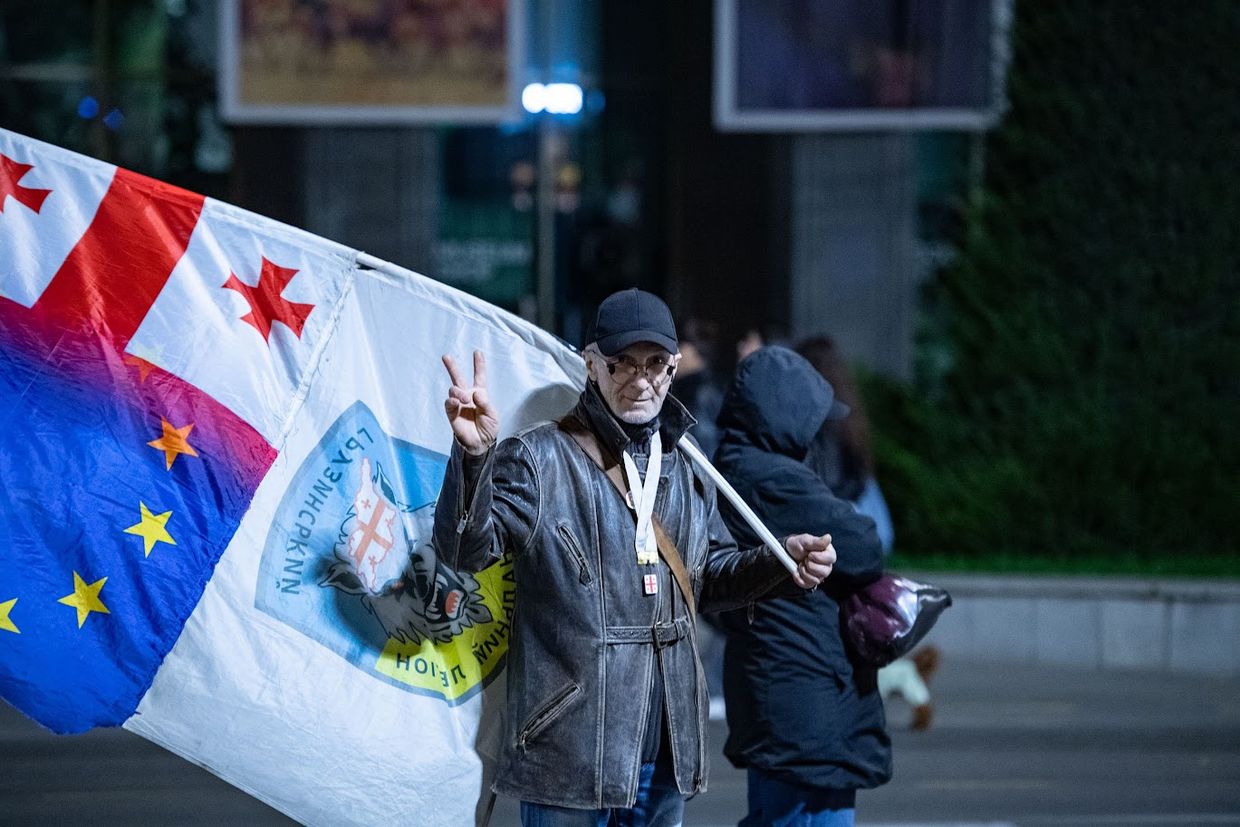
Earlier, in November 2025, another anti-government protester with a prior administrative penalty, Zurab Menteshashvili, was also charged under criminal law. He was accused of repeatedly blocking a road — an offence punishable by up to one year in prison.
Menteshashvili was placed in pre-trial detention, after which he began a hunger strike.
Criminal penalties for certain repeated protest-related administrative offences were introduced by the ruling Georgian Dream party amid ongoing daily anti-government rallies in Tbilisi and several other cities. The demonstrations began in November 2024, after the government announced it would halt the country’s EU membership bid until 2028.