Hand-hearts and drum solos — Pashinyan’s populist social media strategy
The Armenian Prime Minister has turned his social media into a viral regional sensation — but does his charm survive contact with reality?
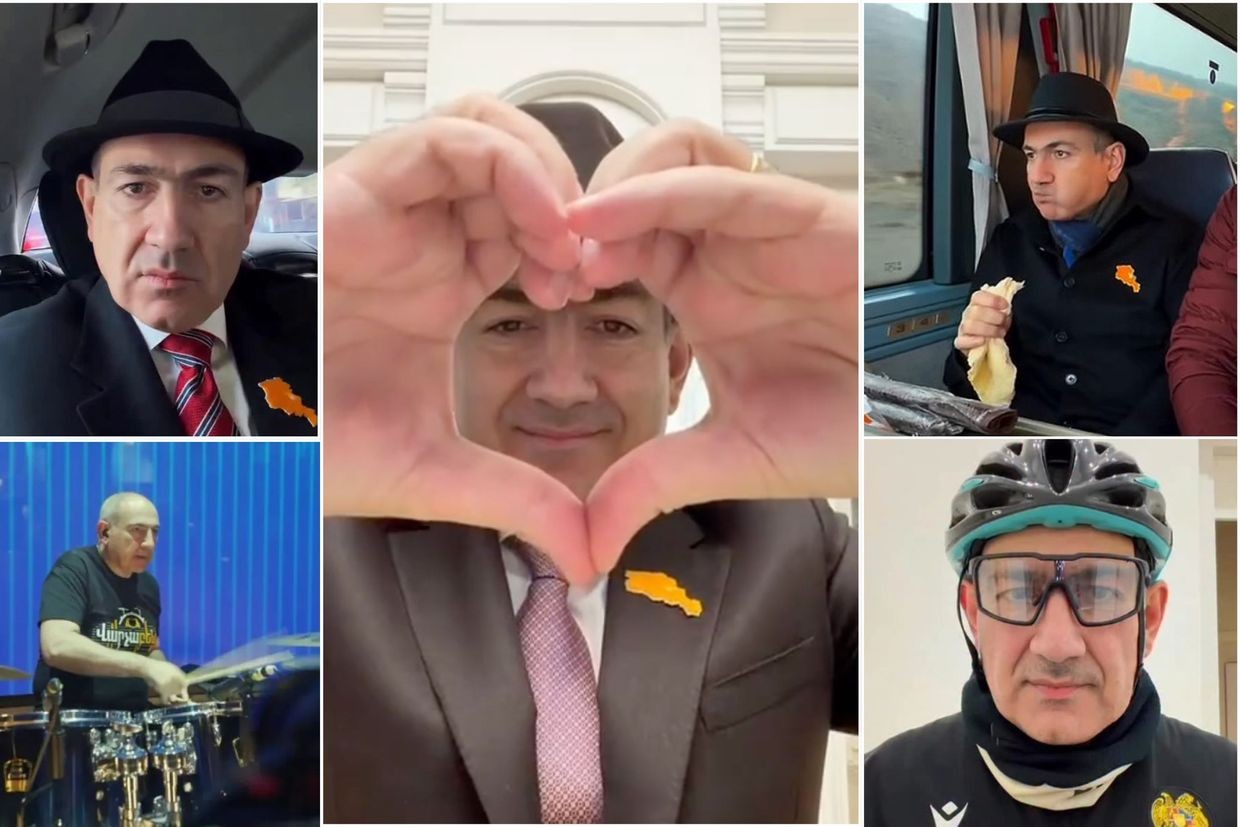
Just days after two landmark European summits in Yerevan saw French President Emmanuel Macron dominate Armenian Prime Minister Nikol Pashinyan’s social media feed, the latter’s posts have shifted back to the campaign trail. This time, he and Parliamentary Speaker Alen Simonyan were filmed eating sweet corn puffs aboard the party’s campaign coach, nicknamed the ‘happy bus’.
For a head of state, it’s an eccentric social media strategy that Pashinyan adopted well before the formal start to the campaign season, and one that has proven to be popular. From late February to March, he uploaded reels of himself and Simonyan on the Civil Contract bus, snacking on local treats, such as fried potato pirozhki, corn on the cob, sweet sujuk (stringed candied walnuts), and lavash bread. In another clip, Pashinyan is seen burning his hand before enjoying boiled potatoes en route with his fellow MP, attracting more than six million views.
It appears that for Pashinyan, whose Civil Contract party is seeking a third consecutive term in the upcoming parliamentary elections, the more clicks, the better. He pays close attention to his metrics and periodically shares his Meta analytics online.
On 11 May, he posted a screenshot to his more than 900,000 followers, showing that his Instagram page surpassed 100 million views in 30 days for the first time. In the caption, he wrote: ‘Thank you for following my pages. I love you all’, followed by emojis of a red heart and a hand-heart. The latter has become one of his signature campaign symbols emblazoned across promotional materials, from cookies and Civil Contract attire to baseball caps and party vehicles, including the bus.
The hand-heart is also embroidered on his new white button-down shirt, along with a yellow-orange ‘16’ – the Civil Contract ballot number – and the slogan, ‘Stand up for peace!’ He was first seen wearing it while campaigning in southeastern Armenia over the weekend, including in videos where he offered Armenian spelling lessons to Russian-Armenian tycoon and opposition Strong Armenia leader Samvel Karapetyan, mocking him after he mispronounced the words ‘adventure’ and ‘victory’ during public speeches.

Astghik Avetisyan, an independent PR and media specialist, tells OC Media that Pashinyan’s social media approach is ‘a sophisticated yet high-risk model that integrates personalisation, populist framing, and tightly managed image control’.
She’s among the media and democracy experts pointing to a widening gap between curated digital messaging and a more confrontational political reality. Recent incidents covered by local news outlets involve members of the public and hostile rhetoric toward forcibly displaced Nagorno-Karabakh Armenians, fuelling concerns over polarisation and online manipulation ahead of the 7 June vote.
 Ani Ghevondyan
Cracking the algorithm
Since the 2018 Velvet Revolution, Pashinyan has long used unfiltered Facebook Live broadcasts to bypass state-controlled media and communicate directly with the public. Eight years ago, the approach helped galvanise mass protests that led to the resignation of then-Prime Minister Serzh Sargsyan. Pashinyan later credited social media as one of the key tools behind the movement’s success.
Following his rise to power, Pashinyan continued to share real-time updates about the government primarily on Facebook, where he also hosted live Q&As with the public. He often offered glimpses of his personal life online, including live-streaming at the prime minister’s residence and his many attempts to increase the popularity of cycling.
‘[Social media] played a pivotal role in building trust, coordinating collective action, and fostering a sense of shared purpose’, says Avetisyan, who is also president of the Armenian PR Association. ‘At that stage, his communication style closely reflected grassroots dynamics and participatory engagement’.
‘Over time, however, this approach has become more institutionalised and strategically managed’, she says.
In the aftermath of Armenia’s defeat in the 2020 Second Nagorno-Karabakh War, and the ensuing exodus of ethnic Armenians from Nagorno-Karabakh, Pashinyan’s digital platforms took a more serious, sombre turn.
During the 2021 snap parliamentary elections, Pashinyan’s feed consisted of multiple images of himself bowing at monuments, graveyards, and before his supporters.
He didn’t start experimenting with content creation again until 2024. In November of that year, Pashinyan went viral after shaving the signature beard he had worn since the Velvet Revolution and winking into the camera. He also began posting more consistently about his cycling tours.
But it wouldn’t be until October 2025 before Pashinyan truly cracked the algorithm. Young people from across the post-Soviet world transformed him into a popular meme after he posted a video of himself listening to Russian alternative rock star Zemfira’s 2000s hit, ‘PMML’, which has garnered more than 17 million views on Instagram.
From there, his content evolved into almost daily reels of Pashinyan stoically grooving to music in Armenian, French, Russian, and English, typically ending with a smile and a hand-heart gesture. They’re often captioned: ‘Good morning, have a nice day, and I love you all’, accompanied by more hand-heart emojis.
In April, he expanded his playlist to include American hip hop, including rappers Kendrick Lamar and Future — the latter of whom re-shared the clip on his own Instagram story.
Some of his other pre-election vlogs have ranged from the prime minister slurping soup to highlighting his party’s record on school and road renovations, posing with European officials, exchanging more insults with the opposition, and handing out pins in the shape of Armenia’s internationally recognised borders — another key symbol of his campaign and the ‘Real Armenia’ programme: Civil Contract’s effort to raise acceptance of Armenia’s internationally recognised borders along the lines of those in Soviet Armenia.
‘[Civil Contract] has come to the realisation that they can spin everything’, political analyst and director of the Yerevan-based think tank the Regional Centre for Democracy and Security, Tigran Grigoryan, tells OC Media.
‘Like in the example of Karabakh, you can sell one of the worst disasters in recent Armenian history as an achievement, and a lot of people aren’t just buying it, but amplifying this message’.
‘In terms of democratic development, it’s dangerous because of the lack of reaction to ongoing authoritarian tendencies’, Grigoryan adds.
Tigran Grigoryan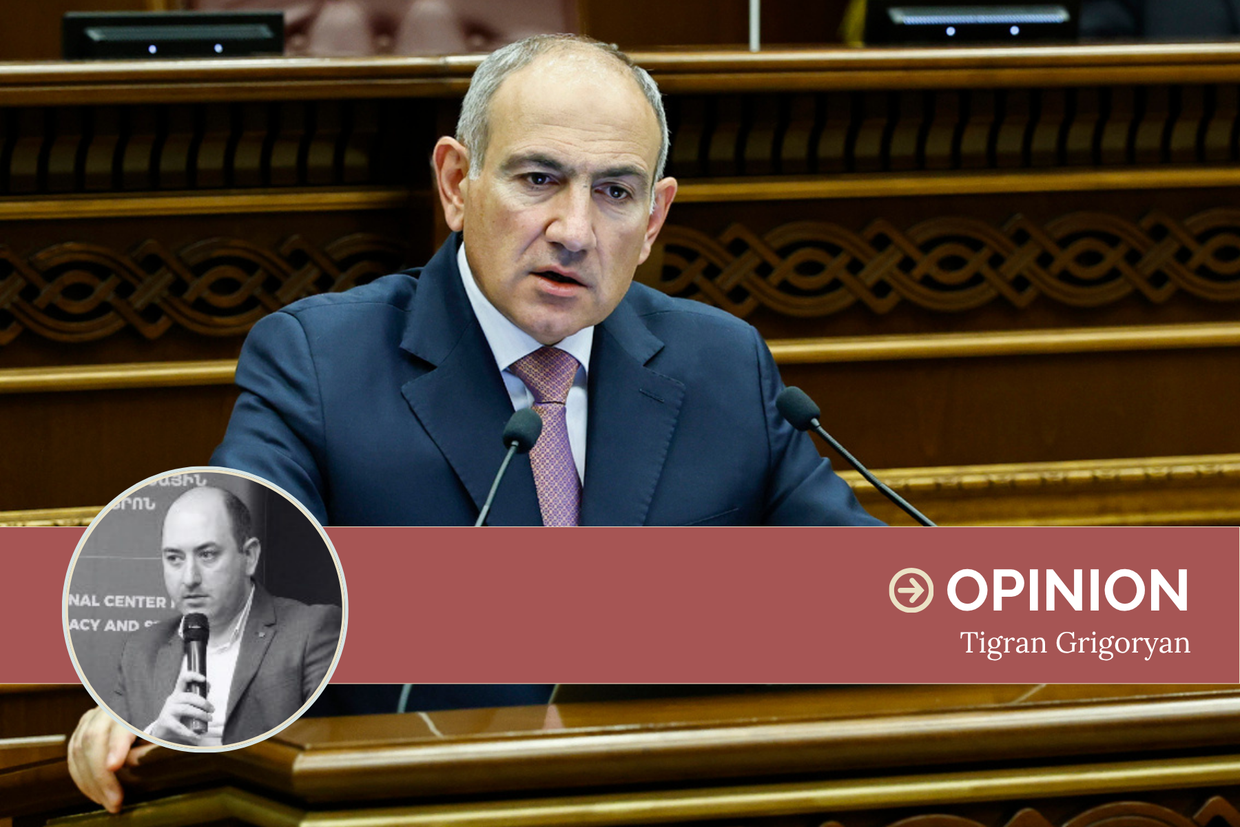
‘Real Armenia, the Republic of Armenia’ is also the title of a song by his musical group, Varchaband, which performed its debut concert in Yerevan on 30 January.
The upbeat tune was featured in the ruling party’s campaign video with teenagers breakdancing in a high school gymnasium as Pashinyan played the drums in the background.
Pashinyan has also frequently shared videos of himself practising drums online. In April, his band performed again in Yerevan, and later at an open-air concert in Gyumri as part of what organisers called the ‘Voice of Peace Festival’.
The festival was financed by Fast Bank, a commercial lender owned by government-linked businessmen. The bank also funded a free concert under the same name in Yerevan’s Republic Square on 25 April.
Separately, on 23 April, the Independent Observer coalition of Armenian election-monitoring groups alleged that Civil Contract’s pre-election concerts sponsored by Fast Bank may have breached campaign finance rules, which prohibit businesses and legal entities from making direct donations to political parties.
OC Media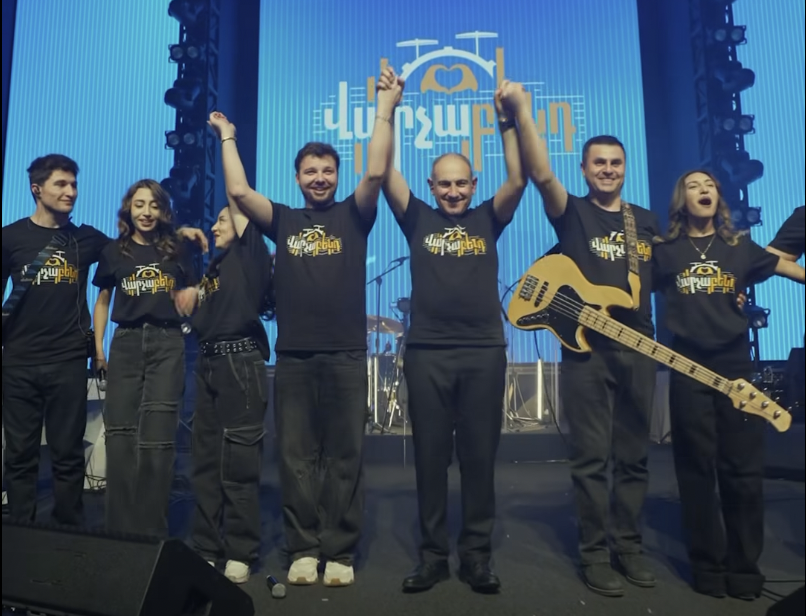
Populist damage control
While world leaders attended the opening ceremony of the 8th European Political Community Summit — showcasing live Armenian song and dance performances and messages of peace, which were livestreamed on Pashinyan’s Facebook page — protesters gathered outside the venue. Among them were Nagorno-Karabakh Armenians, who demanded the release of 19 Armenian prisoners held in Baku and the protection of Armenian heritage in Nagorno-Karabakh.
Demonstrators, civic activists, and opposition figures also accused Armenian authorities of restricting free speech, exerting influence over the judiciary, and pressuring the Armenian Apostolic Church.
Beyond the summit stage, a similar contrast between public messaging and reported events emerged during a Palm Sunday appearance on 29 March, which was prominently featured on Pashinyan’s social media feed.
In the reel, he and Civil Contract MPs are shown attending a crowded church service and participating in the liturgy, with the clip ending on a light moment as he poses for a photograph with a visiting tourist from the UK. Local media, however, reported that 18-year-old Davit Minasian appeared to raise his arm toward the prime minister as he was leaving the service before being punched and restrained by bodyguards.
Minasian was later charged with hooliganism and remanded in custody for two months, before being unexpectedly released following public protests and appeals by activists.
According to Avetisyan, the contrast between Pashinyan’s online and offline communication ‘appears deliberate rather than incidental, suggesting a segmentation of communication channels’.
‘Social media serves to maintain emotional loyalty and symbolic connection, while offline rhetoric is often used to mobilise urgency, fear, and political polarisation’, she says.
Another confrontation to cause waves earlier that month showed Pashinyan raising his voice and wagging his finger at a refugee from Nagorno-Karabakh on the Yerevan Metro, after she refused to accept his party’s campaign pin depicting Armenia without Nagorno-Karabakh. She was among more than 100,000 ethnic Armenians forcibly displaced from the region following Azerbaijan’s military assault in September 2023.
In the exchange, Pashinyan referred to Nagorno-Karabakh Armenians as ‘runaways’, a remark he later said he regretted. In a post on Facebook, he invited the woman to meet again to apologise to her in person.
Avetisyan calls this a ‘classic case of reactive image repair’, but warns that when overused, it can be interpreted as ‘performative’ and ‘may deepen public scepticism, rather than rebuild trust’.
‘In today’s media environment, audiences are particularly sensitive to inconsistencies,’ Avetisyan says. ‘As such, damage-control strategies must align with broader behavioural patterns; otherwise, they may reinforce perceptions of manipulation’.
A group of Armenian civil society organisations condemned Pashinyan’s remarks, saying they reflect a broader pattern of rhetoric among Civil Contract officials and risk promoting hate speech, deepening social divisions, and causing further harm to people forcibly displaced from Nagorno-Karabakh.
Armenia’s Human Rights Defender Anahit Manasyan has also called on officials to exercise restraint when discussing issues involving refugees and forcibly displaced people.
Who’s the target audience?
According to Grigoryan, Pashinyan’s campaign symbolism of hand-heart gestures, Armenia-map pins, and influencer-style videos are deliberately non-political and designed to appeal to younger voters.
‘Politics is not attractive to younger people, and there are a lot of studies showing that they’re the most apolitical segment of the population’, Grigoryan says.

Avetisyan similarly argues that Pashinyan’s social media attempts to reach a broader, diverse audience, including younger demographics, and particularly those who are less ideologically rigid and more responsive to emotional and symbolic messaging.
However, she adds, ‘this broad targeting strategy entails trade-offs.’
‘While it enhances visibility and engagement, it can also reinforce polarised interpretations of political reality and deepen existing societal divides’.
Yet, while experts agree on who Pashinyan is targeting, opinion polls demonstrate he may not be succeeding. Indeed, a public opinion survey conducted in February 2026 by the US-backed International Republican Institute (IRI) showed that only 7% of respondents aged 18–35 trust the incumbent leader.
‘Making viral content while listening to Zemfira is probably a good way to capture Gen Z and Alpha’s attention, but to me, it looks worrying’, 30-year-old Anna, who did not wish to use her real name, tells OC Media. ‘I would rather see on my feed his ideas and suggestions on how to improve things and what can be done to make our lives easier, safer, and better’.
Nevertheless, Anna plans to vote for Civil Contract in June. For her, the upcoming elections have become a matter of ‘choosing the lesser evil’. She supports the party’s efforts to bring Armenia closer to the EU and hopes for greater freedom of movement.
‘I don’t want Armenia to go back to the 1990s’, Anna says. ‘We all see what’s going on in Russia now — they are cut off from the world, no internet, say goodbye to freedom of speech and your internet. And that’s just the tip of the iceberg’.
In contrast, Karni Keushgerian, a 22-year-old master’s student in international relations and diplomacy at the American University of Armenia, finds that Pashinyan’s online communication has been working so far.
‘A lot of the opposition’s social media strategy is just responding to what Pashinyan posts. So ultimately, everything that gets posted, whether that’s pro or anti-Pashinyan — it’s successful’.
While Keushgerian hasn’t yet decided who she will be voting for, she knows it won’t be for the main opposition parties or for Civil Contract. She doesn’t support Pashinyan’s foreign policy decisions on Azerbaijan, Turkey, and Nagorno-Karabakh. She also disagrees with the ruling party’s domestic politics ‘when it comes to the violence they have shown towards civic organisations, and also the Church’.
‘I generally don’t agree with Pashinyan’s “Real Armenia” ideology’, she says.
Pashinyan’s reach outside of Armenia, however, is a whole different story.
‘[Pashinyan] stands out. He’s in a region surrounded by authoritarian countries’, Nerses Hovsepyan, a PhD candidate at the University of Amsterdam, points out to OC Media.
Russian-language content creators on TikTok and Instagram also spoofed part of Pashinyan’s contentious meeting in early April with Russian President Vladimir Putin, during which he subtly praised Armenia’s unrestricted internet access.
Likewise, comments under Pashinyan’s posts are often flooded with Russian-language users, many from countries within the Russian-led Commonwealth of Independent States (CIS).
‘They clearly like him. It’s unusual, it’s odd. It’s very relatable. People from these really consolidated authoritarian countries find it very amusing that the leader of a nation can listen to teenage Russian songs like Zemfira’, Hovsepyan says.
He has also seen a significant number of Azerbaijani commentators writing, ‘you’re the best leader’.
‘I do believe there’s a certain psychological aspect to it, when you’re so used to strongman politics. Such hardline nationalists, corrupt regimes, and then you see your immediate neighbour whom you’ve demonised for so long, having this fun, happy, and relatable, likeable leader posting this relatable, likeable stuff on social media’, Hovsepyan says. ‘That makes them appreciate Armenia’s leader’.
Risks of domestic disinformation
Online, however, Pashinyan and his party aren’t the only ones to saturate the internet with political marketing.
Former Yerevan Mayor Hayk Marutyan, also a comedian, seized the opportunity to parody Pashinyan’s contrasting online and offline image through his own skits on social media, receiving tens, sometimes hundreds of thousands of views. Marutyan later announced on 21 March that his ‘social reformist’ party, New Power, is running in the parliamentary elections.
Multiple political groups have also heavily invested in advertising on Meta. Media.am reported in January that over the course of three months, between $50,000–$98,000 is estimated to have been spent on political ads.
Grigoryan points out that while the ruling party and the EU have warned of threats of foreign manipulations and interference — primarily by Russia — domestic disinformation is also a huge issue.
‘If you go to TikTok, it comes up with so much political content,’ he says. Government-affiliated accounts attack the opposition party, while the opposition has been leaning on AI-generated content and deep fakes.
In February, when Strong Armenia leader Samvel Karapetyan could not attend a party event due to being under house arrest on multiple charges, party members projected an AI-generated version of him. Later that month, Strong Armenia released a fully AI-generated campaign video on Youtube featuring a fictitious superhero, Mister Uzh (Mister Strength), coming to rescue Armenians from high prices and lack of work opportunities.
In general, Grigoryan notes that many people online are not media literate, especially older people, ‘so it’s very easy to trick them’.
However, he emphasises that while the opposition is only now turning to social media, Civil Contract has long been active on TikTok, Instagram, and Facebook, cultivating narratives and working with curated networks of political and social media influencers since the 2021 snap elections.
‘They meet with them on a permanent basis, regularly. These are political analysts, even Facebook activists, and some journalists. They’ve been feeding their narratives for a while now, for three to four years. And these people are now amplifying the messages, all of the programme’s messages’, he says.
An investigation published in late April by CivilNet revealed that Pashinyan's deputy chief of staff, Taron Chakhoyan, was listed in archived registration data for the pro-government outlet, MediaNews.site. The website is accused of coordinating a media manipulation scheme to shape political discourse online by amplifying fake or suspicious social media accounts. Chakhoyan has denied any connections to the site.
Grigoryan adds that Civil Contract has built its own media infrastructure, including influence over the public broadcaster, which, according to the IRI poll, is the most trusted source of information.
‘They have the advantage of controlling public TV, which has once again, in recent Armenian history, become a propagandistic mouthpiece’, he says. ‘I would call it a propaganda infrastructure’.