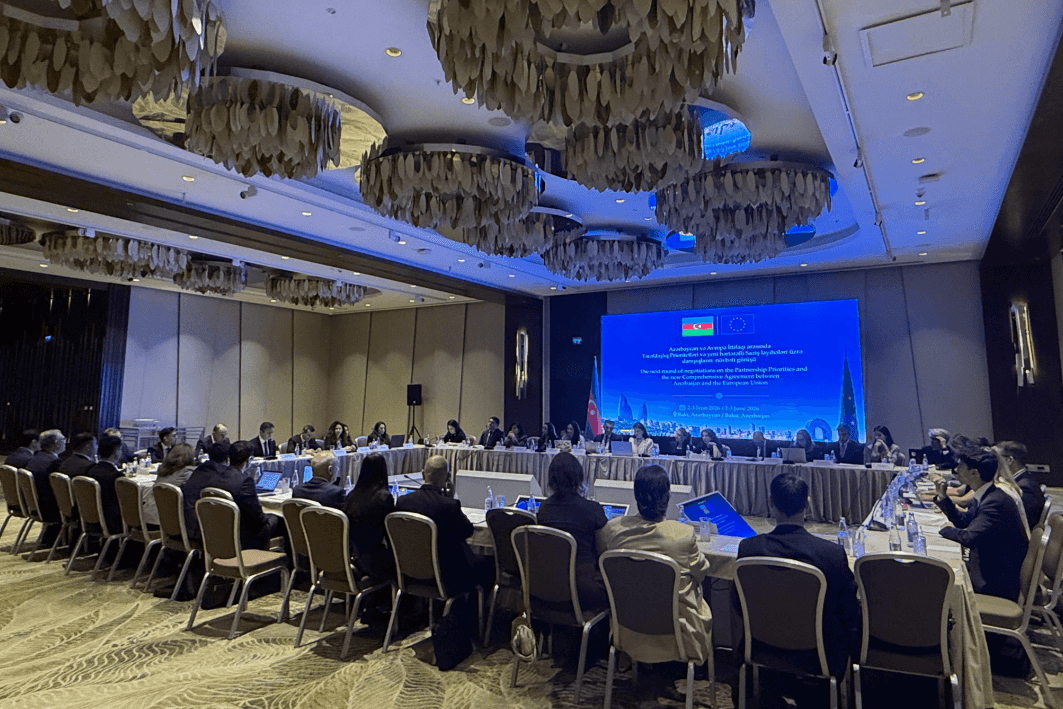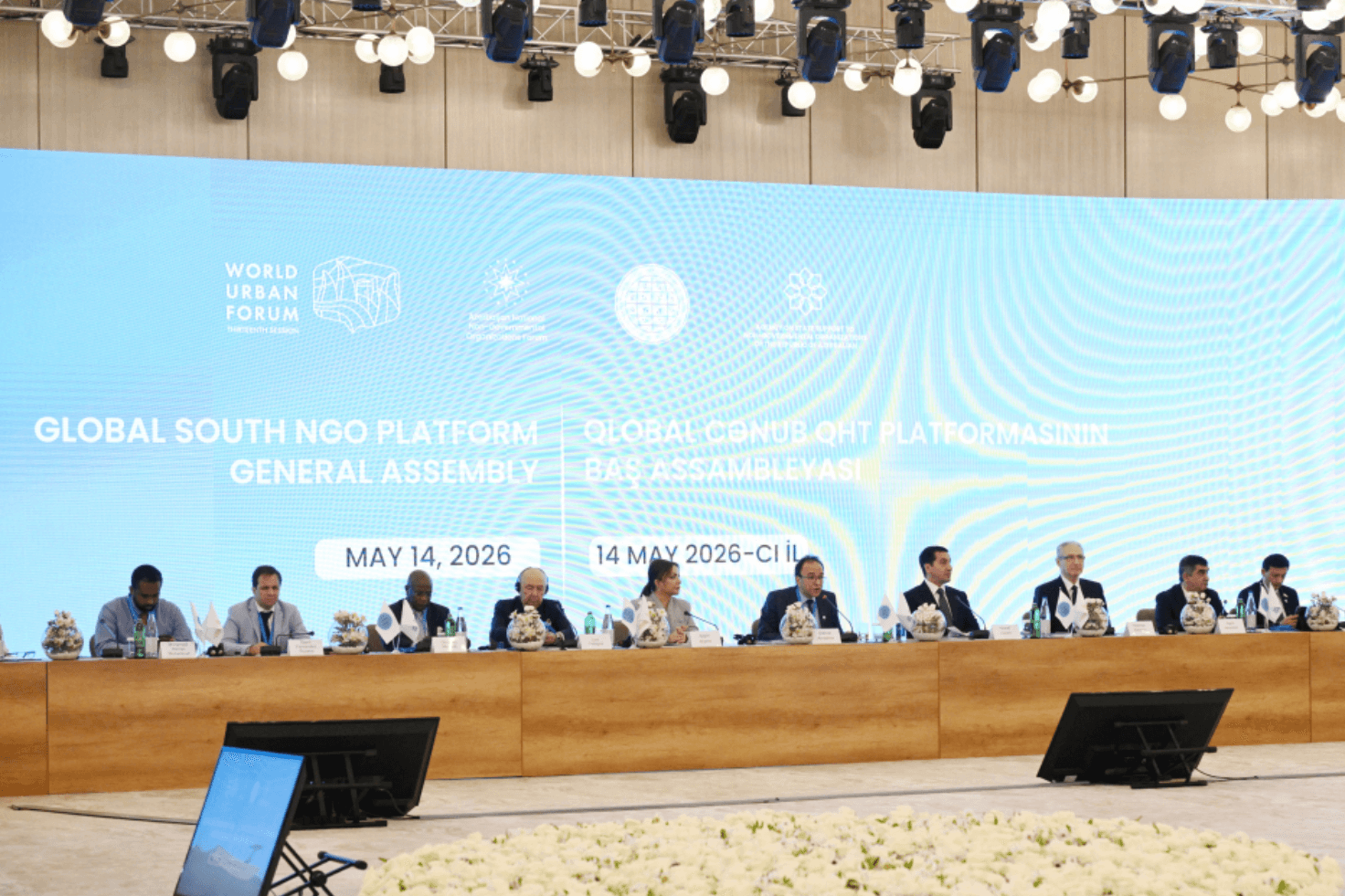
The first General Assembly of the Global South NGOs Platform was held in Baku on Thursday, with the aim ‘to be a bridge’ between the Global North and the Global South. During the meeting, the assembly elected Azerbaijani representative Fuad Karimli as General-Secretary, a position he will hold for the next five years.
Karimli is a researcher with the pro-government think tanks the Topchubashov Centre and the Centre for Economic and Social Development.
Along with Karimli’s election, four other deputies were elected to represent Asia, Africa, Latin America, and the Pacific at the global level.
The idea to first establish the South Global NGOs Platform came during COP29, which was hosted in Baku in November 2024. Today, it consists of over 650 NGOs from 116 countries.
The general assembly was the latest instance in which the Azerbaijani government and its affiliated NGOs have platformed selective condemnations of neocolonialism, often focusing on France. Skeptics of the efforts have suggested the criticism of French neocolonialism is largely due to France’s support for Armenia. At the same time, Azerbaijan has also upped its attempt to court the Global South, including by presenting itself as a regional power between the West and the East.
During his opening speech to launch the general assembly, Azerbaijani Presidential Aide Hikmat Hajiyev stressed that colonialism and neocolonialism were continuing ‘at the global level, only taking on new forms and manifestations’.
He emphasised that Azerbaijan was also part of the Global South ‘geographically, historically, culturally, and by destiny’, and therefore, ‘fully and comprehensively understands all the difficulties’ this region is facing.
Hajiyev further stressed that, while chair of the Non-Aligned Movement from 2019–2022, Azerbaijan had declared the ‘fight against neocolonialism’ to be ‘one of the top topics’.
‘We regret that the UN Special Committee on Decolonisation has not yet been able to fully implement its mandate, as some countries resist the decolonisation process’, Hajiyev said.
He concluded by complaining about the ‘current structure of international institutions', especially the UN Security Council, alleging that the organisation ‘does not reflect the realities of the modern world’.
‘The voice of the countries of the Global South is not sufficiently heard in this institution. Furthermore, equitable geographic representation is not ensured. We believe that the voice and equitable representation of the countries of the Global South must be ensured in the UN Security Council reform process’.
Yet, as now-imprisoned Azerbaijani researcher Bahruz Samadov detailed in a 2023 opinion piece for OC Media, Baku has a history of selective anti-colonialism, especially since the conclusion of the Second Nagorno-Karabakh War in 2020.
Its main target has been France, in part due to its ‘explicitly critical stance’ towards Baku’s rising authoritarianism, as well as its strong support for Armenia.
 Bahruz Samadov
In July 2023, the Baku Initiative Group was founded, with the aim ‘to take the necessary steps to eradicate de facto slavery on the African continent and in various regions of the world’.
Since then, the group has held a number of events critiquing French colonialism and its modern-day impacts, including at the UN.
At the same time, Azerbaijan has been engaging in a new round of repression against civil society members, opening numerous criminal cases against local NGOs.
According to one independent civil society member who spoke to OC Media on the condition of anonymity, the Azerbaijani government has never invited local NGOs to such conferences, and that if they did receive an invitation, they would assume there would be government pressure throughout.
‘The government [fears] that independent NGO members at such events could speak about corruption, human rights, and democracy issues. Today, the government wants to destroy civil society not to develop this sphere’, the civil society representative said.
They added that such conferences are mainly used to pursue formal goals, such as bettering ties with the European Union.
‘Another key factor is that parts of these countries and NGOs are represented at the UN. They can support Azerbaijan’s position at the UN, too. I remember after the Second Nagorno-Karabakh War, due to the support of these countries, some of the resolutions against Azerbaijan did not pass’, the representative concluded.