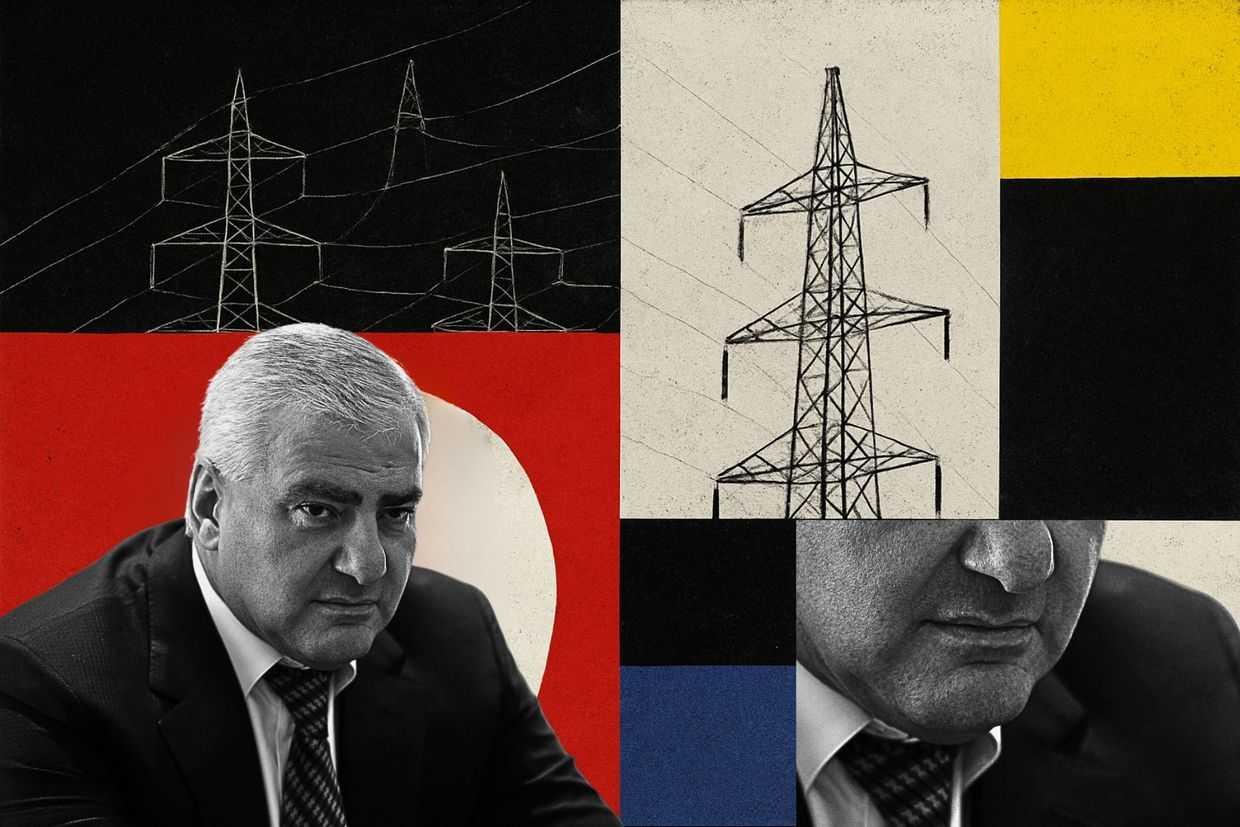
A lawyer has released the first messages from Giorgi Udzilauri, a former associate of Georgian Dream founder and billionaire Bidzina Ivanishvili, who was detained in May on espionage charges. Udzilauri, a former public servant, reportedly criticised the ruling party’s current leadership as undemocratic and isolationist, and said his arrest was a warning to others.
Udzilauri, a harsh critic of the formerly ruling United National Movement (UNM), had longstanding ties to Georgian Dream, describing himself as one of the first 20 people gathered around Ivanishvili during the party’s formation in 2011. He previously worked in PR for Ivanishvili’s Cartu Group conglomerate and, before his detention, headed the Public Relations Department at the Finance Ministry’s Investigative Service.
When announcing his arrest on espionage charges on 5 May — one of several similar detentions over the past two months — the State Security Service of Georgia (SSG) did not specify on whose behalf Udzilauri was allegedly spying. Pro-government media, however, reported that the case involved ‘one of the European states’ — something later confirmed by former SSG Head and the current State Minister for Coordination Among Law Enforcement Agencies, Mamuka Mdinaradze, on 8 May.
In lengthy messages written down by Udzilauri’s lawyer, Beka Guledani, following a prison meeting with his client, Udzilauri said that Georgian Dream had drifted away from its original foundations, with ‘high ideals’ replaced by ‘the interests of opportunists’.
While again sharply criticising the formerly ruling UNM, Udzilauri said that those now in power are figures who did not fight against the former government and for whom ‘both ideals and teamwork are foreign’.
Although he did not specify names, a significant part of Georgian Dream’s current senior figures — including Prime Minister Irakli Kobakhidze and Parliamentary Speaker Shalva Papuashvili — were not among those who founded the party.
According to the text, although Udzilauri believed Georgian Dream had ‘more or less maintained’ a pro-European and democratic course between 2012 and 2022, he observed a growing view within the government that ‘democracy is not particularly convenient for governing’.
‘[The idea was growing] that freedom of speech matters only when you are in opposition and becomes highly irritating once in power’.
‘EU integration also proved uncomfortable, as the new leadership of Georgian Dream faced a choice: either genuinely separate the executive, legislative, and judicial branches, or maintain party dictatorship and trample on democracy’, the text read, adding:
‘Distancing from EU integration happened gradually but consistently, while freedom of expression was slowly restricted, including for public servants’.
‘Cowardly stance toward Russia’
According to the text, Udzilauri attended ‘pro-European student protests’ in central Tbilisi twice while working at the Finance Ministry — likely during the 2024 anti-government demonstrations that followed the government’s EU U-turn.
Guledani also noted that while working in the Government Administration’s press office, Udzilauri attended an unspecified ‘student protest at Tbilisi State University (TSU)’, after which the security services informed the ruling party that ‘Giorgi was supposedly one of the organisers of the process’.
‘Despite being warned upon joining the Investigative Service that his phones were being monitored, his internet traffic tracked, the location of his official vehicle recorded, and conversations inside the car listened to, he did not limit himself in meetings, conversations, or correspondence’, the text read.
According to Guledani, Udzilauri openly mocked the authorities’ anti-Western conspiracy theories — including claims about the existence of the ‘deep state’ and ‘global war party’ — and personally voiced his opposition to the ruling party’s anti-Western policies in conversations with its members.
‘Giorgi opposes the current government’s isolationist policies, the cowardly stance of Georgian diplomacy toward Russia, and the justification of everything through the “threat of war” ’.
Guledani also conveyed Udzilauri’s view that his ‘political stance and ideals’ had turned him into a ‘political prisoner’, and that his arrest was intended as a ‘political signal to all public servants who think differently from the propaganda’.
No criticism toward Ivanishvili
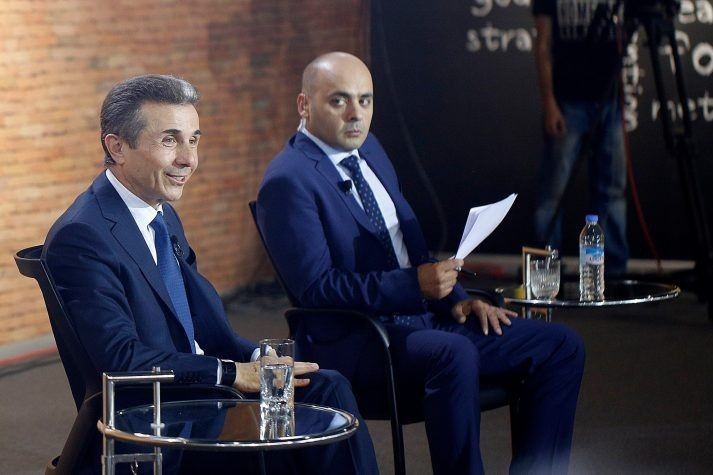
Although he condemned what he described as Georgian Dream’s ‘new leadership’, Udzilauri avoided directly criticising Ivanishvili, who, despite formally serving as the ruling party’s honorary chair, is widely viewed by critics as the real power behind the party.
In Udzilauri’s words, ‘today’s leadership’ of the party ‘do not understand that the West they have now assigned the status of an enemy took part in the struggle of 2011–2012 and the victory that followed’. By this, he referred to the final years of UNM rule before it was replaced by Georgian Dream following the October 2012 elections victory.
Udzilauri claimed that both Ivanishvili and the ‘American and European specialists’ who, according to him, aided Georgian Dream while it was still in opposition, were convinced that ‘a democratic and pro-Western Georgia’ was being founded.
Udzilauri further noted that ‘his activism and enthusiasm were treated as political insubordination’.
‘He acknowledges that he did not follow so-called party discipline and refused to do things he did not want to do’, Guledani said, adding:
‘Giorgi recalls that the last thing he refused to do was to “smear” Eka Beselia, and that he knew they would soon come for him as well’.
Beselia was one of Georgian Dream’s founding members. She resigned from her parliamentary post in December 2018 and left the party in February 2019, following disagreements over judicial appointments. That same winter, intimate footage of Beselia was leaked online — an incident she spoke about publicly, signalling that she would not be silenced.
A string of espionage cases
Udzilauri is one of at least four people detained in April and May by the SSG on espionage charges, though authorities have not specified on whose behalf they were allegedly spying.
Among the others is Tamaz Galoev, a resident of Akhalgori (Leningor), South Ossetia, detained in April, who, according to pro-government media, is accused of spying for Russia.
On 30 May, authorities also announced the detention of two more individuals on the same charges: Gulbaat Rtskhiladze, founder of the pro-Russian Eurasia Institute, and Irakli Chikhladze, founder of the Caucasian Centre for Civil Hearings, which focuses on regional affairs, including conflict and peacebuilding.
Rtskhiladze was accused of spying for two countries, while Chikhladze was reportedly accused of spying for one. The latter’s defence stressed that his case was unrelated to that of Rtskhiladze.
On 8 May, when confirming that Udzilauri had been detained on charges of spying for a European country, Mdinaradze warned ‘the few European countries that are carrying out intensified and active intelligence operations in our country’.
‘Georgian special services have more information than they can imagine [...] We ask them to withdraw these people and remove them from the activities they are engaged in’, he added, warning that otherwise, ‘we will make further hints regarding this matter’.
On Monday, the country’s largest pro-government TV channel, Imedi, asked Mdinaradze whether the people recently detained on espionage charges were accused of spying for ‘Russia, Poland, Iran and France’.
Mdinaradze responded by saying, ‘I cannot confirm it, because Poland has nothing to do with this’, thereby narrowing the space for speculation around France.
A few days later, on Thursday, the French outlet Intelligence Online reported that France’s foreign intelligence service, the Directorate-General for External Security (DGSE), had been forced to recall two intelligence officers from Tbilisi to Paris. According to the outlet, the move came amidst Georgia’s detention of a ‘former ally’ of Ivanishvili.
The article noted that Tbilisi threatened to expose the officers’ identities unless Paris withdrew them.
No official comments have been made on the French side confirming or denying the information as of publication.