A Georgian parliamentary report on rising food prices in the country has found that reducing prices would be difficult without ‘structural reforms’. It came as the National Statistics Bureau (Geostat) announced that inflation in the food sector stood at 7.5% in April.
The commission was formed in February after Prime Minister Irakli Kobakhidze called for an investigation into possible ‘cartel-like’ practices amongst Georgian food distributors and retailers.
The lengthy report stated that reforms should include improving transparency, enhancing logistics, and reducing financial pressure on businesses.
According to the report, the retail market is competitive, profit margins are normal, and most products are sold at a discount (about 70%–80% of sales), meaning actual prices are often lower than shelf prices.
As a result, the commission found that food prices cannot be lowered simply by increasing competition. The report said that administrative price controls were ineffective and could harm the market. Instead, long-term structural reforms — like better infrastructure, support for local production, and stronger competition — were needed, it said.
The report was released shortly before Geostat published its monthly inflation figures, according to which annual inflation in April 2026 reached 5.9%, while the monthly rate reached a two-year high of 1.7% driven by fuel prices.
Inflation in transport stood at 10.3%, food at 7.5%, and utilities, affected by higher electricity prices, at 6.5%.
Geostat also shared a detailed breakdown of inflation by foodstuff:
- Fish and seafood: 21.3%
- Fruit and grapes: 11.8%
- Meat and meat products: 10.1%
- Vegetables and melons: 9.3%
- Bread and bakery products: 7.7%
- Sugar, jam, and other sweets: 7.3%
- Oils and fats: 6.3%
- Milk, cheese, and eggs: 4.5%
- Coffee, tea, and cocoa: 3.2%
- Mineral and spring waters, non-alcoholic beverages, and natural juices: 0.8%.
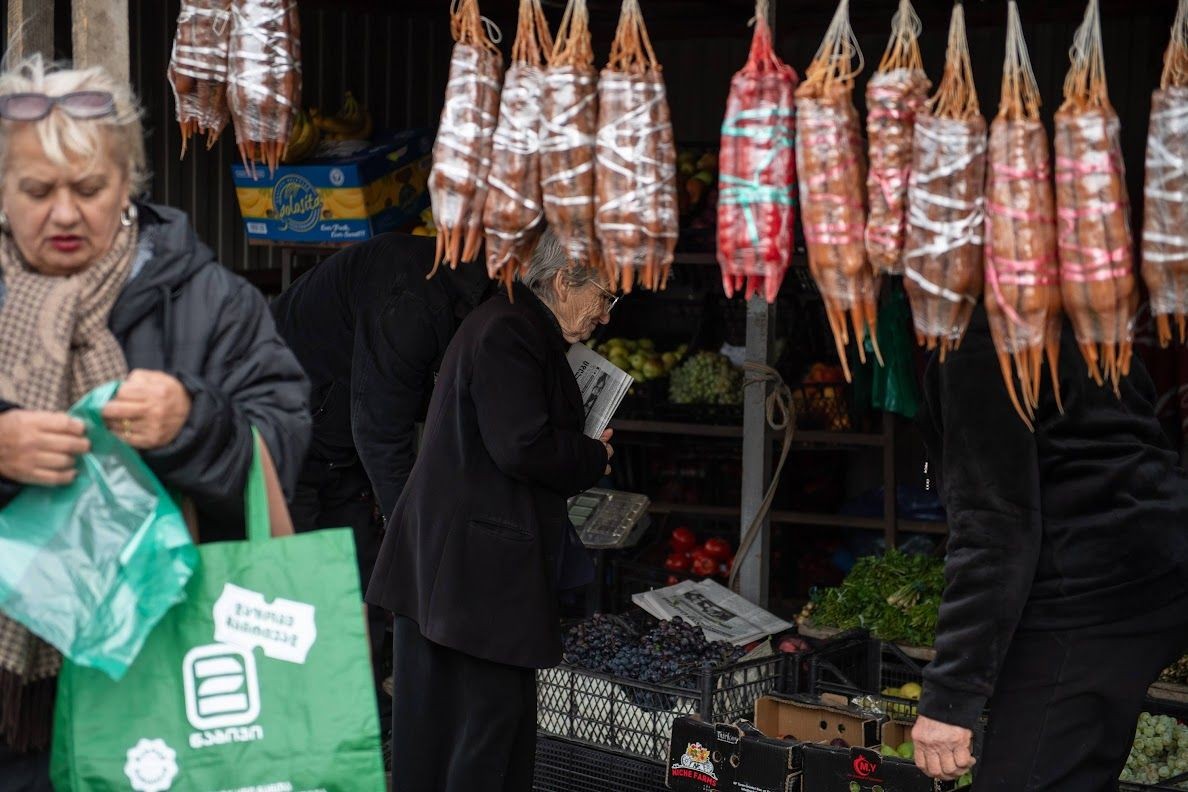
In a vox pop conducted by opposition-aligned TV Pirveli, passersby and street vendors viewed the conclusions of the results of the commission ironically.
‘As long as there is peace and no war, we can try something’, one person said, in a likely allusion to the ruling Georgian Dream party’s electoral campaign messaging, largely focused on how its policies guarantee peace for Georgia.
One pensioner, Marina Loria, told OC Media that she receives ₾495 ($185). She said that she does not buy meat because she is a vegetarian, but when her grandkids visit or she has guests, she has to.
‘This money is hardly enough for my medication. However, the government financed my cataract surgery, so that helps balance the hardship’, she said.
Roman Gotsiridze, a staunch critic of the government’s economic and financial policies and former governor of the National Bank, said that what made matters worse and more suspicious were the so-called coordinated announcements following the parliament’s price commission conclusions.
The Georgian Retail Association, which represents chain supermarkets, issued a statement as part of what Gotsiridze described as an unconstitutional government-organised propaganda campaign that violates Georgia’s competition law. According to the statement, supermarkets intend to coordinate pricing on ‘socially sensitive goods’.
‘This has nothing to do with healthy competition, which ensures lower prices. Instead, it resembles cartel-like coordination between businesses influenced by the government. Such coordination cannot reduce prices; on the contrary, it risks increasing them’, Gotsiridze told OC Media.
Under Georgian law, he said, the issue is not whether prices were high or low — any coordination of prices between competitors is illegal. The law prohibits agreements that directly or indirectly fix prices, restrict price formation, or coordinate commercial terms. The key principle is that competitors must set prices independently. Even coordinated discounts on socially important products, he argued, constitute illegal behaviour, because the violation lies in the coordination itself.
Gotsiridze goes on to say that such agreements weaken competition, hinder independent pricing, and can push smaller, non-chain retailers out of the market. In the long run, he argued, this leads to higher prices and stronger dominance by large chains.
Giorgi Khabashvili, the General Director of Goodwill and Chair of the Georgian Retail Association, said that it was possible to make prices more efficient by easing the supply chain and optimising logistics.
‘Unless we produce something ourselves, we will always be dependent on imports. Take milk production — it costs more at the source here than the European market retail price’, he said.
A number of economists have expressed scepticism, saying that the results only show that the National Bank is failing to fulfil its duty, as inflation is more than twice the target level. That’s one point, said Paata Bairakhtari, economist and founder of the Free Businessmen’s Association (TBA), speaking to OC Media.
‘The so-called absurd commission that was recently created — and which they boasted would supposedly regulate prices — was misguided. Specialists had said from the very beginning that prices cannot be regulated in this way and that the commission would not produce any substantial or tangible results. This official data once again confirm that the commission’s work was merely superficial and a farce’.
 Helena Bedwell