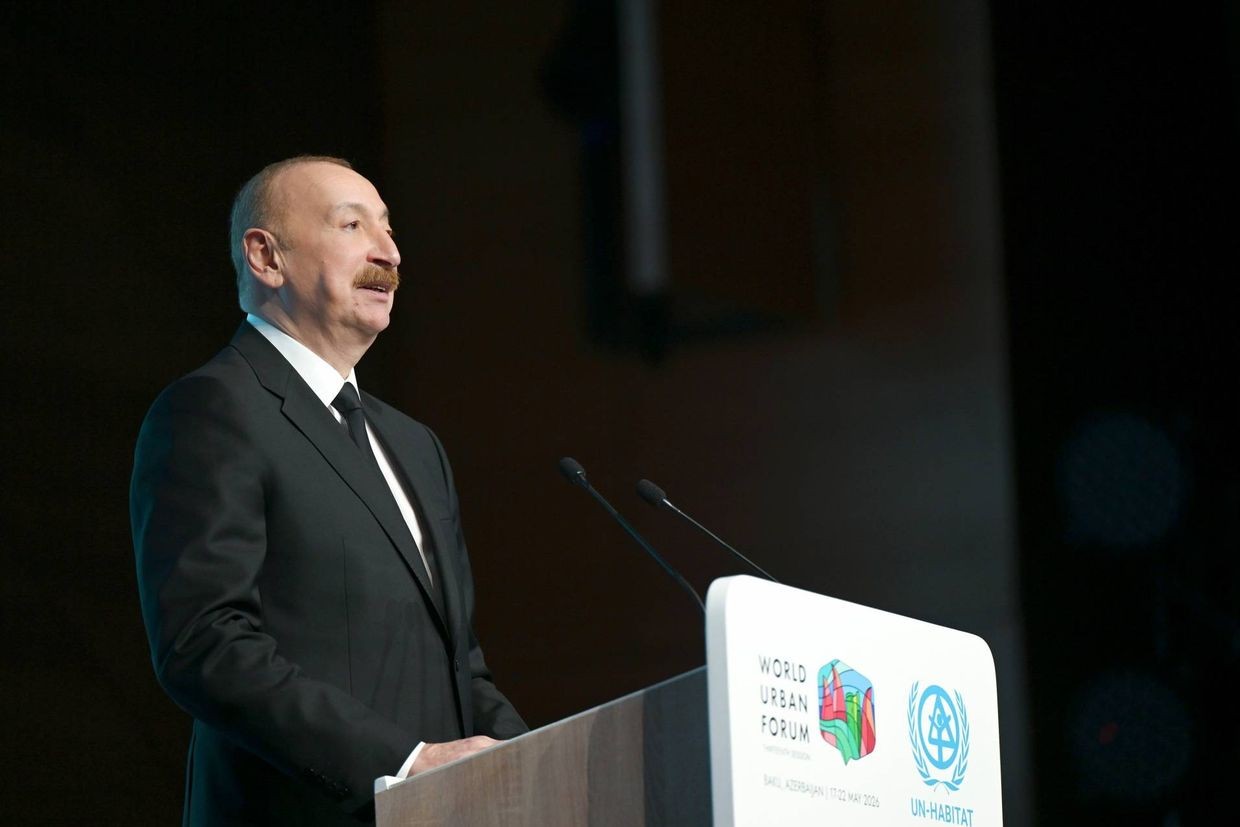
Azerbaijan has hosted the 13th session of the World Urban Forum (WUF13), its largest global event since COP29 in November 2024. In his opening remarks, President Ilham Aliyev stated that one of the main tasks for the government ‘is the reconstruction of Karabakh and Eastern Zangezur’.
He said that as part of the ‘Great Return’ programme, Azerbaijan built around 33 tunnels stretching over 70 kilometres, with five others expected to be built. He added that 435 bridges, power stations, water storage facilities, houses, schools, and hospitals were built in the two regions.
Aliyev stressed that Nagorno-Karabakh and surrounding territories ‘were under Armenian occupation for 30 years’, and ‘suffered total destruction and devastation’.
The region came under Azerbaijan’s control in September 2023 following brief clashes that led to Nagorno-Karabakh’s surrender and the mass exodus of its Armenian population.
‘International observers and visitors compared, for instance, Aghdam with Hiroshima. They called it the “Hiroshima of the Caucasus”, because this city just did not exist’, Aliyev said.
According to Aliyev, as of today, more than 85,000 Azerbaijanis already live in Nagorno-Karabakh and the surrounding territories.
‘And this is how the owners of the land behave, unlike those who come only to demolish, to destroy, and to bring suffering’, Aliyev said.
On Tuesday, Aydin Karimov, the President’s Special Representative in Shusha, offered a slightly lower figure for Azerbaijanis settled in Nagorno-Karabakh and Eastern Zangezur, at more than 80,000 people.
As the Azerbaijani government framed the reconstruction as one of its core goals, on Tuesday presidential aide Hikmat Hajiyev told pro-government media outlet APA that ‘Azerbaijan’s efforts in this area are unique’
‘Today, it can be said that no other country has restored nearly nine cities and more than 300 villages and settlements using its own national and financial resources to the extent that Azerbaijan has. The issue of post-conflict urban and settlement reconstruction deserves special mention’.
Natural gas and oil agreements within the framework of WUF13
Aliyev met with several world leaders on the sidelines of WUF13, including Serbian President Aleksandar Vučić on 17 May. According to APA, Vučić also attended a business meeting with entrepreneurs operating in Azerbaijan.
He stated that both countries will find ‘areas for cooperation’ and that the Serbian side ‘is trying to attract Azerbaijani investors’ to Serbia’s resorts and mountainous areas.
He added that Serbian investors were also interested in investing in Baku and other regions of Azerbaijan.
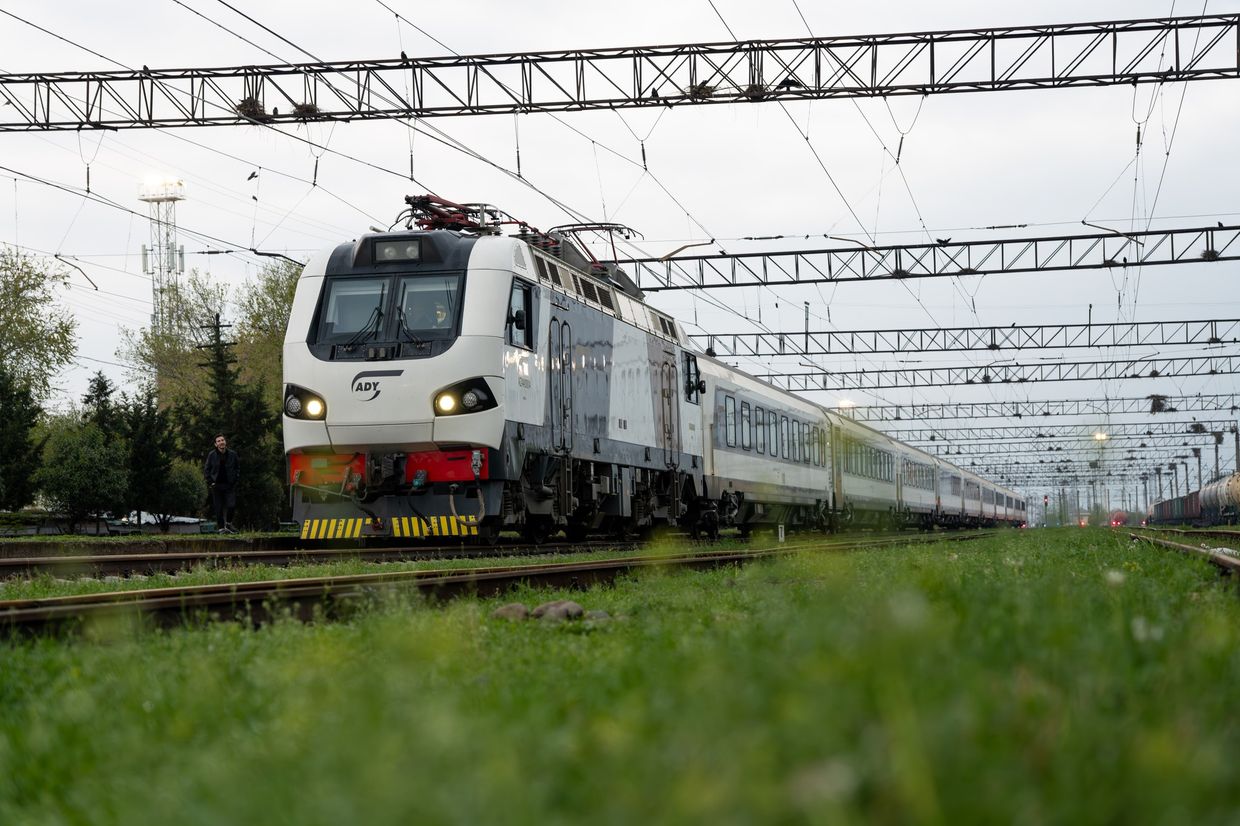
Aliyev also held meetings with a Georgian delegation led by Prime Minister Irakli Kobakhidze, as a result of which, they agreed to resume daily passenger train services on the Baku–Tbilisi–Baku route from 26 May.
Other agreements concerned Azerbaijan’s supply of natural gas and electricity to Georgia, and agreements to continue transit arrangements for additional supplies of Azerbaijani gas to international markets.
The parties also signed the Protocol of the Coordination Council concerning the Baku–Tbilisi–Kars railway construction project.
In addition, according to the agreement, electricity would be supplied to Georgia as well as sent to Turkey through Georgian territory.
Azerbaijan’s state-run oil company SOCAR also signed an agreement with the Georgian Oil and Gas Corporation to ‘define the terms’ of the company’s operation on the ‘Georgian section of the Western Route Export Pipeline, including the Supsa Oil Terminal and associated infrastructure’.
On Tuesday, Aliyev received Tomáš Taraba, Slovakia’s Deputy Prime Minister and Environment Minister.
Taraba said that ‘Slovakia has always stood by Azerbaijan’, and said that Azerbaijan had ‘been a reliable supplier whenever his country needed natural gas’.
For ease of reading, we choose not to use qualifiers such as ‘de facto’, ‘unrecognised’, or ‘partially recognised’ when discussing institutions or political positions within Abkhazia, Nagorno-Karabakh, and South Ossetia. This does not imply a position on their status.
 Aytan Farhadova