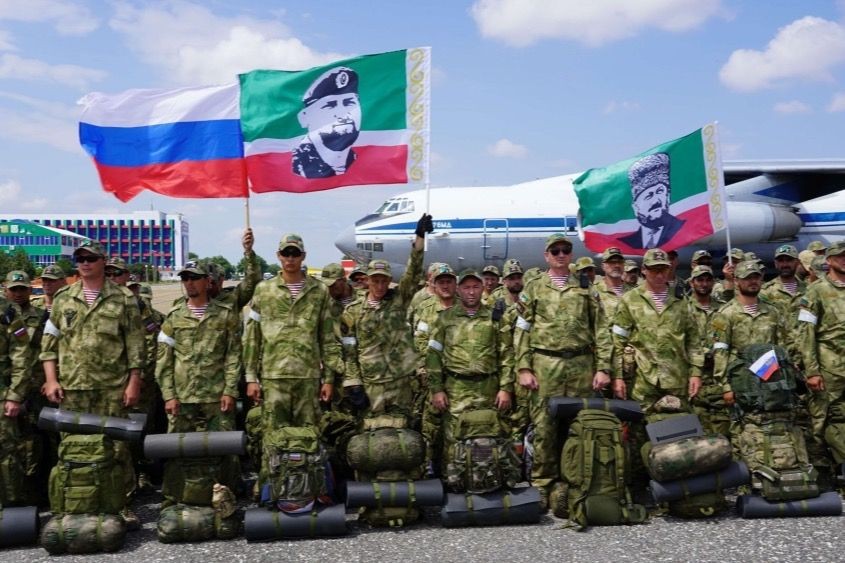
A report by Memorial has found that Chechen Head Ramzan Kadyrov directly commands upwards of 33,000 security and military personnel, a figure which has appeared to have doubled since the beginning of Russia’s full-scale war against Ukraine in 2022.
In comparison, in 2022, Memorial estimated the number of all structures and units effectively under Kadyrov’s control at 16,000–18,000.
The authors of the report emphasise that this increased number includes not only older Russian National Guard (Rosgvardia) and police units, but also new formations created after the start of the full-scale invasion. These include the 78th Special Motor Rifle Regiment Sever-Akhmat (North-Akhmat), the 349th Motor Rifle Regiment Akhmat-Russia, the 1434th Regiment Akhmat-Chechnya, the 270th Motor Rifle Regiment Akhmat-Caucasus, the Yug-Akhmat (South-Akhmat), Zapad-Akhmat (West-Akhmat) and Vostok-Akhmat (East-Akhmat) motor rifle battalions, as well as the Sheikh Mansur reserve training rifle battalion.
‘All of these are not “gendarmerie-type” Rosgvardia units, but full-fledged army formations in terms of their structure, staffing, weapons, and equipment,’ the human rights defenders write. According to them, these formations are formally part of Ministry of Defence structures, but are ‘loyal and primarily subordinated to Ramzan Kadyrov’, the report states.
The authors of the report also note that the security structures under Kadyrov’s control and stationed in Chechnya ‘can now, without any quotation marks, be called the “Kadyrov army”, while ‘Kadyrov’s “TikTok troops” in Ukraine effectively mask this reality, distracting the observer from the main point’.
At the same time, Memorial writes that the structural changes have not weakened Kadyrov’s influence but, on the contrary, have allowed him to extend it to new units through loyal commanders.
A separate section of the report is devoted to how these formations are recruited, noting that besides financial incentive, methods of pressure are applied which they describe as typical for Kadyrov’s system.
‘Standard methods used by Kadyrov’s regime were employed: threats of fabricated criminal cases, abductions, threats against relatives, including women, and blackmail,’ the report states.
According to Memorial, since 2022, forced conscription has also been used as punishment for perceived offences against the republic’s leadership.
The report notes that controls on roads and at administrative borders in the republic have intensified, with security forces checking documents and mobile phones, particularly of young men. The report also states that recruitment plans for various units exist and that figures on personnel strength are often based not on actual individuals but on contracts and repeated deployments to the war zone. According to the authors, this is why official reports on the number of those sent to the war do not always reflect the actual number of personnel.
On 14 April, Kadyrov stated that over the entire course of the full-scale war in Ukraine, ‘more than 70,880 fighters, including over 24,790 volunteers’ had been sent from Chechnya to the combat zone. Today, he claims, ‘around 14,000 soldiers’ from Chechnya are deployed ‘in key areas’.
A separate part of the Memorial report focuses on the Akhmat special forces under the command of Apti Alaudinov. Memorial writes that this structure receives personnel, equipment, and supplies from Chechnya and through structures controlled by Kadyrov, but its place within the current hierarchy of Russia’s system of command remains unclear. The document notes that the Akhmat special forces no longer appear to be a formation fully subordinated solely to the Chechen leadership.
 Elizaveta Chukharova