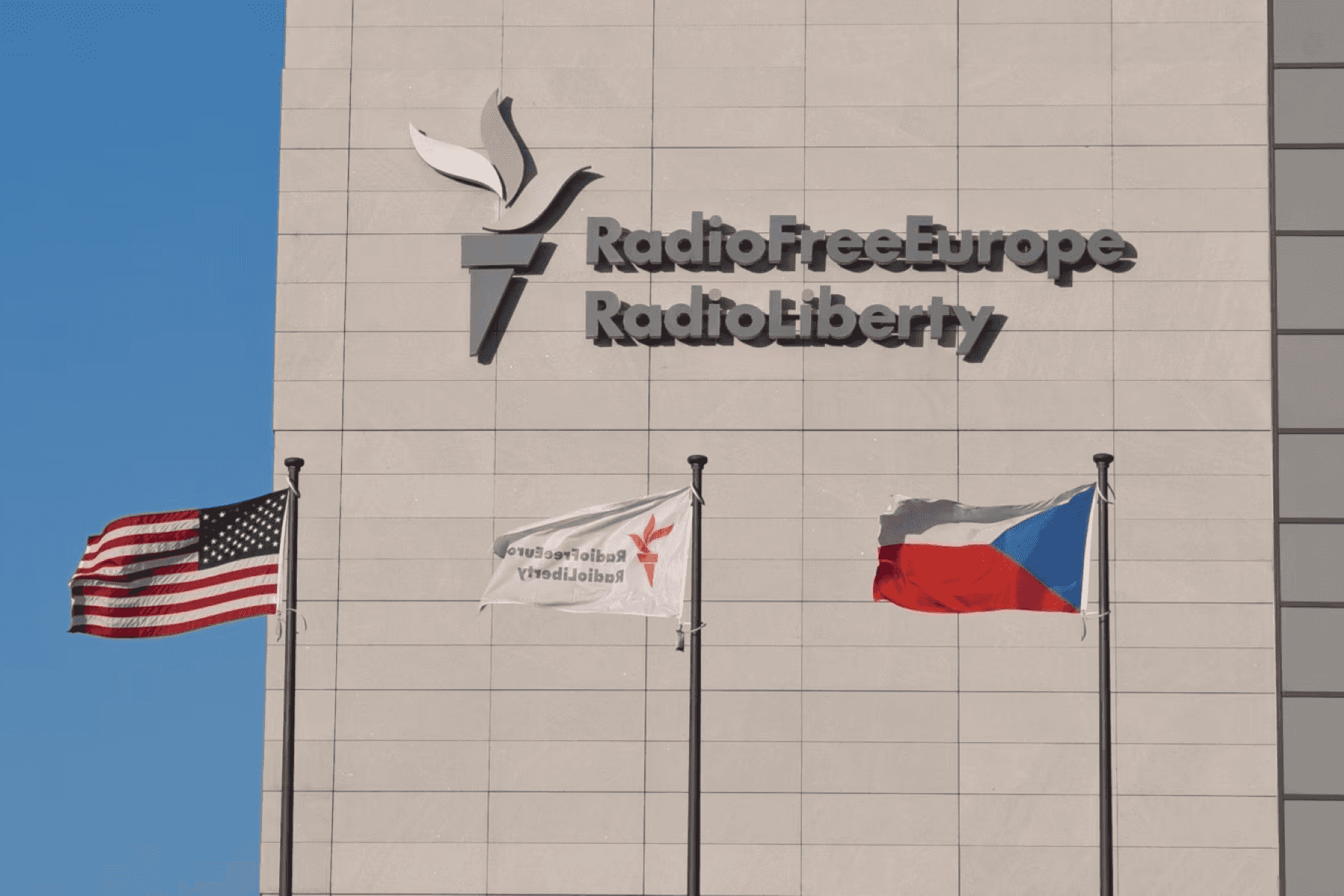
RFE/RL’s Russian-language regional outlet Ekho Kavkaza (Echo of the Caucasus) has ceased operations. The move came amid financial challenges faced by Radio Free Europe/Radio Liberty under the administration of US President Donald Trump and broader structural changes affecting several of the organisation’s bureaus.
Information regarding the suspension of Ekho Kavkaza’s operations from 1 May was included in a press release published by RFE/RL about its ‘strategic reforms’ on Tuesday.
According to an informed source within the organisation, staff members based in both the Tbilisi office and Prague HQ have already been laid off. The source also noted that compensations have been given to contracted employees.
Ekho Kavkaza’s editor-in-chief Demis Polandov wrote in a Thursday social media post that it was his ‘last working day at Radio Liberty’. At the time of publication, he was not available for comment.
Founded in 2009, Ekho Kavkaza was a media project named as its mission to cover ‘events in Georgia and the self-proclaimed republics of Abkhazia and South Ossetia in Russian’. As RFE/RL as a whole, the project faced hostility and restrictive designations from the Russian authorities.
Moscow first declared RFE/RL a ‘foreign agent’ in 2017, and in February 2024 went further, labeling it — along with all its divisions, including Ekho Kavkaza — an ‘undesirable organisation’. Under Russia’s draconian legislation, the second designation is more severe, exposing not only the outlet’s staff, but also its donors and even interviewees to the risk of criminal charges.
Shortly afterward, in March 2024, Ekho Kavkaza announced the suspension of its radio broadcasting, noting that the anticipated challenges associated with being designated an undesirable entity left it with no other choice.
‘We cannot risk losing our correspondents and experts with Russian citizenship on live radio. The lack of live speech and the impossibility of recording interviews with politicians, experts, and ordinary people from Abkhazia and South Ossetia make the radio format currently impractical’, it said at the time.
However, the project’s website and social media platforms have continued to operate to this day. Following the closure, Ekho Kavkaza’s online presence is likely to remain accessible, but will no longer be updated.
The outlet itself bid farewell to its audience on Sunday, expressing hope that ‘the materials collected over the years will still serve as a valuable source of information for everyone who continues to study our region’.
Alongside Ekho Kavkaza’s closure, the RFE/RL management further announced merging the operations of several of its other services — Russian Service (Radio Svoboda), Current Time, Tatar-Bashkir Service (Radio Azadliq), and North Caucasus Service (Marsho Radio) — into a single multiple-media programming unit for audiences in Russia.
‘All four service brand names will remain in use, reflecting the dedicated followings they have built among their audiences over many years’, the press release read.
According to RFE/RL, following Ekho Kavkaza’s shutdown, ‘the new Russia programming unit will cover newsworthy events in these occupied regions for Russian-language audiences’.
Trump administration and financial challenges
Founded in 1949, RFE/RL is funded by the US Congress through a federal grant from the US Agency for Global Media (USAGM). Alongside the Voice of America (VOA), the media outlet has often been credited with helping spread information and news to countries behind the Iron Curtain during the Cold War.
RFE/RL operates several branches in the Caucasus, publishing news and analysis in Russian, Georgian, Azerbaijani, Armenian, and Chechen, and is regarded as one of the region’s leading independent, non-partisan media sources.
Speaking about the reasons behind Ekho Kavkaza’s closure, the source noted that it is linked to the Trump administration’s handling of RFE/RL’s funding through the USAGM — first suspending and then restoring it, but at a reduced level.
In March 2025, soon after coming to power, as part of the ‘reduction of the federal bureaucracy’, the administration moved to dramatically reduce the operations of USAGM and agencies supported by it, including RFE/RL. Soon after, RFE/RL’s CEO Stephen Capus said that the media company’s grant agreement was terminated.
RFE/RL challenged the decision in court, arguing that the executive branch cannot legally withhold money already allocated by Congress. US courts largely agreed, issuing orders that blocked the funding cuts and later requiring the government to release at least part of the money.
The financial uncertainty amid legal battles has placed the company under serious strain over the course of 2025.
Although funding for the USAGM and its affiliated outlets was ultimately allocated in the 2026 fiscal year budget signed by Trump, the amounts are lower than in previous years: According to Reporters without Borders (RSF), the budget was cut roughly 25% from previous years.
Congress-appropriated funds for RFE/RL itself in fiscal year 2026 is $112.5 million.
‘These measures are being undertaken to preserve RFE/RL’s position as an impactful, relevant, and fiscally responsible organization’, Capus is quoted saying in Tuesday’s press release.
‘We are reinforcing our commitment to enterprise journalism — particularly investigative and analytical reporting. As we restructure, we say goodbye to some truly talented colleagues who have long dedicated themselves to RFE/RL’s mission’, he added.
Shortly before the latest announcements, at the end of March, RFE/RL closed its Bulgarian, Romanian, and North Macedonia services, as well as Radio Mashaal — its Pashto-language service for Pakistan’s tribal regions.
For ease of reading, we choose not to use qualifiers such as ‘de facto’, ‘unrecognised’, or ‘partially recognised’ when discussing institutions or political positions within Abkhazia, Nagorno-Karabakh, and South Ossetia. This does not imply a position on their status.