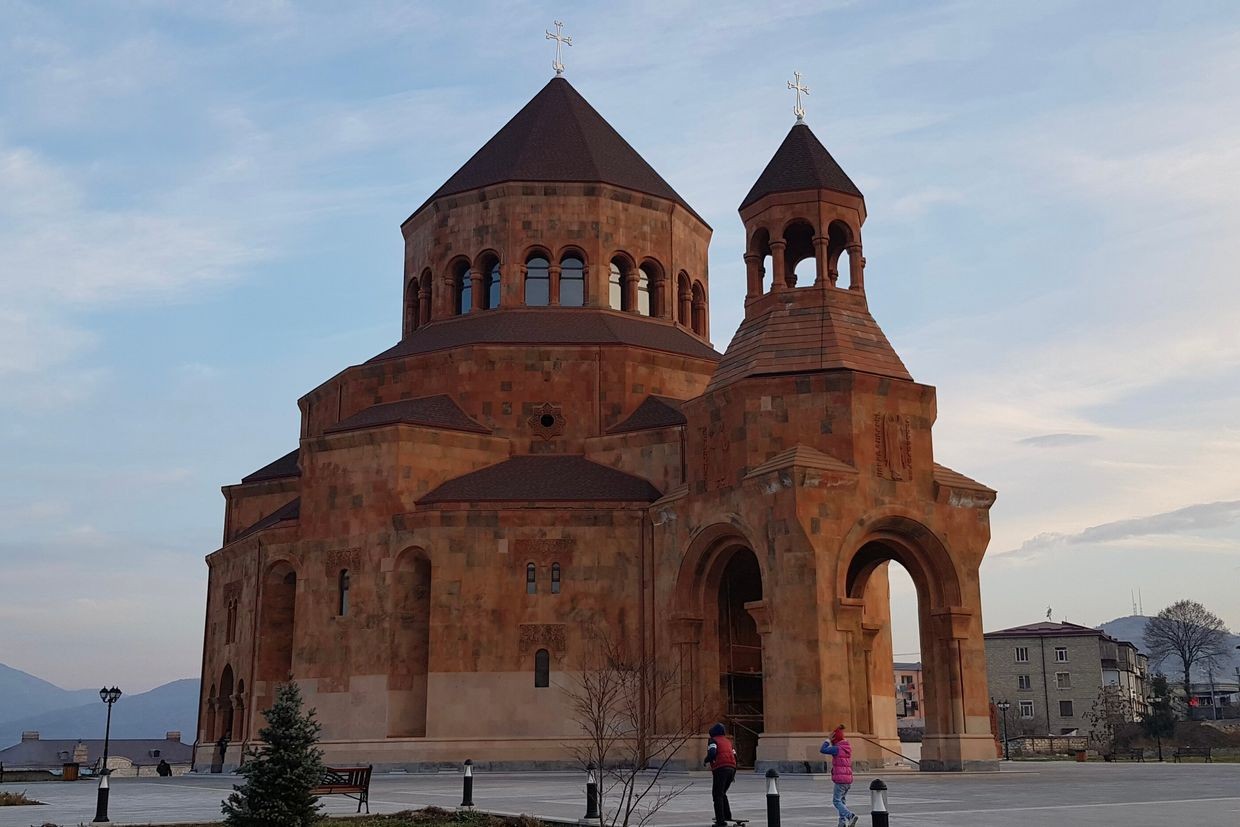
Satellite imagery analysis has suggested that Azerbaijan destroyed the Holy Mother of God Cathedral, the main Armenian church in Stepanakert. The church was the largest among Armenian churches in Nagorno-Karabakh.
Armenian investigative outlet Hetq was among the first to verify reports of the church’s demolition circulating online. Images taken by the European Sentinel-2 satellite as of 2 April showed ‘the white paving stones surrounding the Mother Cathedral, but not the church itself’.
The church was still standing as of 3 March, Hetq said, publishing supporting imagery.
Construction of the church began in 2006; it was consecrated in April 2019. Located in central Stepanakert, it served as the region’s primary church, and was also used as a shelter during the Second Nagorno-Karabakh War in 2020 and during subsequent escalations with Azerbaijan, providing refuge from Azerbaijani air strikes.
Earlier in April, it was reported that another church in Stepanakert, Surb Hakob, built in 2007, was also destroyed.
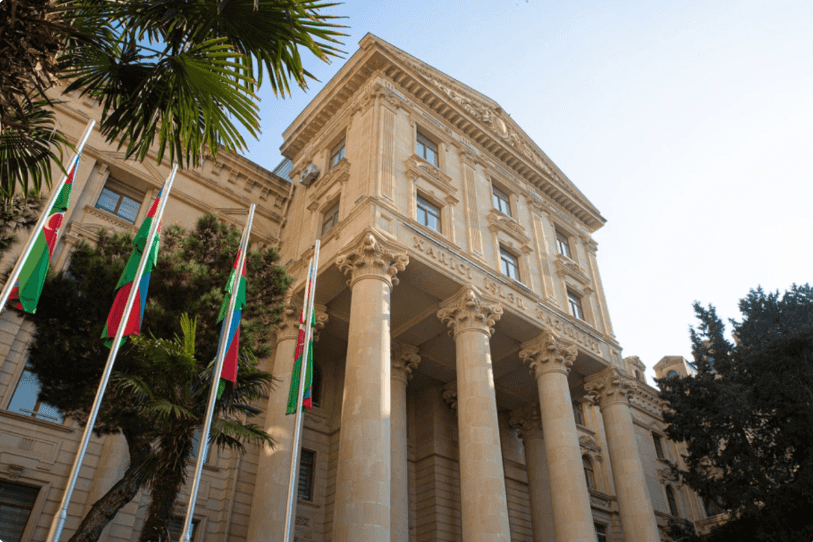
RFE/RL has failed to get any comment from Azerbaijani Foreign Ministry regarding the reported demolition. Instead Azerbaijani pro-government media outlet APA published a lengthy piece on Wednesday pointing at Armenia’s ‘responsibility for acts of vandalism against Azerbaijan’s religious monuments’ in Nagorno-Karabakh and beyond. APA has further claimed that Armenians in Nagorno-Karabakh appropriated religious sites in the region.
The demolition of the church has been widely criticised in Armenia, with Nagorno-Karabakh Armenians and government critics blaming Armenian authorities for failing to ensure the preservation of the region’s cultural heritage.
The Artsakh Union, an non-governmental organisation focused on the protection of the rights and interests of Nagorno-Karabakh Armenians, urged Yerevan to ‘reconsider its encouraging inaction and rhetoric’.
The union allegedly was referring to a remark offered by Armenian Prime Minister Nikol Pashinyan during an 18 April press briefing when asked to comment on the reports of the church’s destruction.
‘My concern is the historical and cultural monuments located in the territory of Armenia’, Pashinyan said, adding that they had tripled the funding for their restoration.
On Thursday, when asked about the same issue, Pashinyan said his government was currently obtaining complete information and expressed their reluctance to make the destruction ‘a subject of international discussions at the state level’.
‘On such issues, especially at this stage, one must be prudent, because they are a double-edged sword’, Pashinyan said.
He earlier stressed the importance of stopping mutual recriminations amidst peace efforts.
 Arshaluys Barseghyan
Stepanakert and other areas in Nagorno-Karabakh have undergone major changes since Azerbaijan took full control over the region in September 2023 following a lightning offensive that forced the vast majority of Nagorno-Karabakh’s Armenians into exile.
Azerbaijani authorities often state that some buildings were constructed ‘illegally’ and were therefore subject to demolition. However, alongside newer structures, centuries-old sites have also been affected.
The damaged and destroyed cultural heritage sites include centuries-old spiritual sites and cemeteries, residential quarters in Stepanakert dating back to the 19th and 20th centuries, former government buildings, and entire villages, in addition to property owned by Armenians before their exodus.
In 2022, Azerbaijan’s then-Culture Minister Anar Karimov, citing a fringe historical theory, threatened to destroy Armenian inscriptions on religious monuments throughout territories Azerbaijan retook in the Second Nagorno-Karabakh War.
Arshaluys Barseghyan
For ease of reading, we choose not to use qualifiers such as ‘de facto’, ‘unrecognised’, or ‘partially recognised’ when discussing institutions or political positions within Abkhazia, Nagorno-Karabakh, and South Ossetia. This does not imply a position on their status.