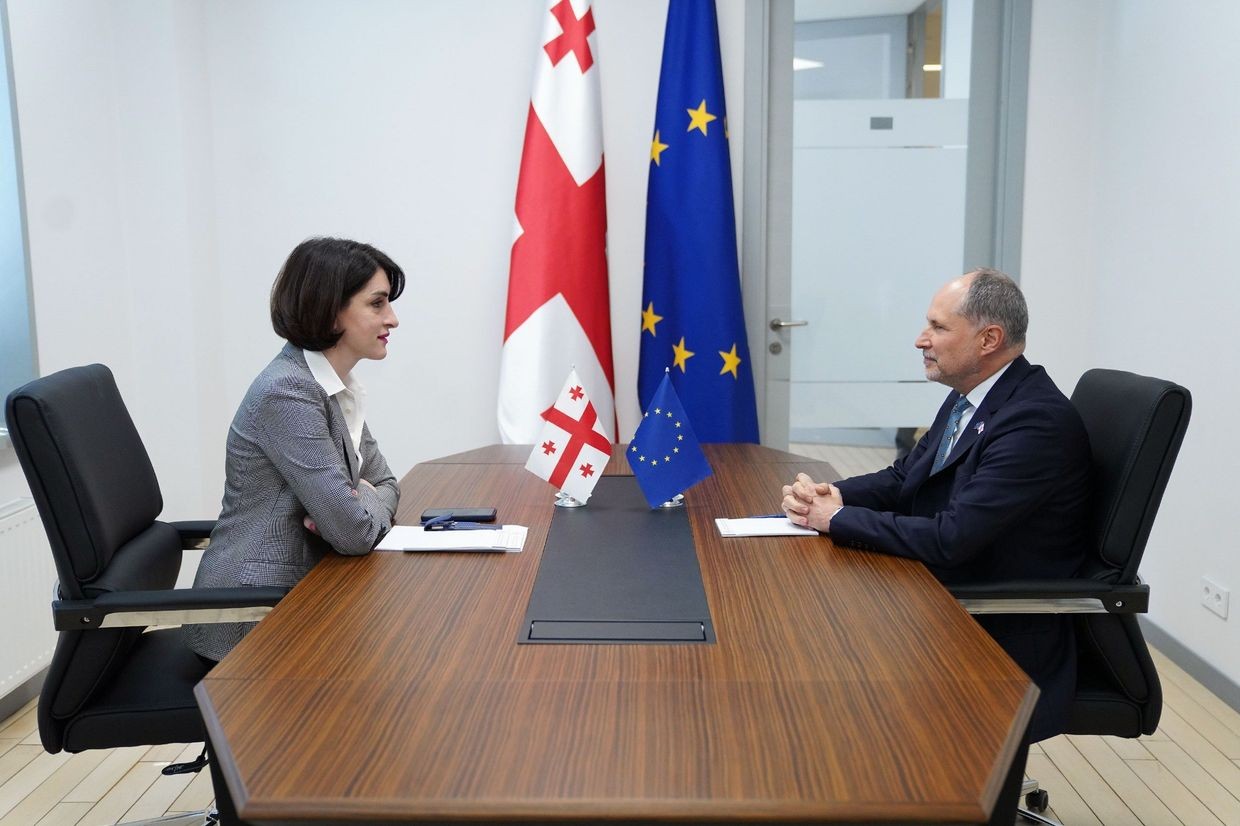
Georgia’s Foreign Ministry has summoned the EU Ambassador to Georgia, Paweł Herczyński, over remarks he made in Brussels on 22 April criticising the current government’s policies.
The Georgian government’s harsh reaction followed Herczyński’s statements made at the European External Action Service (EEAS), during the opening of an exhibition. Herczyński noted there that ‘Georgia is not on the right trajectory’ and ‘the authorities have chosen an alternative model — [a] model of authoritarianism’.
‘The future in Georgia is not written yet, but whatever will be decided in the next weeks and months will determine if Georgia belongs to the family of European countries based on democracy, rule of law, and human rights, or Georgia unfortunately would move back to its dark past’, he said.
On Tuesday, he was summoned to meet with Foreign Minister Maka Botchorishvili. According to the Foreign Ministry, during the meeting, Botchorishvili noted that ‘the current policy of Brussels toward Georgia, as well as the steps taken and statements issued in relation to the country, undermine trust between the parties and adversely affect the Georgia-EU partnership’.
‘Regrettably, the actions undertaken by Brussels can only be assessed as contributing to further polarisation within Georgian society and as fostering a radicalised political agenda’, the ministry added, also noting what it described as the Georgian government’s ‘consistent’ readiness for ‘constructive dialogue’ and stating that Tbilisi expects a ‘approach based on fairness and mutual respect’ from the EU.
The EU Delegation to Georgia also commented on the meeting, saying that Herczyński was ‘invited’ to meet Botchorishvili. It noted that a ‘substantive discussion about EU-Georgia relations’ took place and mentioned the EU’s support for Georgia since regaining its independence from the Soviet Union.
The statement underlined that EU accession requires ‘sincere commitment and tangible reforms’, expressing regret that the ‘current trajectory taken by Georgian authorities pushes Georgia away from the path of EU membership’.
‘Persistent anti-EU rhetoric further undermines the credibility of Georgia’s EU aspirations’, the delegation noted.
‘The European Union does not force anyone to become a member. We wish that Georgian authorities do not miss this historic opportunity that still exists’, it concluded.
Herczyński’s statements on 22 April, first reported by the independent Georgian online news outlet Netgazeti, were quickly followed by criticism from leaders of the ruling party, including Prime Minister Irakli Kobakhidze.
One of Herczyński’s remarks — ‘we can not let Georgia and the wonderful, warm, hospitable Georgian people go back to dark times of violence, civil war, poverty, deprivation, corruption — was interpreted by Georgian Dream as a ‘threat’ of the instigation of a civil war.
Over the past few years, following the passage of a slew of restrictive laws by Georgian Dream, violence against anti-government protesters, and the disputed 2024 parliamentary elections, relations between Georgia and its traditional international partners — including the EU — have sharply deteriorated.
The process has been accompanied by claims promoted by the ruling party and its associates that the ‘global war party’ or ‘deep state’ have taken control over the West, including Europe, and that it has been attempting to undermine Georgia’s sovereignty.
Against this backdrop, in November 2024, the Georgian Dream government announced the ‘postponement’ of negotiations on the country’s EU membership until 2028, which sparked large-scale protests in Tbilisi and other cities.
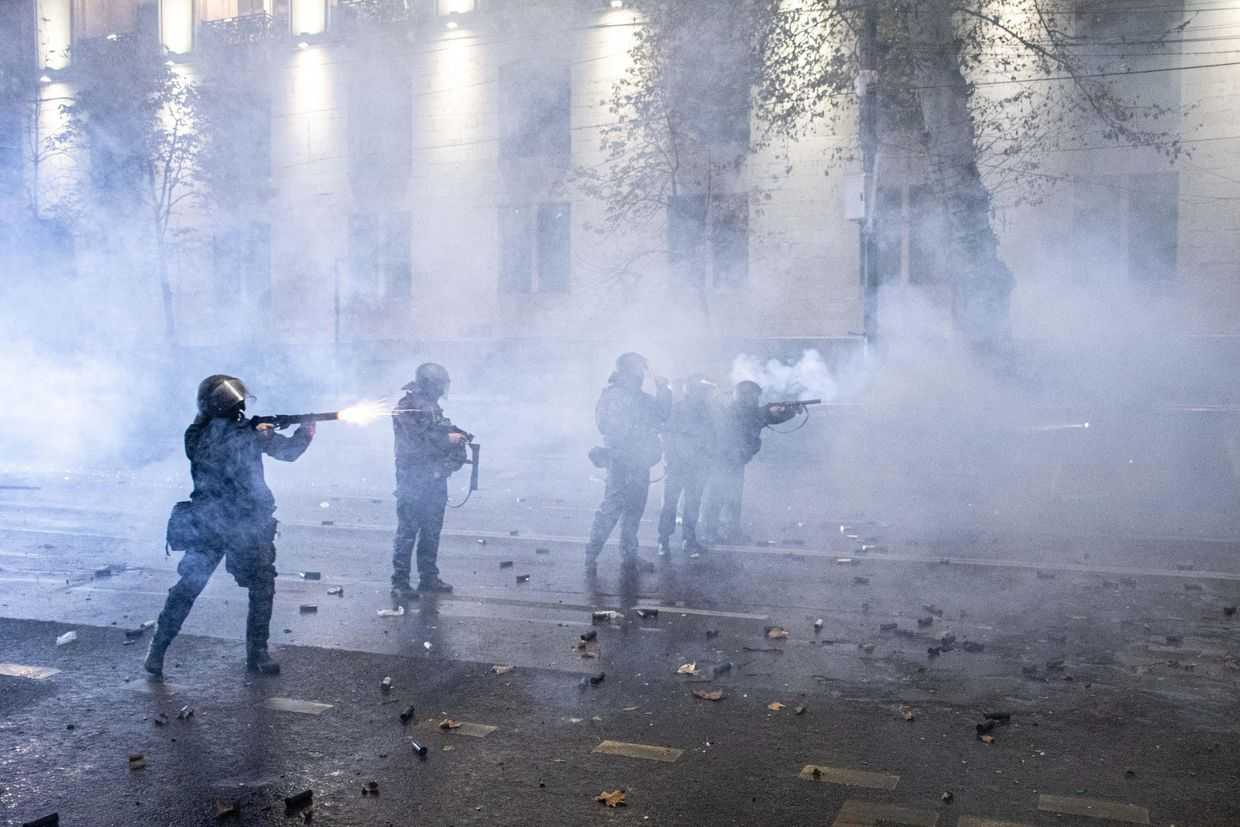
The authorities responded to the protests with both police violence and a new series of restrictive laws targeting street protests, the media, civil society, and the political opposition. At the same time, dozens of protesters, as well as opposition politicians and a media founder, were jailed on various charges.
These developments further strained relations with the EU, which, in its damning 2025 report, described Georgia as a ‘candidate country in name only’, highlighting the tarnishing of the candidate status it had been granted in 2023.
The events have also put Georgia’s visa-free travel with the EU, in effect since 2017, at risk, raising the prospect of its suspension.
In response to the EU’s criticism, the ruling party has repeatedly accused Brussels of blackmail, lying, funding ‘radicalism and disinformation’, and deviating from European values.
Against the backdrop of strained relations, the Georgian Foreign Ministry has also recently summoned other Western ambassadors, specifically from the UK and Germany. Meanwhile, Georgian diplomats were summoned by the US and Germany.