Tether, the world’s largest stablecoin issuer has chosen Tbilisi as its latest expansion target, with Prime Minister Irakli Kobakhidze calling it a watershed moment for the country’s investment credibility.
Tether is the world’s largest blockchain technology-based platform and manager of roughly $200 billion in assets and gold reserves.
The company has formally launched operations in Georgia — bringing with it an ambitious roadmap that includes a digital version of the Georgian lari — GELt. The expansion comes with investments that the government says will cover education, social programmes, and broader economic development.
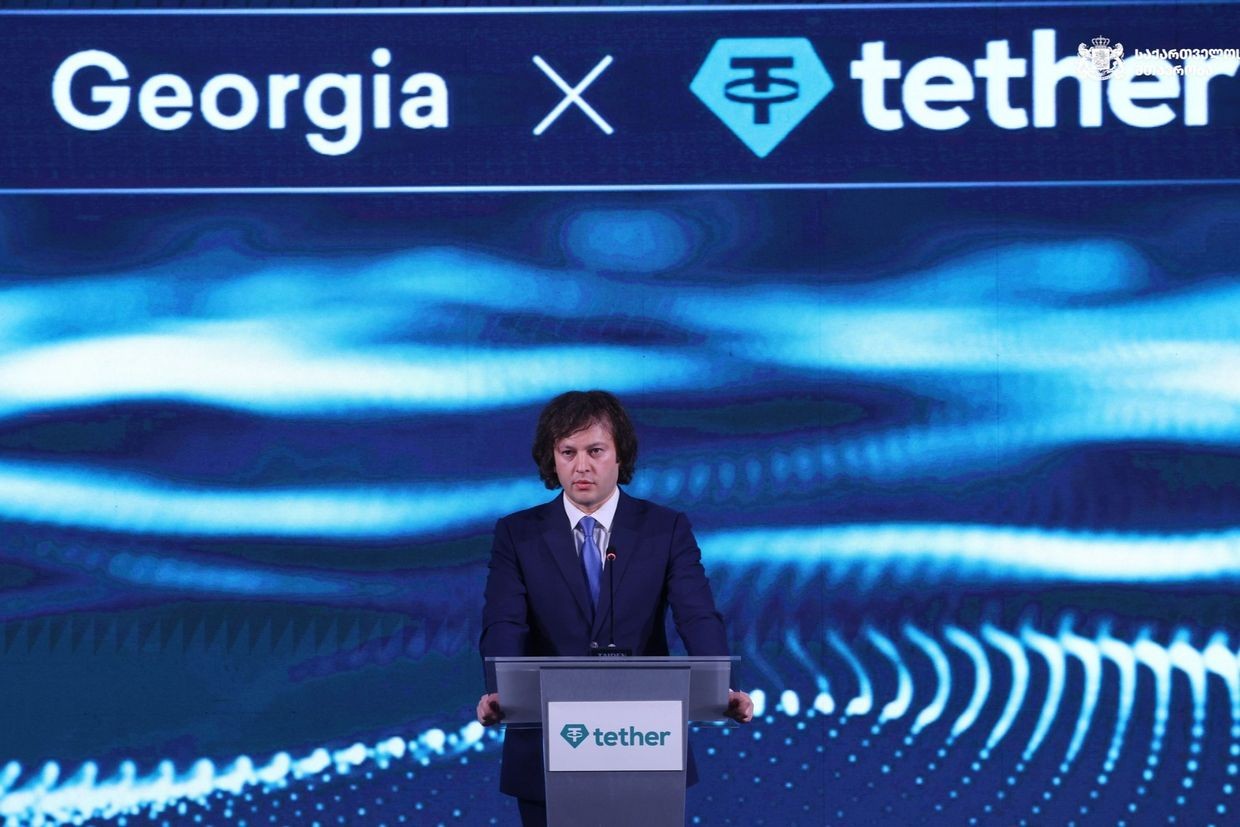
Speaking at the presentation of Tether’s investment project in Tbilisi, Kobakhidze regarded the company’s arrival as a signal to global capital markets that Georgia has matured as a destination for international business.
‘By beginning cooperation with Tether, we are taking a new, very important, and very exciting step on the path of our economic development’, Kobakhidze said.
Kobakhidze said Tether is a ‘very powerful bridge between traditional and digital economies’ and said the company’s planned investments extend beyond commercial interests. He highlighted spending in the social and educational sectors as evidence that the partnership carries a public-benefit dimension.
‘This cooperation goes far beyond business interests and is oriented toward broad public benefit’, he said.
On her part, Economy Minister Mariam Kvrivishvili said that the state had ‘created a competitive environment for innovation’ through its ‘flexible tax policy, support for the IT sector, and an overall business climate that has become a significant advantage for Georgia’.
According to Giorgi Kepuladze, the chair of the local civil society organisation Society and Banks, Tether’s issuance of a lari-equivalent stablecoin was an ‘interesting step’.
In practice, the GELt will function as a digital currency equal to one lari, and will make transfers easier and cheaper for people. However, Kepuladze warned that this development should be approached carefully and pragmatically.
‘The main condition for the success of such a project is trust and fulfilment in practice, monitoring’, Kepuladze added, while clarifying that GELt’s introduction would not replace traditional banks, and instead operate as a new instrument.
Georgia's financial regulators are comfortable with the arrangement. Natia Turnava, Governor of the National Bank, told OC Media that the central bank takes a measured, rather than prohibitive, approach to digital assets. She explained that the bank has a strict regulatory framework for crypto, and that it does not restrict the sector, but regulates it transparently.
‘Tether is among top 12 buyers of American Treasury Bills and the global issuer of USDT stable coin’, she said.
The National Bank has its own plans to digitise the lari, having worked mainly on the digital lari pilot project during 2021–2024, however plans did not yet yield the expected results.
That position aligns with Georgia's broader push to attract technology investment while maintaining oversight. A transparent regulatory environment has increasingly become a selling point for jurisdictions competing for crypto-adjacent business, particularly as other markets in the region tighten rules or impose outright bans.
For the government, Tether’s entry is as much about optics as economics. Kobakhidze said the partnership ‘shows that investors’ confidence in our country is gradually increasing’ and that ‘Georgia is a trustworthy and reliable partner for international companies’.
‘Tether’s digital lari could be useful for crypto and international transfers, but since it’s a privately issued currency tied to the lari, consumers should understand the risks’, Roman Gotsiridze, former National Bank governor and current opposition figure, told OC Media, adding that given this government’s history of ‘empty promises’, there are ‘serious doubts about whether it will actually happen’.
 Helena Bedwell