Georgia orders massive airspace closure over Ivanishvili residence, allegedly on his ‘whim’

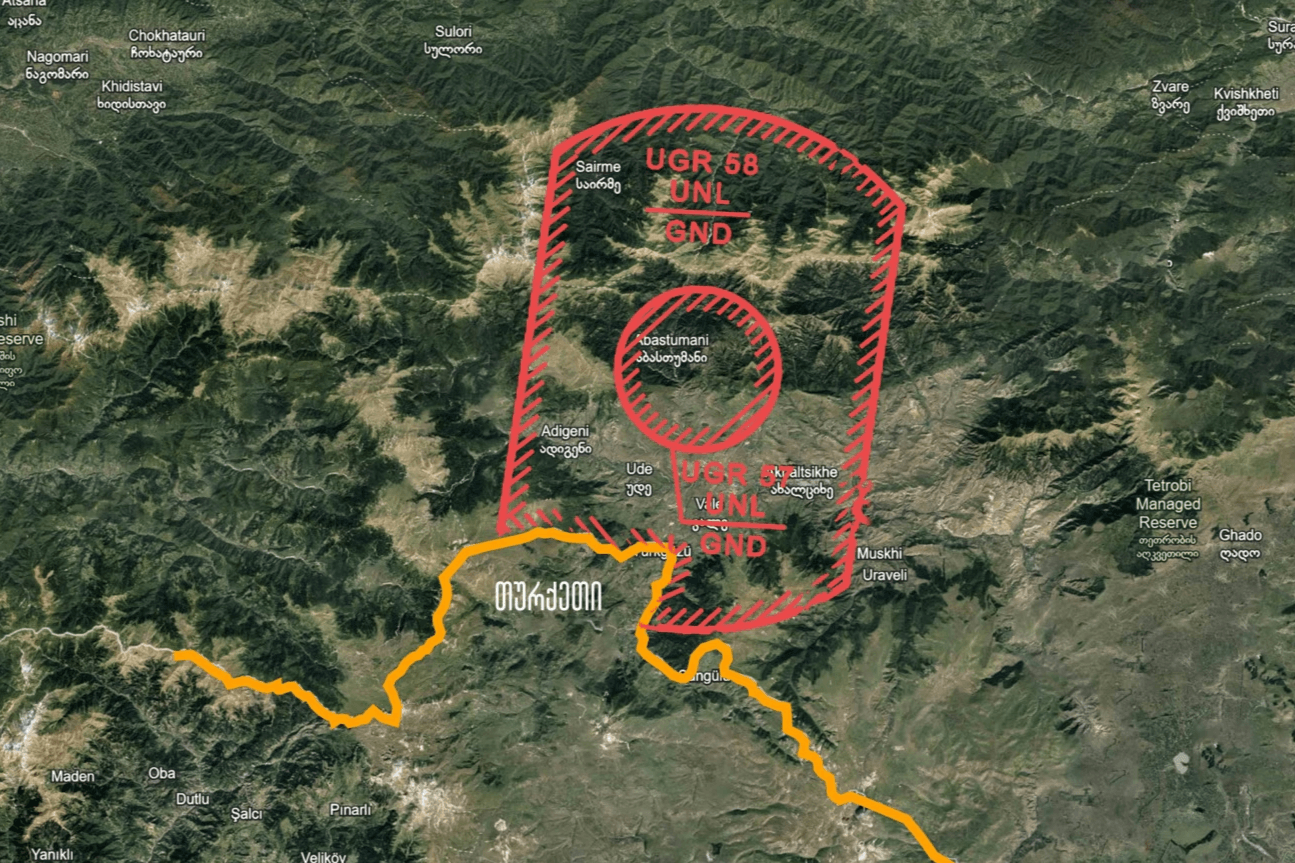
A large no-fly zone established over a sizable area in Georgia’s south, allegedly for the Abastumani Observatory, was introduced on the ‘whim’ of ruling Georgian Dream founder Bidzina Ivanishvili, a source told RFE/RL. Experts have warned that the airspace restrictions could impact the financial feasibility of using Georgian airspace for transit.
According to RFE/RL, the no-fly zone begins at the Turkish–Georgian border and ends approximately 45 kilometres deep into Georgia, covering the southern Abastumani region, the Adigeni region, and other parts of southern Georgia.
In total, it closes approximately 2,000 square kilometres of airspace, and would have come into effect on 16 April.
Ivanishvili, a billionaire largely considered to be Georgia’s informal ruler, took a keen interest in Abastumani in the late 2010s. According to Transparency International – Georgia, entities linked to Ivanishvili purchased over 52,000 square metres of land for around ₾6.4 million ($2.4 million) since August 2018.
According to RFE/RL, Ivanishvili purchased land and houses from locals living in Abastumani and created a ‘living space hidden in greenery’. He has also spearheaded what he referred to as the ‘Abastumani experiment’, which outlines plans to exclusively allow electric vehicles to drive in the region. RFE/RL has additionally reported that in 2019, the government cut down a ‘pristine coniferous forest’ to build a new road in the region.
While the Abastumani Observatory’s director Aleksandre Tevzadze has confirmed to RFE/RL that he had requested the closure of the airspace for clearer observations, the media outlet has cited government and aviation industry sources as saying the restrictions were more ‘related to Ivanishvili’s interest in the climate of Abastumani’.
The media outlet has additionally noted that it has not found any examples of such restrictions over prominent observatories around the world, including in the EU and the US.
RFE/RL has also obtained documents confirming that no-fly zones were established temporarily over an eight kilometre stretch in Abastumani since 2019, with one order having one exception: flights that land in or take off from Abastumani.
The outlet noted that the only feasible landing area in the region was Ivanishvili’s personal helipad, attached to his private home.
Noting that Russian and Iranian airspace restrictions turned the Caucasus into a main connection point between Europe and Asia, RFE/RL wrote that the flying restrictions in Abastumani, though not huge, could have major implications for Georgia’s role as a transit hub.
RFE/RL has cited a ‘well-informed source from a state agency’ that demand for Georgia’s airspace ‘almost doubled’ since Russia’s full-scale invasion of Ukraine. The anonymous source added that the Abastumani restrictions ‘will shift flight flows to the north of the country, which in turn, is less favorable for airlines’.
‘The extended route, increased flight times, increased fuel consumption — this may not be noticeable for airlines in terms of costs for a single flight but many flights multiplied by many days and we will get quite impressive numbers’, the source continued.
 Helena Bedwell