How Georgian artist Tedo Rekhviashvili smuggled an Abkhazia piece into Nauru’s Biennale pavilion
Rekhviashvili, whose family is from Abkhazia, tells OC Media how he slipped the piece into the exhibition of a microstate that recognises Abkhazia.
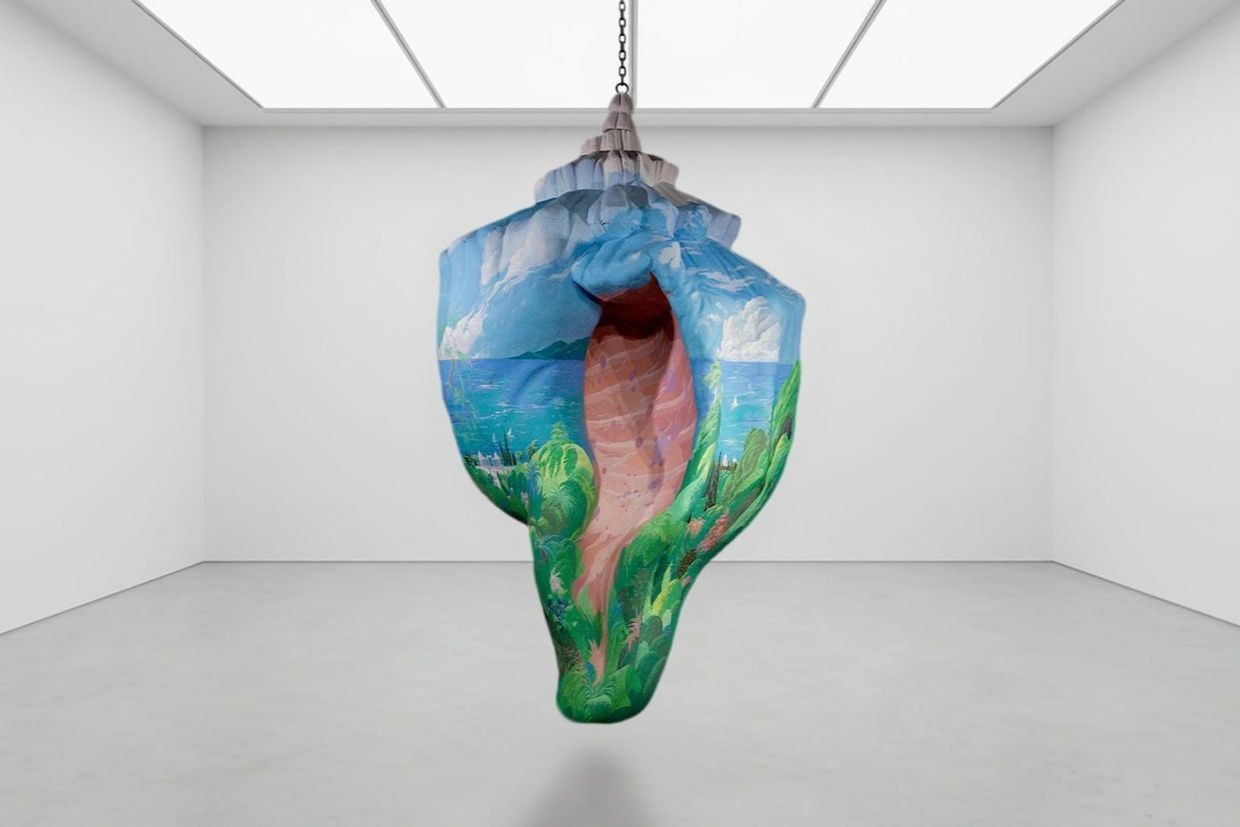
A human-sized shell hangs from the ceiling in a pavilion at the Venice Biennale, one of the most important exhibitions of modern art in the world. The shell’s outer side depicts paradise — coastal Abkhazia under the sun.
You get closer and hear, for a few seconds, a blissful sound of waves and seagulls, interrupted almost instantly by an explosion. A woman is screaming, machine guns fire, and people run for their lives. Under the lush, green landscape of the outer shell hides a history of a violent conflict that scarred 1990s Georgia and left thousands dead and displaced.
The piece was not exhibited in the Georgian section of the international festival, but in the pavilion of Nauru, a tiny island country in the South Pacific Ocean with a population of just over 10,000. Nauru is one of five UN-member states to recognise Abkhazia’s independence.
The conflict over the region left Abkhazia economically and politically dependent on Russia, which maintains a military presence there. The last major episode of the conflict, the August 2008 War, saw Russia recognise Abkhazia and South Ossetia as independent states.
Nicaragua, Venezuela, Nauru, and, later, Syria, followed suit — reportedly in exchange for financial aid or political support from Russia.
So how did this artwork, titled ‘A Sea That Remembers’ end up representing a microstate allied with Russia?
The author of the work, Tedo Rekhviashvili, a Tbilisi-based artist, told OC Media that he ‘smuggled’ the politically charged piece into the show.
Making use of a coincidence
A few months back, Rekhviasvhili’s friend, an art journalist, approached him at his show and told him there was a chance he could get into the Venice Biennale. At the time, Rekhiashvili, while excited at the prospect of taking part in the exhibition, did not know that the invitation would be coming from Nauru. While national pavilions are traditionally organised to represent the country’s own cultural production, it has become increasingly common to invite foreign artists to exhibit their works.
‘My family is from Abkhazia, I am Georgian, so I found it highly unethical’, he recalls.
However, after a night of contemplation, he changed his mind and decided to turn things around, calling the coincidence ‘too strange to be ignored’. He contacted the curators of the pavilion directly, as Nauru, which was making its debut at the exhibition, worked with Europe-based curators. Rekhviashvili said he would participate on the condition that they let him work using Abkhazia as a theme. The curators greenlit the concept, but Rekhviashvili says that the project never seemed to have reached Nauru itself.
‘Nauru is a country that had no idea about Georgia, [when voting] and now it’s possible that they weren’t aware of what was going on here either’, he says.
The theme of Nauru’s pavilion, ‘AIM Inundated — Imagining Life After Land’, reflects on the island’s fragility in the face of climate change and focuses on the country ‘as a place where the consequences of global decision-making have long been lived realities’, as per the concept note. Rekhviasvhili tells OC Media that the artwork of the pavilion centers on the subject of loss — ‘of homeland, a space where you grew up. In our case, it’s about the loss and disappearance of Abkhazia through war and destruction’.
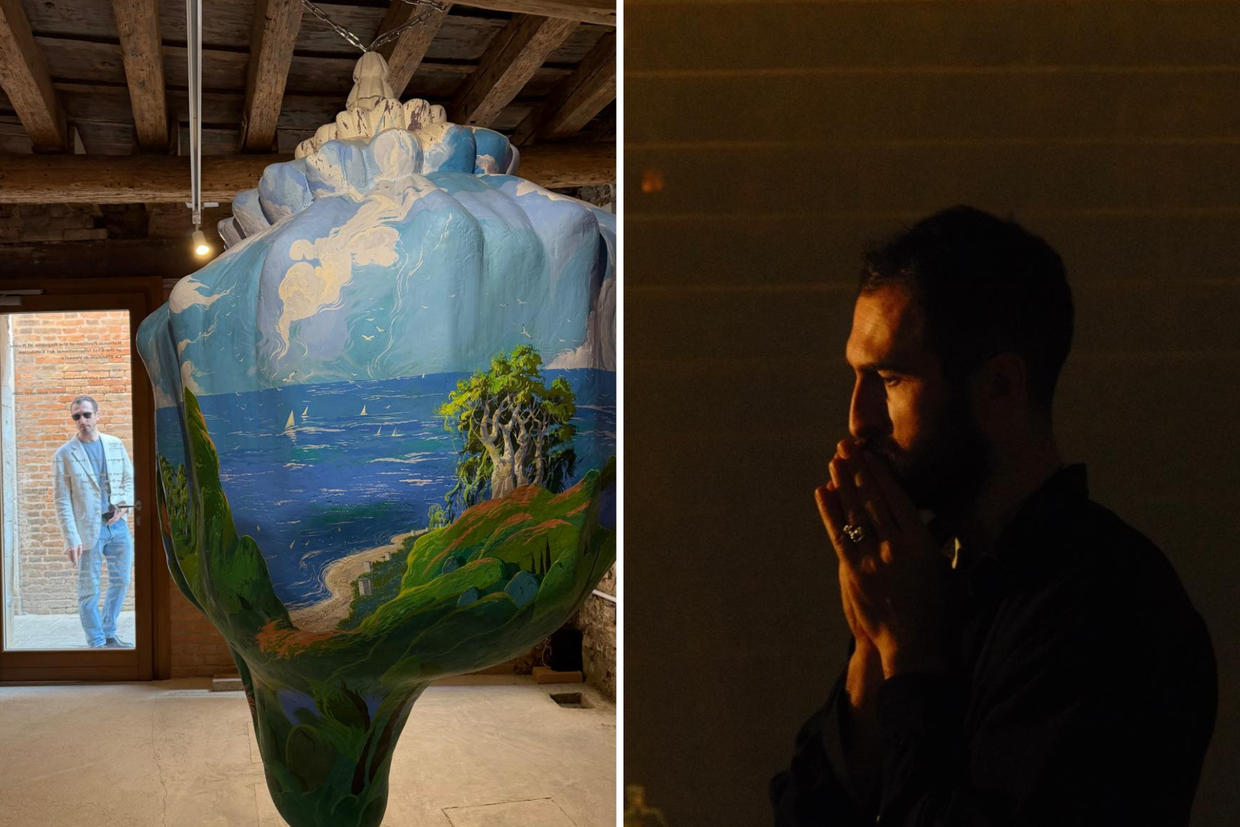
He chose a seashell as a vessel of memory, reflecting on his childhood. Rekshviasvhili was born in Adigeni, Southern Georgia, but has close familial ties to Abkhazia, with his mother’s side being almost entirely from that region.
‘It was my mother who told me to listen to the seashell when I missed the sea. This particular one tells the story of what happened in reality, and how the war started.’
Protest through art
‘Being in this manifesto situation is very precious to me’, Rekhviashvili says.
Rekhviashvili is no stranger to politically and socially charged art; his paintings and installations often resonate with the current climate, such as his representation of the Georgian Parliament or ‘Politician, Bishop, and Oligarch.’ In 2022, the artist burned his own painting to protest the massive layoffs in cultural institutions initiated by Georgian Culture Minister Tea Tsulukiani. He describes the politics that have affected Georgian art as an ‘iron fist to control art’. These policies have led to the dismissal of critics from Georgia’s museums and National Film Centre and the installation of a pro-government figure to head the Writer’s House.
‘Any artist who tries to make anything of high quality is in a battle in Georgia today’, he says.
Georgia does not have a pavilion of its own at Biennale, but is hosting a group show of local and international artists under the concept of ‘Modern Argonauts — Georgian Crossroads’, with the support and selection of the Ministry of Culture. Rekhviashvili found it to be unacceptable for him to be associated with the government in any form.
‘There are successful artists [in Georgia] who play on two fronts very skillfully, but I don’t do anything like that’, he tells OC Media.
‘The government is afraid of the artists and active people in general, and many artists in our country have been subjected to repression because they are actively fighting for rights, democracy, and the values that are considered achievements of today’s world’.
A few artists have been imprisoned in Georgia in relation to participation in anti-government protests, including poet Zviad Ratiani, actor Andro Chichinadze, and others.
‘An explosive atmosphere’
This year, the Venice Biennale was marked with scandals even before Rekhviashvili’s artwork was unveiled — not least for Russia’s return to the festival.
Russian artists voluntarily withdrew from the festival after its full-scale invasion of Ukraine in 2022. In the next edition, Russia lent its pavilion to Bolivia, but in the Biennale in 2026, decided to return with its own exhibition. Since 2019, Russia’s pavilion is curated by SmartArt, a company co-managed by Ekaterina Vinokurova, the daughter of Russian Foreign Minister Sergei Lavrov.
The EU Commission has urged the Biennale foundation to comply with EU sanctions, threatening to withdraw its funding to the festival should Russia make an appearance.
As a compromise, Russia was allowed to have a pavilion at the Biennale only between 5–8 May for media and industry invitees. The entire jury of the festival resigned on 30 April, in acknowledgement of their previous statement to refrain from considering those countries whose leaders are currently charged with crimes against humanity by the International Criminal Court.
On 7 May, activist group Pussy Riot and feminist activist group Femen organised a protest in front of the Russian pavilion, which they attempted to storm with some 40 protesters. The police pushed them back, but activists, dressed in black and wearing pink balaclavas, continued to rally outside and draped a Ukrainian flag over a statue outside the pavilion.
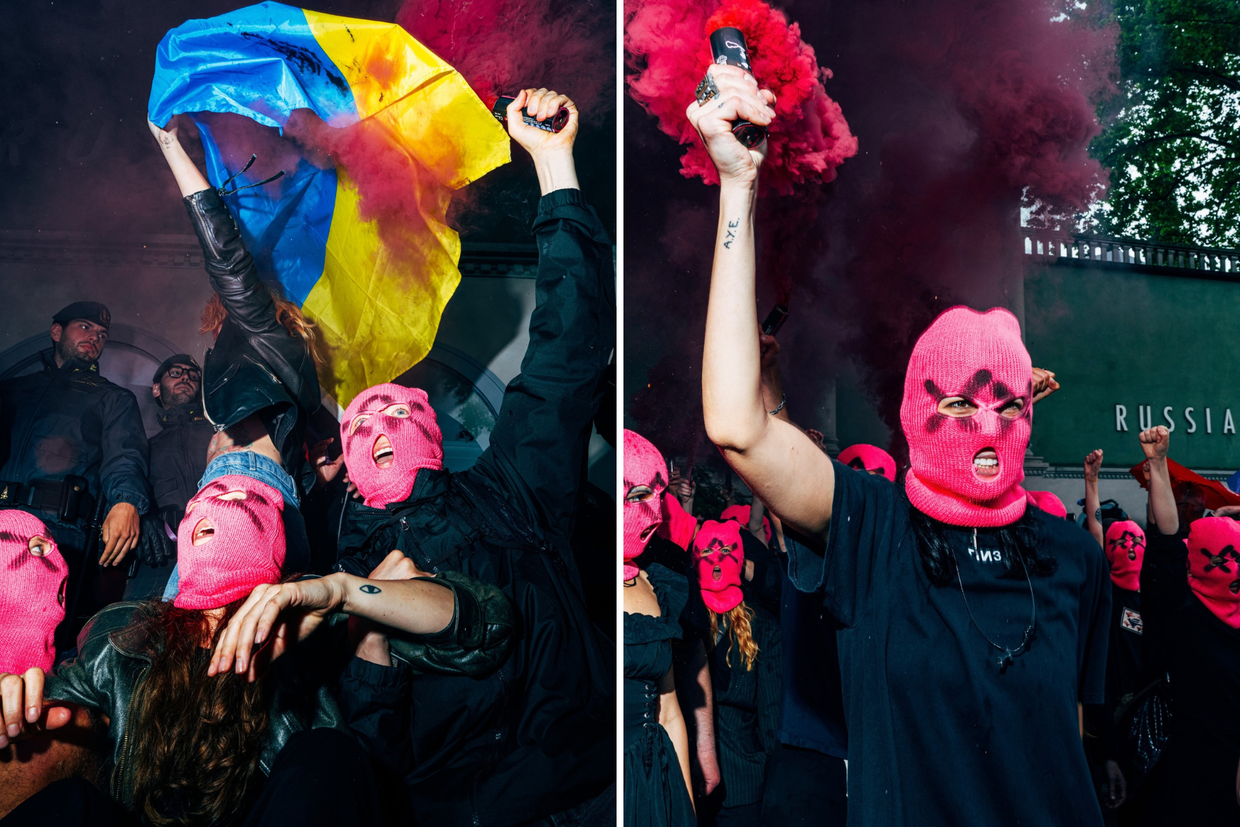
Rekhviashvili says the atmosphere is ‘constantly exploding’ and is glad that his artwork coincided with Russia’s participation.
‘These two contradict each other’, he says, adding that he hopes that the visitors of the exhibition will share that sense of importance of the conflict, ‘even from 35 years ago’.
‘I think the viewer will feel it, and this shell will tell the story.’
‘A Sea That Remembers’ will return to Georgia where it will be displayed for the public after it has been purchased by an unnamed fund.